8 Essential ADHD Time Management Tips for 2025
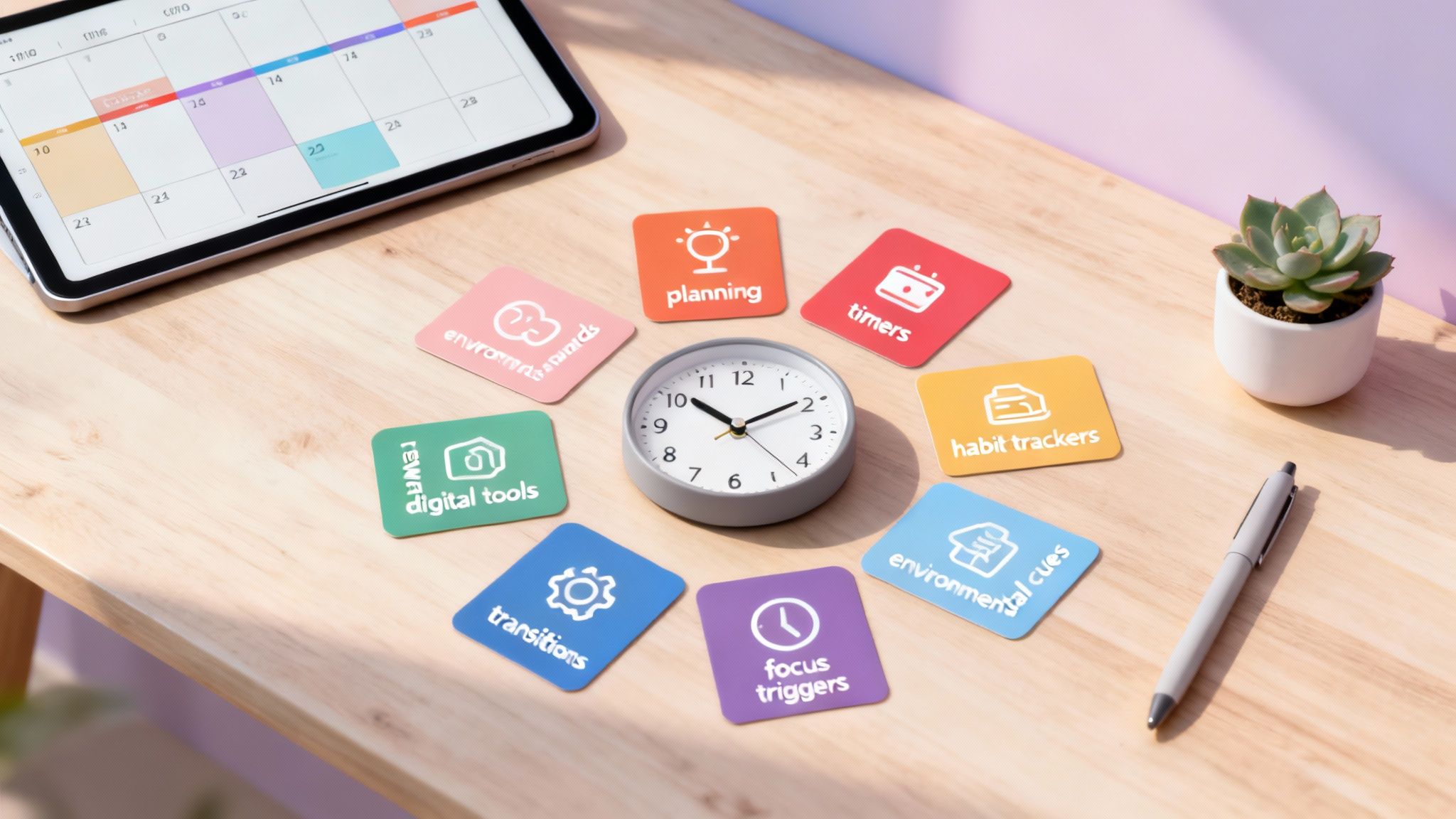
For those with ADHD, time can feel like a slippery concept, always moving too fast or too slow. Traditional time management advice often misses the mark, feeling rigid and incompatible with a brain wired for interest and novelty. This guide moves beyond generic tips, offering eight practical, brain-friendly strategies designed to work with your ADHD, not against it. We'll explore how to make time tangible, leverage your unique neurobiology, and build systems that support focus and reduce overwhelm.
You'll discover actionable ADHD time management tips to start tasks, manage transitions, and finally feel in control of your schedule. As you read, consider how you can listen to this article and other important texts hands-free to enhance focus. A tool like Speak4Me can assist by turning written content into audio, engaging both your visual and auditory senses for better comprehension. To gain a broader understanding of effective approaches, you can also delve into these proven time management tips and strategies for adults with ADHD to find what works best for you.
This isn't about forcing yourself into a neurotypical mold; it's about finding the right tools and techniques to thrive.
Download Speak4Me free on iOS to transform how you consume information and manage your tasks.
1. External Time Visualization Tools
A common challenge with ADHD is "time blindness," where the passage of time feels abstract and difficult to track. External time visualization tools are one of the most effective ADHD time management tips because they make time a tangible, visible concept. Instead of relying on an internal clock that may be unreliable, you can see time passing.
These tools transform time from an abstract number into a concrete visual. For example, a Time Timer shows a red disc that slowly disappears as the minutes tick by. This provides constant, low-anxiety feedback on how much time is left for a task, making it easier to start and stay focused. You can see, not just know, that 15 minutes is a manageable block of time.
Why Visual Timers Work
Using visual timers helps externalize your sense of time, reducing the mental effort needed to keep track of it. This frees up cognitive resources to focus on the actual task.
Reduces Anxiety: Seeing a clear beginning and end to a task makes it feel less overwhelming.
Improves Task Initiation: A short, visible time block (like 20 minutes) is much easier to commit to than an undefined work period.
Builds Time Awareness: Consistently using these tools helps your brain develop a better feel for how long different tasks actually take.
For a quick reference on how these tools make time tangible, see the summary below.
This visual approach is key; it provides immediate, easy-to-process feedback without requiring you to constantly check a clock and do mental math.
How to Implement This Strategy
To get started, place a timer directly in your line of sight. Try combining this with other focus strategies. For example, while listening to a long article with an app like Speak4Me, set a visual timer for a 25-minute listening block to maintain your focus without interruption. This simple hack can support your concentration and make tasks more manageable.
Ready to improve your focus? Download Speak4Me free on iOS (https://apps.apple.com/us/app/id894460403) and pair it with a visual timer for your next big task.
2. Body Doubling
A major hurdle with ADHD is executive dysfunction, which makes starting and sticking with tasks incredibly difficult. Body doubling is one of the most effective ADHD time management tips because it uses gentle, external accountability to overcome this inertia. The simple presence of another person, whether physically or virtually, creates an anchor for your focus.
This technique doesn't require interaction. The 'body double' is simply there, working alongside you. This creates a subtle social pressure that helps calm a distractible brain and encourages task initiation. Knowing someone else is present and focused can be the external cue needed to get started on tasks you’d otherwise avoid.

Why Body Doubling Works
Body doubling externalizes motivation and accountability, reducing the mental load of self-regulation. This frees up your brainpower to concentrate on the task itself.
Reduces Procrastination: The scheduled nature of a body doubling session creates a commitment, making it much harder to put off a task.
Improves Focus: Having someone else present and working quietly minimizes the temptation to switch tasks or get sidetracked by distractions.
Creates Structure: It provides a defined start and end time for a work block, making daunting tasks feel more contained and manageable.
This strategy transforms a solo struggle into a shared, supportive environment. It’s a powerful way to borrow executive function from your surroundings.
How to Implement This Strategy
Start by identifying tasks you consistently procrastinate on, as these are perfect candidates for body doubling. Arrange a session with a friend in person or use a virtual platform like Focusmate. For an all-day, low-pressure option, you can even tune into "study with me" live streams on YouTube. The key is to find what format provides the right level of accountability for you.
You can also use body doubling to get through tedious tasks like listening to dense reading material with Speak4Me. This method is an excellent way to improve your focus and stay on track.
Ready to tackle your to-do list? Download Speak4Me free on iOS (https://apps.apple.com/us/app/id894460403) and use it with a body doubling session to create a powerful productivity system.
3. Task Breakdown and Micro-Tasking
A major hurdle for the ADHD brain is task initiation, often caused by feeling overwhelmed. Task breakdown and micro-tasking are powerful ADHD time management tips that directly combat this paralysis. Instead of seeing a giant, intimidating project, you break it down into tiny, actionable steps that take only 2-5 minutes to complete. This shifts the focus from the overwhelming whole to a single, manageable first action.
This strategy re-engineers a task like "Write report" into a series of non-threatening micro-tasks: 1. Open document, 2. Write title, 3. Write first sentence. Similarly, "Clean kitchen" becomes: 1. Load 5 dishes into dishwasher, 2. Wipe one counter section. Each step is so small that the mental resistance to starting practically disappears, making it easier to build momentum.
Why Micro-Tasking Works
Breaking down tasks externalizes the planning process, reducing the executive function load required to get started. It converts a vague intention into a clear, physical action plan.
Reduces Overwhelm: A list of 5-minute tasks feels achievable, unlike a multi-hour project.
Boosts Dopamine: Each completed micro-task provides a small dopamine hit, creating a positive feedback loop that encourages you to continue.
Eliminates Ambiguity: A step like "Write first sentence" is specific and leaves no room for confusion about what to do next.
This approach effectively short-circuits the procrastination cycle by making the first step too easy to refuse.
How to Implement This Strategy
Start by writing down the large task at the top of a page. Then, ask yourself, "What is the very first physical action I need to take?" Write that down. Continue breaking down each subsequent step until every item on your list feels simple and quick.
Use a dedicated app like Todoist or TickTick to organize your micro-tasks. For complex projects, you can even use AI tools like Goblin Tools to automatically break down your larger goals. Combining this with audio tools can be a game-changer. For instance, while researching for a paper, you can have Speak4Me read an article aloud while you focus on completing micro-tasks like "take three bullet-point notes" or "find one key quote." This helps maintain focus and productivity.
Ready to tackle your to-do list? Download Speak4Me free on iOS (https://apps.apple.com/us/app/id894460403) and pair it with micro-tasking to conquer your next big project.
4. Implementation Intentions and 'If-Then' Planning
ADHD often impacts executive functions like decision-making and task initiation. Implementation intentions, also known as 'if-then' planning, are powerful ADHD time management tips because they pre-solve these challenges. Instead of relying on willpower in the moment, you create a simple, automatic script for your brain to follow.
This strategy links a specific cue (the 'if') with a predetermined action (the 'then'). For example, saying "If I feel overwhelmed by my to-do list, then I will pick the smallest task I can complete in five minutes" bypasses the paralysis of having too many choices. This creates a direct pathway from trigger to action, reducing the cognitive load required to get started.
Why 'If-Then' Planning Works
This method, developed by psychologist Dr. Peter Gollwitzer, essentially automates your responses to common time management obstacles. It externalizes your decision-making, so you don't have to debate what to do next.
Reduces Decision Fatigue: It eliminates the need for in-the-moment deliberation, which can be draining for an ADHD brain.
Improves Task Initiation: The "then" part of the plan becomes a clear, non-negotiable first step, making it easier to overcome inertia.
Builds Consistent Habits: By repeatedly linking a situation to an action, you build reliable routines that work with your brain's wiring, not against it.
This approach turns abstract goals like "be more organized" into concrete, actionable steps that are easy to follow even on low-energy days.
How to Implement This Strategy
Start by identifying one or two major pain points in your day. Write down specific 'if-then' plans and place them where you'll see them, like a sticky note on your monitor. For instance, you could create the plan: "If I sit down at my desk, then I will listen to my first work email using Speak4Me." This connects the cue of sitting down directly to a productive action.
Ready to build better habits? Download Speak4Me free on iOS (https://apps.apple.com/us/app/id894460403) and create an 'if-then' plan to start your next task with focused listening.
5. External Working Memory Systems
A significant challenge with ADHD is an unreliable working memory, which makes mentally juggling tasks, deadlines, and ideas nearly impossible. External working memory systems are powerful ADHD time management tips because they act as a "second brain," a trusted place to offload all information so your mind doesn't have to hold it. Instead of trying to remember everything, you simply capture it in a system you can rely on.
This approach involves creating a comprehensive, external place to house all your thoughts, tasks, and commitments. Whether it's a dedicated notebook or a digital app, the goal is total reliance. You capture everything the moment it occurs to you, freeing up mental bandwidth and reducing the anxiety of potentially forgetting something important.
Why Externalizing Memory Works
Using an external system outsources the demanding job of remembering, allowing your brain to focus on processing and executing tasks rather than simply storing information. This is crucial for managing ADHD-related cognitive load.
Reduces Mental Clutter: Capturing every idea and to-do item clears your mind for deeper focus.
Prevents Forgotten Tasks: Writing things down immediately ensures important commitments don't fall through the cracks.
Builds Trust and Reduces Anxiety: Knowing everything is stored safely in one place alleviates the constant worry that you've forgotten something.
How to Implement This Strategy
The key is to choose one primary system and commit to it fully. Use the "write it down now or lose it forever" mindset. Place capture tools everywhere: a notepad by your bed, a widget on your phone, or a small notebook in your car. Schedule a brief weekly review to organize all the items you've captured throughout the week.
For instance, you could use an app like Speak4Me to quickly capture verbal notes. While reviewing a project document, use the text-to-speech feature to listen to the text, then dictate your ideas and action items into a new note without losing your train of thought. This creates a seamless workflow between processing information and capturing next steps.
Ready to build your second brain? Download Speak4Me free on iOS (https://apps.apple.com/us/app/id894460403) and start capturing your thoughts effortlessly.
6. Structured Transition Rituals
Switching between tasks can feel like hitting a mental wall with ADHD. The brain often resists letting go of the current activity or feels paralyzed by the thought of starting a new one. Structured transition rituals are one of the most effective ADHD time management tips because they create a predictable bridge between activities, reducing the cognitive load of shifting gears.
These rituals are specific, repeatable sequences of small actions that signal to your brain that a change is coming. For example, a "work startup" ritual might be making coffee, writing down three priorities, and setting a timer. This provides a clear, low-effort pathway that helps you overcome the inertia and executive dysfunction common during transitions. Instead of a jarring mental leap, you follow a simple, practiced script.
Why Transition Rituals Work
Using structured rituals externalizes the decision-making process of switching tasks, which automates the difficult part. This frees up your mental energy to focus on the upcoming activity rather than on the struggle of the transition itself.
Reduces Cognitive Load: Following a pre-set routine eliminates the need to decide what to do next.
Overcomes Inertia: A small physical action (like standing up) can break the state of being "stuck."
Builds Predictability: Rituals create a sense of control and safety, making transitions feel less chaotic and overwhelming.
This approach essentially builds a ramp between tasks, making the journey from "done with this" to "starting that" smoother and more automatic.
How to Implement This Strategy
Start by identifying your most difficult transitions, like starting work or switching projects. Design a short (under 5 minutes) ritual for one of them. For instance, to transition from a work task to a reading session, your ritual could be: stand and stretch, grab a glass of water, and open your reading app.
Combine this with assistive tools for maximum effect. If you're transitioning to a focused listening session, use a ritual to prepare your mind. Then, use an app like Speak4Me to listen to your document or article, which supports your focus once the transition is complete.
Ready to make your transitions smoother? Download Speak4Me free on iOS (https://apps.apple.com/us/app/id894460403) and build a ritual around your next listening task.
7. Time-Boxing with Built-In Buffer Time
A core challenge with ADHD is consistently underestimating how long tasks will take. Time-boxing with built-in buffer time is one of the most practical ADHD time management tips because it directly addresses this by scheduling realistic padding around tasks. Instead of creating a tight, rigid schedule that breaks at the first delay, you build a flexible one that anticipates interruptions and time blindness.
This strategy involves allocating a specific block of time for a task and then intentionally adding extra "buffer" time. For instance, if you estimate a report will take 45 minutes, you schedule a 90-minute block for it. This buffer absorbs unexpected distractions, setup time, and the natural tendency to underestimate, preventing your entire day from derailing.
Why Buffer Time Works
Building in buffer time externalizes the need for realistic planning, reducing the stress and anxiety of a constantly collapsing schedule. It acknowledges that tasks rarely go exactly as planned, especially with ADHD.
Reduces Schedule Anxiety: Knowing you have extra time built in prevents the panic that comes from falling behind.
Prevents Task-Switching Overwhelm: A 15-minute buffer between meetings gives your brain the necessary transition time to reset and refocus.
Builds Realistic Expectations: Consistently using buffers helps you learn how long tasks truly take, improving future planning.
This approach transforms your schedule from a source of pressure into a supportive tool designed for how your brain actually works.
How to Implement This Strategy
Start by tracking how long your common tasks actually take for a week to understand your personal "ADHD time multiplier." If tasks consistently take 50% longer than planned, start adding a 50% buffer. For example, use Google Calendar to color-code your task blocks in blue and your buffer blocks in gray to visualize your flexible time. Protect this buffer time as fiercely as a scheduled appointment.
You can combine this with tools that help you focus within your time-box. For example, if you need to review a dense document during a 60-minute block (with a 30-minute buffer), use an app like Speak4Me to have the text read aloud. This can assist you in processing the information more efficiently and staying on track within your allotted time.
Ready to build a more resilient schedule? Download Speak4Me free on iOS (https://apps.apple.com/us/app/id894460403) and use it during your next time-boxed task.
8. Dopamine-Driven Productivity Strategies
The ADHD brain operates on an interest-based nervous system, meaning it’s driven by tasks that are novel, urgent, challenging, or interesting. Dopamine-driven productivity strategies are powerful ADHD time management tips because they work with this neurobiology instead of against it. The goal is to intentionally add stimulation and immediate rewards to tasks to make them more engaging.
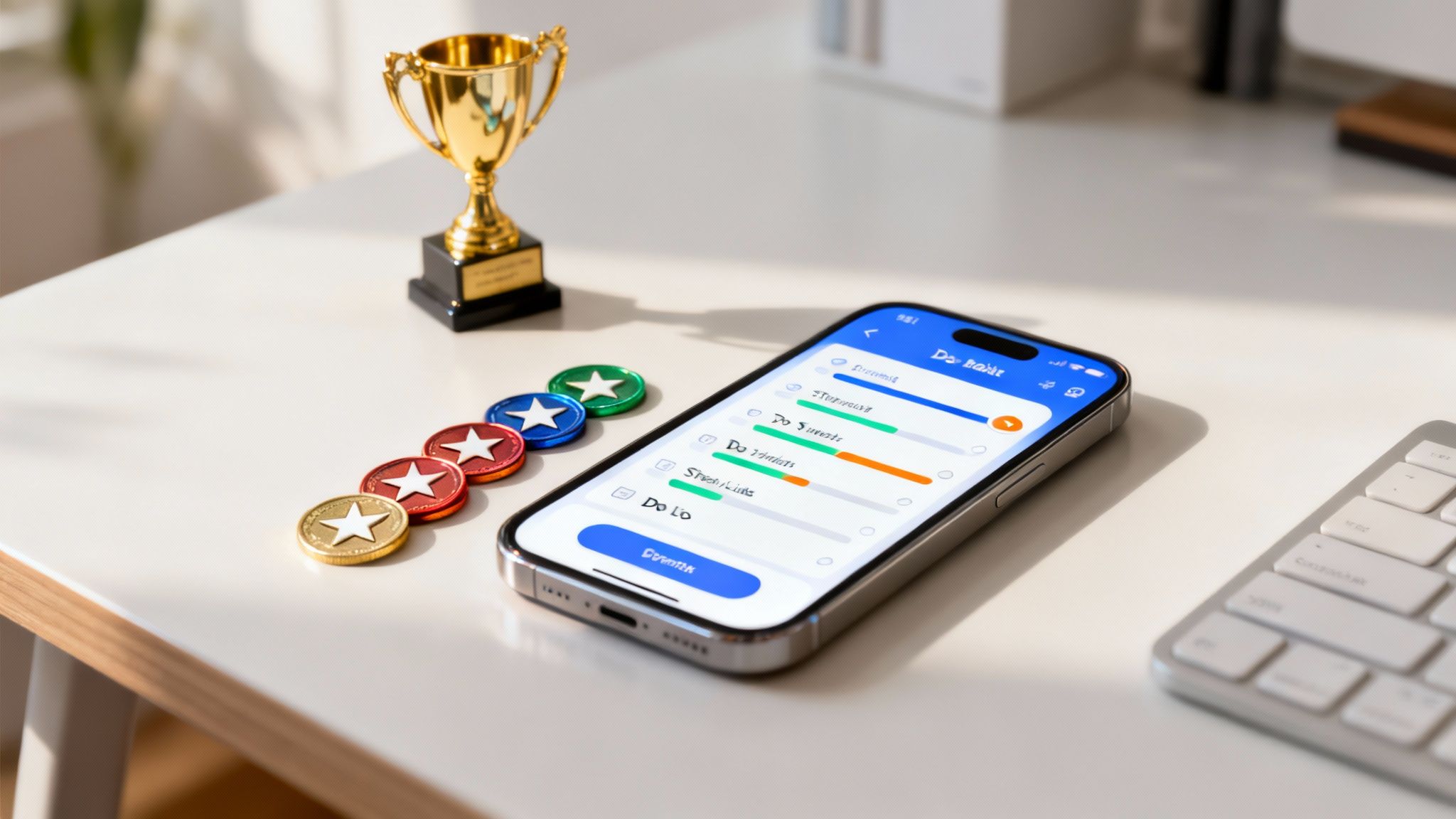
Instead of relying on sheer willpower, you can turn mundane tasks into a game. For example, using an app like Habitica transforms your to-do list into a role-playing game where completing tasks levels up your character. This approach provides the frequent, small bursts of dopamine needed to maintain focus and motivation, turning dreaded chores into rewarding challenges.
Why This Approach Works
Harnessing your brain's reward system reduces the friction of starting and completing tasks. It externalizes motivation, making it less dependent on your internal state of focus or energy levels on any given day.
Creates Motivation: Gamification and rewards provide an immediate incentive to get started.
Maintains Engagement: Novelty and challenge prevent boredom from setting in on longer projects.
Builds Positive Momentum: Each small reward reinforces the habit of task completion, creating a positive feedback loop.
This method is especially effective for repetitive or uninteresting tasks that are otherwise difficult to tackle.
How to Implement This Strategy
Start by creating a "reward menu" with a mix of 5, 15, and 30-minute rewards you genuinely enjoy. Try "temptation bundling," where you pair a task you avoid with something you love, like only listening to your favorite podcast while doing laundry. You can find more digital tools to help with this in this guide to the best productivity apps for ADHD.
A great way to apply this is by bundling a listening task with a reward. Use Speak4Me to listen to your study materials, and reward yourself with 15 minutes of a fun activity for every 45-minute focus block you complete.
Ready to make productivity more engaging? Download Speak4Me free on iOS (https://apps.apple.com/us/app/id894460403) and pair it with a reward system to conquer your to-do list.
8 ADHD Time Management Tips Comparison
Strategy | Implementation Complexity 🔄 | Resource Requirements ⚡ | Expected Outcomes 📊 | Ideal Use Cases 💡 | Key Advantages ⭐ |
|---|---|---|---|---|---|
External Time Visualization Tools | Medium - needs initial setup and device/app use | Moderate - physical device cost or app access | Improved time awareness and task pacing | Managing hyperfocus, task duration, transitions | Concrete visual cues, reduces anxiety, non-intrusive |
Body Doubling | Low - simple but needs coordination | Low - free or low cost, needs another person | Increased task initiation and sustained focus | Any task with initiation difficulties | Passive accountability, reduces isolation |
Task Breakdown and Micro-Tasking | Medium - requires upfront task analysis | Low - time investment, optional app use | Reduced overwhelm, visible progress | Large projects, complex tasks | Clear, small steps reduce paralysis, dopamine hits |
Implementation Intentions and 'If-Then' Planning | Low - writing and regular review needed | Minimal - pen and paper or digital notes | Increased follow-through, reduced decision fatigue | Addressing habitual challenges and transitions | Automates responses, simple but effective |
External Working Memory Systems | High - requires system design and maintenance | Moderate to High - tools like apps or notebooks | Reduced forgetting, mental clutter, anxiety | Managing all tasks, appointments, and ideas | Reliable capture system, frees mental energy |
Structured Transition Rituals | Medium - creating and practicing rituals | Low - no special tools needed | Smoother task switching, reduced procrastination | Difficult task transitions and ending hyperfocus | Predictable routines reduce cognitive load |
Time-Boxing with Built-In Buffer Time | Medium - scheduling and tracking required | Low - calendar/calendar app use | More realistic schedules, reduced lateness | Time management with ADHD time blindness | Accommodates ADHD timing issues, reduces stress |
Dopamine-Driven Productivity Strategies | Medium - creativity and experimentation | Varies - apps, rewards, social elements | Increased motivation and task initiation | Tasks needing engagement and motivation | Aligns with ADHD neurobiology, sustainable engagement |
Build Your Personalized ADHD Toolkit
Navigating the world with an ADHD brain means that traditional, neurotypical time management advice often falls flat. The strategies we've explored, from using external time visualization tools to practicing structured transition rituals, aren't just minor adjustments; they are fundamental shifts designed to work with your brain's unique wiring, not against it. The goal isn't to find a single perfect solution, but to experiment and assemble a personalized system that provides the external structure and internal motivation you need.
Remember, the core principle is about externalizing executive functions. Your working memory is often overloaded, so creating external systems is key. Whether it’s breaking tasks down into micro-steps, using a body double for accountability, or setting up a dedicated external memory system, you are essentially building a supportive scaffold around yourself. This scaffold helps you stay on track, reduces cognitive load, and makes the initiation of tasks feel far less daunting. These practical adhd time management tips are about creating an environment where your brain can thrive.
Your Actionable Next Steps
Instead of trying to implement all eight strategies at once, which can lead to overwhelm, choose just one or two that resonate most with your current challenges.
If you struggle with starting tasks, try implementing the 'If-Then' planning technique or a dopamine-driven reward system.
If you constantly lose track of time, start with time-boxing and integrate a visual timer into your workspace.
If you feel isolated and unmotivated, explore virtual or in-person body doubling sessions.
The key is to treat this as an experiment. Observe what works, what doesn't, and be prepared to adapt. Your needs might change from day to day, and your toolkit should be flexible enough to change with you. Beyond individual techniques, understanding broader ways to hack your ADHD can help you build a personalized system that truly works.
Ultimately, mastering time management with ADHD is a journey of self-compassion and strategic support. It's about giving yourself the tools you need to bridge the gap between intention and action. Embrace the strategies that bring you clarity and momentum, and let go of the ones that don't. By consistently applying these ADHD-friendly approaches, you can transform your relationship with time, reduce stress, and unlock your full potential, turning daily chaos into focused, meaningful progress.
Ready to add a powerful auditory tool to your productivity toolkit? Speak4Me can assist you with processing lengthy articles, emails, or study materials by converting text to natural-sounding speech, making it easier to absorb information without visual fatigue. Download Speak4Me free on iOS at https://apps.apple.com/us/app/id894460403 and start listening your way to better focus and efficiency.
Try Speak4Me for Free
