AI Voice Text to Speech: Transforming Digital Communication
Picture this: you have a personal reader who can take any text on your screen and instantly read it aloud in a clear, natural voice. That’s the magic behind AI voice text to speech (TTS). We've come a long way from the robotic, monotone voices of the past. Today's technology creates genuinely human-like audio, making digital content easier to access and use in more ways than ever.
What Is AI Voice Text to Speech Technology?
At its heart, AI voice text to speech is a smart technology that turns written digital words into spoken audio. Think of it as a translator that converts the text you see into the sound you can hear.
But unlike the clunky systems you might remember, modern AI-powered TTS is incredibly sophisticated. It uses complex algorithms to do more than just read words; it understands them. The software analyzes context, punctuation, and even subtle emotional tones to deliver speech that sounds like a real person is talking to you.
So, how does it pull this off? The system first breaks down text into its basic phonetic sounds. Then, the "AI" part kicks in. It's been trained on massive libraries of human speech, learning all the little details that make us sound human—like intonation, pacing, and rhythm. This is what separates authentic speech from a flat, word-by-word playback.
This ability has completely changed how we interact with information. For a deeper dive into the basics, you can check out this overview of text-to-speech technology and what it can do.
Why Does It Matter Today?
High-quality AI voice technology is already making a real difference in our daily lives. It’s a game-changer for accessibility, productivity, and learning, offering real-world solutions for all kinds of people.
Better Accessibility: For people with visual impairments or reading challenges like dyslexia, it's an essential tool. It makes websites, documents, and apps more inclusive and easier to navigate.
Boosted Productivity: Busy professionals and students can turn reading materials into audio files. Imagine listening to articles, emails, or reports during your commute, at the gym, or while doing chores. Suddenly, that downtime becomes productive.
Flexible Learning: If you're an auditory learner who absorbs information best by listening, TTS is a perfect fit. Converting study guides into audio can improve focus and help you remember more.
In short, AI voice text to speech gives you the freedom to consume content on your own terms. It makes information fit your life, not the other way around.
Ultimately, this technology gives everyone a new way to engage with the written word. Instead of being glued to a screen, you can listen while you multitask, making it far more efficient and convenient to stay informed. To experience these benefits, Download Speak4Me free on iOS.
How AI Teaches Computers to Speak Naturally
Ever wonder how the AI voices we hear today sound so convincingly human? It’s not magic. The jump from those clunky, robotic voices of the past to the smooth, natural audio we have now comes down to some seriously smart AI. Think of it like teaching a computer not just to read words, but to understand the meaning and emotion behind them.
Older text-to-speech (TTS) systems were pretty basic. They worked by chopping up words into individual sounds—phonemes—and then gluing them back together. This method, called concatenative synthesis, got the job done, but the result was often choppy and monotone. It completely lacked the rhythm and flow of a real human conversation.
Modern ai voice text to speech technology is in a different league entirely, and it’s all thanks to something called neural networks.
The Role of Neural Networks
Neural networks are complex computer systems inspired by the way our own brains work. They're designed to learn from massive amounts of data, spot patterns, and make intelligent predictions. For voice generation, we feed these networks thousands of hours of recorded human speech. They listen and learn everything—from pronunciation and pacing to the subtle intonations that make speech sound authentic.
Instead of just stitching sounds together, the AI figures out the unspoken rules of language on its own. It looks at the text for context, understands what a comma or a question mark means for pacing, and even predicts which words a person would naturally stress. This is how it creates speech that has a genuinely human-like rhythm.
It's this deep learning process that closes the gap between simply reading words aloud and actually communicating an idea. The AI doesn’t just know what to say; it learns how to say it.
To really see how far we've come, it helps to compare the old and new methods side-by-side.
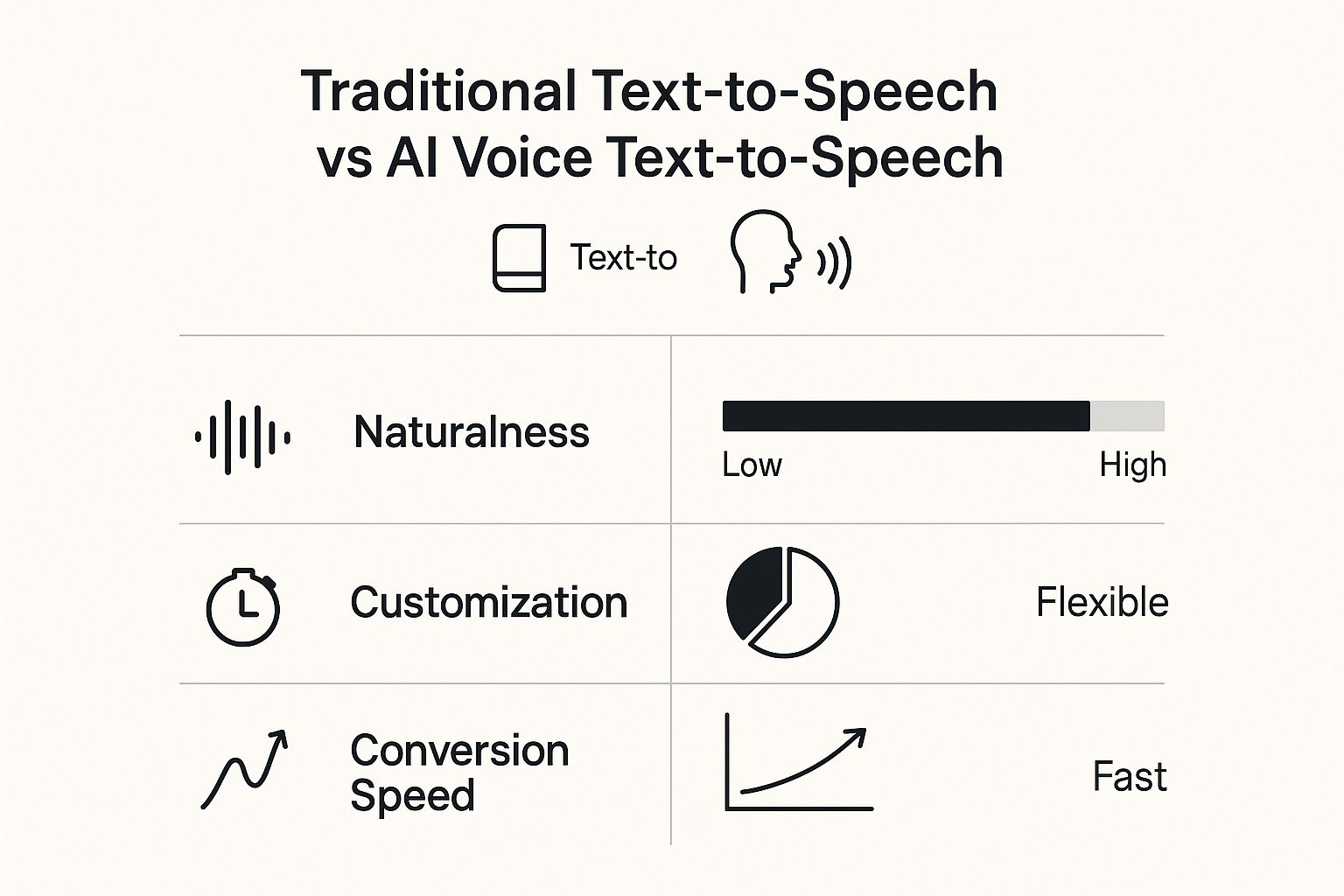
Comparing Traditional TTS and Modern AI TTS
The table below breaks down the key differences between the robotic-sounding TTS systems of the past and the remarkably human-like AI voices available today.
Feature | Traditional TTS | AI-Powered TTS |
|---|---|---|
Naturalness | Often robotic, choppy, and monotone. | Incredibly fluid, natural, and expressive. |
Intonation & Pacing | Lacks emotional nuance and proper rhythm. | Understands context to apply human-like pacing and emphasis. |
Customization | Very limited options for voice styles or accents. | Highly customizable with a wide range of voices, accents, and emotional tones. |
Learning Method | Relies on pre-recorded sound fragments (phonemes). | Learns from vast datasets of human speech using neural networks. |
Speed & Efficiency | Can be slow to process and generate audio. | Generates high-quality audio almost instantly. |
As you can see, the shift to AI has completely changed the game, moving us from clunky, limited systems to technology that is flexible, fast, and, most importantly, natural-sounding.
The Growing Demand for Realistic Voices
This huge leap in quality has opened the door for AI voices in all sorts of new places, and the market is booming. The global AI voice generator market was valued at USD 3.58 billion in 2024 and is expected to skyrocket to USD 36.43 billion by 2032. This explosive growth is coming from its use in video voiceovers, podcasts, and e-learning, where a realistic voice makes all the difference in keeping an audience engaged. You can learn more about this trend by exploring insights on the AI voice generator market.
This amazing technology isn't just for big studios anymore; it's accessible to everyone. By understanding context and emotion, AI models can turn any text into an audio experience that’s genuinely pleasant to listen to.
Ready to hear the difference for yourself? Download Speak4Me free on iOS and discover how clear and natural AI-powered audio can be.
The Real-World Wins of Using AI Voice Technology
Beyond the cool factor, the true value of AI voice text to speech is how it changes our daily lives. This isn't just a neat trick; it's a genuinely useful tool that completely rethinks how we get information, learn, and manage our time. The benefits are real, practical, and fit right into the hustle of modern life.
From helping people learn in their own way to making the digital world open to everyone, AI voice has a ton of uses. Let's dig into the key benefits that make it a must-have for both personal and professional use.

Making Information Accessible to Everyone
One of the most powerful things AI voice does is tear down barriers to information. For someone with a visual impairment, it’s a lifeline to the digital world. It can read everything aloud—news articles, emails, important documents—turning a screen-based experience into one they can hear, which gives them more independence.
It's also a huge help for people with reading difficulties like dyslexia. By turning written words into spoken audio, it lets users take in information without the stress of reading. This can boost comprehension and cut down on frustration, making a world of content accessible that was once a struggle to get through.
Technology should be for everyone, and AI voice tools are a perfect example of that principle in action. They make sure digital content isn't just out there, but truly usable for people of all abilities.
Supercharging Your Daily Productivity
Let's face it, finding time to sit down and read is tough. AI text to speech offers a brilliant solution by letting you multitask. It frees reading from being something you have to do sitting still and turns it into something you can do while you're on the move.
Think about how you could weave audio into your day:
Your commute: Instead of just sitting in traffic, you could be listening to work reports, getting through your inbox, or catching up on the day's news.
Your workout: Make that run or gym session a chance to learn by listening to an audiobook or that long article you've been putting off.
Around the house: Knock out your chores while listening to a chapter from a textbook or reviewing notes for your next big meeting.
This ability to consume content while doing other things is a massive productivity boost. It helps you get back lost hours in your day and stay in the loop, all without being chained to a screen.
Helping You Learn and Remember More
We all learn in different ways. Some of us are visual learners, but many others are auditory learners who remember things better when they hear them. AI voice technology is a perfect fit for this learning style, making it a fantastic educational tool.
Students can turn their lecture notes, research papers, and study guides into audio files. This lets them review material in a way that clicks for them. It’s also great for proofreading your own writing—it’s amazing how many typos and clunky sentences you can catch just by hearing them read back to you.
Studies even show that using multiple senses at once, like seeing and hearing, can help lock information into your memory. For a closer look at how this works, you can see real-world applications of AI voice technology in education and how it’s helping meet different learning needs.
And it’s not just for students. It’s for anyone trying to pick up a new skill or study for a certification. Hearing the material can make a huge difference in what sticks.
Everyday Uses for Text to Speech Technology
The real magic of AI voice text to speech technology isn't some far-off futuristic idea. It's how easily it slips into our daily lives, becoming a practical tool that people are using right now. It helps us save time, work smarter, and even find new ways to be creative. From the office to your living room, its uses are more varied and helpful than you might think.
This technology has quickly become a do-it-all assistant, ready for pretty much any task you throw at it. Let's dig into some of the most common ways people are making text to speech a part of their everyday routine.
Your Personal Reading Assistant
Ever wish you could get through your morning news or that mountain of emails without being glued to your screen? That's one of the simplest, yet most powerful, uses for text to speech. You can have your device read articles, newsletters, or messages out loud while you’re making coffee, driving to work, or just getting ready for the day.
Suddenly, those moments of downtime become productive. An app like Speak4Me can take any text—a website, a PDF, an important email—and turn it into clear audio. It's an effortless way to stay on top of everything without missing a beat.
An Essential Tool for Professionals
In the business world, getting your message right is everything. Text to speech gives you a secret weapon for proofreading. When you hear your own writing read back to you, you catch things your eyes might have skimmed over, like awkward sentences, typos, or grammatical mistakes.
Listening to your work is like having a second pair of eyes—or in this case, ears. It helps you identify clunky sentences and ensures your message flows smoothly and professionally, giving your final draft that extra polish.
It’s a simple trick, but it can make a huge difference in the quality of your reports, presentations, and emails. Think of it as a quick, final quality check before you hit send.
Empowering Learners and Students
For students of all ages, text to speech is a total game-changer. It’s perfect for anyone who learns better by listening. You can turn dense textbook chapters, long research papers, and complex study guides into audio files you can listen to anywhere. This is especially helpful for people with reading challenges like dyslexia, giving them another way to engage with their schoolwork. To learn more, check out our guide on using text to speech for dyslexia.
A Creative Spark for Content Creators
Text to speech isn't just for productivity; it’s a great tool for creatives, too. Podcasters and video producers can use it to create quick placeholder voiceovers. This helps them get the timing and flow of a script just right before bringing in a voice actor, saving a ton of time in editing. Creative platforms are also getting in on the action for things like engaging storytelling, as you can see with projects like lovabletales.ai.
The demand for this kind of high-quality, instant audio is exploding. The global Text-to-Speech market was valued at around USD 3.87 billion in 2025 and is expected to hit USD 7.28 billion by 2030. A lot of that growth is coming from industries like the auto sector, where everyone wants better hands-free voice controls.
Ready to see how text to speech can fit into your life? Download Speak4Me free on iOS and start turning your text into audio today.
How to Get Started with Speak4Me
Jumping into AI voice text to speech technology is a lot easier than you might think. With the right app, you can turn your text into clear, natural-sounding audio in just a few taps. We designed Speak4Me to be that tool—powerful yet simple, making advanced AI accessible to everyone, no matter your technical skill level.
This section will walk you through what makes Speak4Me a great choice for communication support. We’ll focus on what you can do right away, from instantly voicing your typed text to saving common phrases so you can get to them quickly. The goal is to show you just how intuitive and helpful the app can really be.

A Simple and Clean Interface
The first thing you’ll probably notice about Speak4Me is its clean, uncluttered design. You won't have to hunt through complicated menus or confusing settings. The entire experience is built around one single purpose: turning your words into voice.
Just type what you want to say into the text box, press a button, and the app speaks it aloud. This straightforward approach means you can communicate quickly and efficiently, which is exactly what you need when you want help in the moment.
High-Quality Voices at Your Fingertips
A text-to-speech app is only as good as the voices it uses. Speak4Me gives you a selection of high-quality, natural-sounding AI voices that are actually pleasant to listen to. These aren't the robotic, monotone voices from a decade ago; they're designed with human-like intonation and pacing to make sure your message comes across clearly.
The quality of an AI voice makes a huge difference in communication. By providing clear and lifelike speech, Speak4Me helps ensure your message is understood just as you intend it, leading to better and more natural conversations.
You can pick the voice that you like best, giving you a personalized experience that feels right. This focus on audio quality is what really separates a good AI voice text to speech tool from the rest.
Core Features to Support You
Speak4Me is packed with practical features that solve real-world problems. It’s more than just a text reader; it’s a communication partner. Here’s a quick look at what it can do for you:
Instant Playback: Type any word or phrase and hear it spoken right away. This is perfect for quick conversations or just checking how something is pronounced.
Save Your Favorites: You can store phrases you use all the time in a custom list for one-tap access. This is a huge time-saver for things you say often.
History at a Glance: The app keeps a running history of your recently spoken phrases, so you can easily pull them up again without having to retype everything.
These features all work together to make things feel smooth and effortless, whether you're using the app for daily communication, learning, or even just proofreading.
Ready to see how simple and powerful an AI voice tool can be? Download Speak4Me free on iOS and start exploring its features today.
What's Next for AI Voice Synthesis?
The world of AI voice text-to-speech is moving at lightning speed. What felt like a far-off dream just a few years ago is now becoming our everyday reality. We've already leaped from those clunky, robotic voices of the past to narration that sounds impressively natural. But that was just the start. We're now heading into an era where AI voices could become completely indistinguishable from our own, unlocking entirely new ways to interact with the world around us.
This isn't just some niche tech trend, either. It’s a massive market in the making. The Text-to-Speech market jumped from USD 4.15 billion in 2024 to an estimated USD 4.96 billion in 2025. Experts predict it could even hit nearly USD 10 billion by 2029. That incredible growth is fueled by voice tech popping up everywhere, from the smart speaker in your kitchen to advanced systems in healthcare. You can dive deeper into the growing TTS market to see the numbers for yourself.
Voices That Sound and Feel Real
One of the most exciting things on the horizon is the push toward hyper-realistic voices. Future AI won't just read words off a page; it will understand the emotion behind them. It will learn to replicate the tiny, subtle shifts in tone and inflection that make human speech so rich and expressive. Just imagine an AI storyteller that can convey genuine excitement during a climax or an AI that reads a sensitive report with the right amount of gravity.
This is where technology starts to feel truly personal and human. It opens the door for things like:
Living Audiobooks: Picture characters with unique voices that actually react to the story, sounding happy, sad, or scared as the plot unfolds.
Compassionate AI: Think of digital companions that can offer support with a voice that sounds genuinely empathetic and understanding.
Perfect Voiceovers on Demand: Content creators could generate flawless narration for their videos in any style or accent, all without ever stepping into a recording booth.
Tearing Down Language Barriers in Real-Time
Another game-changer is real-time voice translation. In the not-so-distant future, you could speak into your phone in English, and someone on the other side of the planet would instantly hear your words in their own language—spoken in a voice that sounds just like yours. This kind of technology will completely dissolve communication barriers, making it easier than ever to collaborate, travel, and connect with people from different cultures.
The future of AI voice isn't just about sounding human; it's about connecting humans. By bridging language gaps in real time, this technology will foster a more interconnected and understanding world.
As we look at how AI voices are evolving, it's fascinating to see how they'll connect with other fields, like the emerging AI trends in the publishing industry.
Navigating the Ethical Road Ahead
Of course, this much power brings a lot of responsibility. The ability to perfectly clone someone's voice raises some serious ethical questions about identity, consent, and the potential for misuse. As a society, we'll need to create clear rules and safeguards to make sure this incredible technology is used for good. Protecting our voice data and preventing bad actors from creating fake audio will be a huge priority as these tools become more common.
Keeping our finger on the pulse of these trends is what we're all about. By building on today's best technology, Speak4Me is your gateway to this exciting future. Join the voice revolution and Download Speak4Me free on iOS today.
Got Questions About AI Text-to-Speech?
As AI voice text to speech becomes more a part of our daily lives, it's totally normal to be curious about how it all works and what it can actually do for you. Let's break down some of the most common questions and give you straight-up answers.
We'll cover everything from picking the right app to peeking under the hood at the tech that makes these voices sound so human.
What Is the Best AI Voice Text to Speech App?
Honestly, the "best" app really comes down to what you need it for. If you're an iOS user looking for something that’s simple, dependable, and just plain works, Speak4Me is a fantastic pick. It was built specifically to help people communicate better, offering high-quality, natural-sounding AI voices without a complicated interface.
Whether you need a hand with everyday chats, a tool to proofread by listening, or an aid for learning, Speak4Me gives you the core features you need to turn text into clear audio. It’s designed to do one thing and do it incredibly well.
The only way to know for sure is to give it a spin. Download Speak4Me free on iOS and see what you think.
How Does AI Make TTS Voices Sound So Natural?
The magic behind those incredibly human-like AI voices is a technology called deep learning. Think of it like this: old-school text-to-speech systems were like robots gluing together pre-recorded words, which is why they sounded so choppy.
Modern AI, on the other hand, uses what are called neural networks. These networks are trained on massive libraries of human speech, so they don't just learn words—they learn the music of language. They pick up on the subtle shifts in tone, rhythm, and emotion that we use when we talk.
Instead of just reading words, the AI understands the context of a whole sentence. That’s how it nails the natural flow of conversation, making the voice smooth and expressive instead of robotic.
Can I Use AI Text to Speech for Content Creation?
Absolutely. Plenty of creators use AI voice text to speech for video voiceovers, podcast intros, and online courses. It’s a quick and budget-friendly way to get high-quality audio without booking a studio or buying expensive mics.
Just one word of caution: always double-check the terms of service for the tool you're using. Some have rules about using their voices for commercial projects. An app like Speak4Me, for instance, is built to be more of a personal communication tool. Just make sure you have the green light for whatever you're creating.
Is AI Text to Speech Technology Hard to Use?
Not in the slightest. In fact, one of the best things about modern AI TTS apps is how incredibly easy they are. Most, including Speak4Me, have a super clean layout. You just type or paste your text, maybe pick a voice you like, and hit play. That’s it.
All the heavy lifting and complex AI stuff happens behind the scenes, so you get a smooth, simple experience. You don't need to be a tech wizard to use it. The whole point is to make this technology available to anyone and everyone.
Ready to hear the difference for yourself? Speak4Me puts a powerful, easy-to-use text-to-speech tool right in your pocket. Download Speak4Me free on iOS and start listening.
Try Speak4Me for Free
