How to Improve Comprehension Skills and Understand More

Improving your comprehension isn't about just passively letting words wash over you. It's about actively wrestling with information to build real meaning. Think of it as a mix of active reading techniques, growing your vocabulary, and consistent practice to connect new ideas with what you already know.
Why Strong Comprehension Is a Modern Superpower
In a world overflowing with information, the ability to truly understand what you read and hear is more valuable than ever. Strong comprehension is the bedrock of so much in our lives, from getting ahead at work to making smart personal decisions. This isn't just about school; it’s about navigating complex projects, picking up new skills quickly, and having more meaningful conversations.

Unfortunately, it's a skill many people find challenging. Adult literacy is a bigger issue than most realize. Shocking data reveals that 54% of U.S. adults read below a sixth-grade level. This has a direct impact on career opportunities, as people with stronger comprehension skills have access to a much wider range of jobs.
The Brain Behind the Words
So, what's happening in our brains when we comprehend something? A lot of it comes down to understanding executive functions. These are the mental processes—like focus, planning, and working memory—that act as the engine for decoding text and holding onto information. When these functions are firing on all cylinders, understanding feels almost automatic.
Getting better at this means going beyond just recognizing words on a page. It’s about building a mental framework where new knowledge can find a home and connect with what's already there. This guide is packed with practical, real-world strategies to help you sharpen your understanding and turn raw information into lasting knowledge.
The goal isn't just to read more, but to understand more with less effort. By training your brain to process information actively, you unlock a more efficient way of learning that pays dividends in every area of your life.
Your Path to Better Comprehension
This guide is designed to help you build the core skills that will completely change how you engage with information. Supportive tools can also play a huge role in this journey. For instance, an app like Speak4Me helps turn any text into audio, giving you another way to process the content and reinforce what you're learning.
Here's a quick look at the core skills this guide will help you build, and how a tool like Speak4Me can assist each step.
Comprehension Skill | What It Means for You | How Speak4Me Can Assist |
|---|---|---|
Active Engagement | Questioning, summarizing, and connecting with the text instead of just scanning. | Hearing complex sentences read aloud can clarify meaning and improve focus. |
Effective Listening | Retaining key information from lectures, meetings, and podcasts. | Practice summarizing audio content to strengthen auditory processing skills. |
Vocabulary Building | Understanding more words and concepts to unlock more complex texts. | Hearing new words pronounced correctly helps lock them into your memory. |
By focusing on these areas, you're not just reading or listening—you're building a powerful, lifelong skill. Ready to see how it works for you?
Turn Your Reading from a Passive Habit into an Active Skill
If you really want to get more out of what you read, the first and most important shift is moving from passive to active reading. Think of it like this: passive reading is like letting your eyes just glide over the words on a page. Active reading is more like having a conversation with the author. You're not just a bystander; you're part of the dialogue.

This change doesn't happen by accident. It takes a conscious decision to stop just consuming words and start questioning, connecting, and even challenging the ideas you encounter. The whole point is to make the material stick.
Ask Questions Before You Even Start Reading
Your engagement shouldn't start with the first paragraph—it should start before you even read a single word. Give the text a quick once-over. Skim the title, check out the subheadings, and glance at any charts or images. This little preview primes your brain for what's about to come.
Before you dive deep, try asking yourself a few simple questions:
What do I already know about this? Tapping into your existing knowledge gives the new information a framework to latch onto.
What am I hoping to get out of this text? Having a clear goal keeps you focused and prevents your mind from wandering.
What clues does the structure give me? Headings and bolded words are basically the author's roadmap. Use them.
This pre-reading habit takes maybe 60 seconds, but it makes a world of difference in how well you absorb dense or difficult material.
Make Your Notes Actually Mean Something
Highlighting feels productive, doesn't it? But more often than not, it's a passive habit that doesn't do much for retention. The real magic happens when you summarize concepts in your own words. After you finish a tricky paragraph, pause. Jot down the main idea in the margin or in a notebook.
This simple act forces your brain to truly process the meaning instead of just recognizing the words. And when you hit a sentence that just won't click, technology can be a huge help. Using a text-to-speech tool, for instance, adds an auditory layer that can completely change how you understand the material. You can discover more on how to improve reading comprehension with text-to-speech and see how hearing the words can unlock meaning.
Here's the secret: The real benefit of taking notes isn't about creating a perfect summary to review later. It’s about the mental workout of translating the author's ideas into your own thoughts. That’s where deep comprehension is forged.
This technique is a lifesaver for complex topics. By breaking down and rephrasing information, you're building a solid mental blueprint of the subject. For more great ideas, it's always worth checking out different perspectives on how to improve reading comprehension from other experts in the field.
Next time you get stuck, don't just reread the same sentence ten times. Instead, have Speak4Me read it aloud to you. Sometimes, just hearing the intonation and flow can make the structure and meaning click into place. Ready to make your reading a more engaging and effective experience? Download Speak4Me free on iOS and see the difference for yourself.
Become a More Effective Listener
Real comprehension goes far beyond the words on a page—it's woven into everything you hear. Sharpening your listening skills is one of the most powerful things you can do to understand the world better, whether you're in a team meeting, a lecture, or just talking with a friend. It's all about making a conscious shift from just hearing sounds to actively processing what they mean.

Let's be honest, we're all guilty of "half-listening" sometimes. You're nodding along, but your mind is really planning your response or jumping ahead to your to-do list. But truly effective listening is a full-brain activity. It’s about catching not just the words but the tone, the intent, and the message hiding underneath.
This skill is absolutely essential. Think about trying to make sense of complex instructions from your boss or pulling the three key takeaways from an hour-long podcast. If you aren't actively listening, those crucial details will slip right through your fingers.
Put Active Listening into Practice
So, how do you actually become a better listener? It takes practical, hands-on methods to stay focused and engaged. This isn’t about having perfect hearing; it’s about what you do with the information once it arrives.
Here are a few techniques you can start using right away:
Mentally Paraphrase: As someone speaks, silently restate their main points in your own words. This simple mental trick forces your brain to actually process the information instead of letting it wash over you.
Ask Clarifying Questions: Don't just nod. Engage with the speaker by asking specific questions like, “So, just to be clear, the main priority is X?” This confirms your understanding and shows the other person you're truly tuned in.
Hunt for the Core Idea: In any conversation or presentation, practice filtering out the noise. Constantly ask yourself: what is the single most important point being made right now?
The secret to great listening is curiosity. When you walk into a conversation genuinely wanting to understand, not just waiting for your turn to talk, your comprehension skyrockets.
Use Technology to Train Your Ears
Like any other skill, listening gets better with practice. This is where the right tool can really help, especially if you lean toward an auditory learning style. Think of an app like Speak4Me as a personal trainer for your ears.
Here’s a simple exercise: find an article or report you need to absorb. Instead of just reading it, have Speak4Me read it to you. After a few paragraphs, pause the audio and try to summarize what you just heard out loud. This act of recall builds the mental muscles you need to retain spoken information, making it a powerful way to improve how you process everything you hear.
Ready to start training your ears and become a more effective listener? Download Speak4Me free on iOS to turn any text into your next practice session.
Grow Your Vocabulary and Background Knowledge
Let's be honest: you can't understand what you're reading if you don't know the words or the context. It’s like trying to build a piece of IKEA furniture with half the screws missing and the instructions in a language you don't speak. You might get a wobbly bookshelf, but you'll never grasp the full picture.
Improving your comprehension isn't about memorizing endless lists of obscure words. It’s about building a solid foundation, one concept at a time, so new information has a place to land. A richer vocabulary helps you catch subtle meanings and complex ideas without constantly reaching for a dictionary, which completely kills your reading flow.
Build Your Mental Library on Purpose
One of the best things you can do? Read widely. Seriously. Don't just stick to your favorite genre or a single news site. Grab a non-fiction book about a moment in history you know nothing about, dive into a science article, or pick up a novel from a completely different culture. Each new topic gives you a whole new set of words and ideas, expanding the mental library you can pull from.
When a new word pops up, fight the urge to just skip past it. Try to piece together its meaning from the sentences around it—the context is your best clue. This little bit of active detective work sticks in your memory far better than just looking up a definition ever will.
Building background knowledge is like creating a mental web. The more connections you have, the easier it is for new information to stick because it has something to latch onto.
This is more important than ever. Recent studies have shown a concerning trend in reading ability. For instance, only about 36% of U.S. fourth graders are proficient readers, which signals a real need to strengthen these core skills from the ground up. You can find more eye-opening reading score statistics that highlight why this foundation is so critical.
Use Your Ears to Make Words Stick
Seeing a new word is great, but hearing it said correctly adds another powerful layer to your memory. This is where a little tech can make a huge difference in your comprehension journey. When you run into a tricky word or an unfamiliar name, hearing it spoken out loud can be a game-changer.
Here’s how you can put this into practice:
Find a new word: You're reading an article and stumble upon "epistemology."
Hear it spoken: Instead of just looking it up, use an app like Speak4Me to hear how it’s actually pronounced.
Say it yourself: Repeat the word out loud. This simple act of seeing, hearing, and speaking creates multiple connections in your brain, making that new word much harder to forget.
This multi-sensory trick turns vocabulary building from a chore into something you actively do. You're not just reading definitions; you're engaging with the language. It’s a simple but effective way to build a bigger vocabulary and a deeper knowledge base, one sound at a time.
Ready to give your brain an auditory boost? Download Speak4Me free on iOS and start hearing the words you read.
Make What You Learn Actually Stick Through Review and Reflection
Let's be honest, taking in new information is just the first step. The real trick is getting it to stay there. We've all had that experience of reading an entire chapter or listening to a podcast only to forget most of it by the next day. If you want knowledge to move from your short-term to your long-term memory, you need a solid game plan for review and reflection.
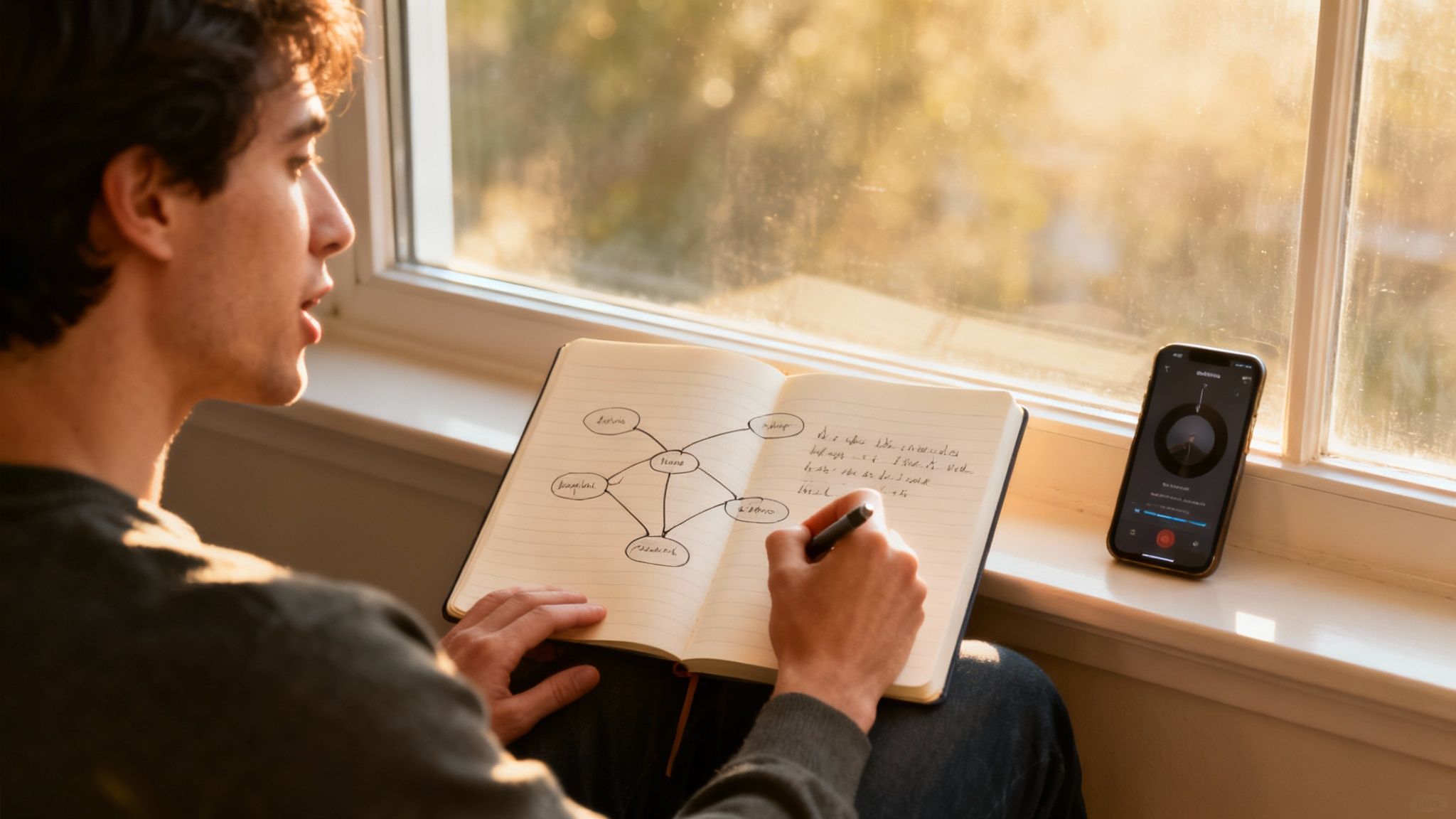
This doesn't have to feel like cramming for an exam. It’s more about being smart and strategic in how you revisit what you’ve learned, making it genuinely meaningful to you.
From Fleeting Thoughts to Permanent Knowledge
One of the most effective review techniques I’ve come across is the “teach-back” method. It’s incredibly simple: try to explain a new concept to someone else. If no one's around, just explain it out loud to yourself. This little exercise forces your brain to organize the information in a clear, logical way and immediately shines a spotlight on any areas where you're still a bit fuzzy.
Another powerful strategy is to be smart about repetition. Mindlessly re-reading the same page 10 times won't do much good. Instead, try spacing out your review sessions. Look over your notes or the original material a day later, then a few days after that, and then again a week later. This "spaced repetition" is a signal to your brain that this information is important and worth keeping. For a deeper dive into this, check out these proven techniques on how to improve memory retention.
Making It Personal
Reflection is where the magic really happens. It’s the process of connecting new information to your own life, your past experiences, and what you already understand. It’s how you turn abstract facts into usable knowledge.
Think of it this way: when you link a new idea to something you already know, you're not just storing a random piece of data. You're weaving it into the very fabric of your mind, making it far easier to recall later because it’s part of a bigger, interconnected picture.
This is more important now than ever. Although global literacy has improved over the decades, that progress can be fragile. In fact, studies revealed a drop in average reading achievement scores in several countries between 2016 and 2021, largely due to disruptions from the pandemic. Strengthening our own comprehension skills is our best defense against this trend.
This is a great place to bring in a tool like Speak4Me. It’s perfect for turning downtime into productive review time. It can assist you in listening to your notes, important articles, or summaries while you’re driving, working out, or just doing chores. This kind of auditory reinforcement is a fantastic way to solidify information in your memory without having to stare at a screen.
Don’t let that valuable knowledge you worked so hard to gain just slip away. Make it a lasting part of your expertise. Download Speak4Me free on iOS and start making your learning stick.
Common Questions About Improving Comprehension
As you start working on your comprehension skills, you're bound to have some questions. That's a good thing! It means you're actively thinking about how to get better.
Let's walk through some of the most common ones I hear. Getting these cleared up can help you push past roadblocks and keep making progress.
How Quickly Can I Actually Improve My Comprehension?
This is the big one, isn't it? While there’s no magic number, with consistent effort, you can see a noticeable difference in just a few weeks. The key isn't how long you practice, but how you practice.
Forget about spending hours passively skimming text. Quality trumps quantity every single time. A focused 20 minutes each day using the active strategies we've discussed will build those mental muscles much faster than hours of distracted reading.
Does Technology Like Text-to-Speech Really Help?
Yes, absolutely. Think of it as a powerful training partner. Tools that provide auditory feedback are especially great because they engage a different part of your brain.
Here’s why it works so well:
Vocabulary Sticks: Hearing a new word pronounced correctly makes it much more likely to stick in your memory.
Keeps You on Track: Listening while you read gives your brain two inputs to process, which can crowd out distractions and improve focus.
Untangles Complex Sentences: Ever read a sentence three times and it still doesn't make sense? Hearing it spoken aloud can instantly clarify the structure and meaning.
It’s about finding what clicks with your learning style.
The goal isn't to replace reading with technology. It's about using technology to make your reading more effective—a support system to strengthen your skills.
What Is the Best Way to Stay Focused While Reading?
In a world full of distractions, focus is a superpower. The best approach is to tackle distractions from two sides: your environment and your mind.
First, deal with the external stuff. Find a quiet spot. More importantly, put your phone on silent and out of sight. Seriously, just moving it off your desk can work wonders.
Then, tackle the internal chatter by keeping your mind actively engaged. Ask questions as you read. If you want an extra layer of focus, try listening to the text with a tool like Speak4Me while you follow along. This dual input makes it much harder for your mind to drift away.
Is Reading on a Screen Worse Than a Physical Book?
A lot of people feel they concentrate better with a physical book, and that makes sense—no notifications popping up or other tabs calling your name.
But honestly, the format you choose is less important than the method you use.
The active strategies—questioning the author, summarizing paragraphs, taking notes—are what really drive understanding. Digital formats even have their own perks, like instant access to text-to-speech. Try both and see what feels best, but always remember that active engagement is the real secret.
Ready to use technology to sharpen your focus and boost your retention? With Speak4Me, you can turn any text into audio and start practicing these techniques today. Download Speak4Me free on iOS.
Try Speak4Me for Free
