how to overcome learning disabilities: A Practical Guide

When you're figuring out how to manage a learning disability, it’s not about looking for a "cure." It’s about building a toolkit that plays to your strengths. True success comes from a smart mix of effective learning strategies, a solid support system, and the right technology. With an approach that fits you, you can thrive anywhere.
Your Path to Thriving with a Learning Disability

Thriving with a learning disability starts with a powerful mental shift. It means moving your focus away from the challenges and zeroing in on your natural talents. Whether you're dealing with dyslexia, dyscalculia, or another learning difference, your journey is your own.
This guide is designed to be an actionable roadmap. It’s based on a simple but powerful idea: the right tools and mindset can unlock your potential. We'll walk through practical strategies you can start using right away to make learning, studying, and working feel more manageable and, ultimately, more successful.
Getting a Lay of the Land
First things first, it's helpful to understand the different learning profiles out there. Each one brings its own unique set of hurdles and requires a different game plan. Getting familiar with the various common learning disabilities and their link to ADHD is the perfect starting point.
Knowing these distinctions is so important because it proves that a one-size-fits-all approach just doesn't work. It also reminds you how many people are on a similar journey. In fact, about 15% of students worldwide have some form of learning disability. Unfortunately, statistics often show gaps in employment and education for this group, which really highlights the need for good support and smart strategies to break down those barriers.
Here's a quick look at the foundational strategies that can make a real difference. Think of these as the key pillars supporting your success.
Key Pillars for Overcoming Learning Disabilities
Strategy Pillar | What It Involves | Primary Benefit |
|---|---|---|
Personalized Strategies | Finding out if you're a visual, auditory, or hands-on learner and adjusting your study or work habits to match. | Makes learning feel more natural and less like a struggle, improving retention and understanding. |
Assistive Technology | Using tools for reading, writing, and organization, like text-to-speech apps, spell-checkers, or digital planners. | Removes common roadblocks, saving time and mental energy so you can focus on the actual content. |
Strong Support Systems | Creating a network of teachers, mentors, family, and friends who get it and can offer encouragement and practical help. | Builds confidence and provides a safety net, making it easier to ask for help and advocate for your needs. |
By weaving these pillars into your daily life, you create a powerful framework for success. It’s not about trying to change who you are—it’s about giving yourself the tools to let your abilities shine.
Ready to add a powerful new tool to your kit? Download Speak4Me free on iOS and discover how assistive technology can support your journey.
Building Your Personalized Learning Toolkit
There’s no magic wand for overcoming a learning disability. Instead, it’s about crafting a custom-built toolkit filled with strategies that click with how your brain is wired. Forget the cookie-cutter advice; what works for one person might not work for you, and that’s perfectly okay.
The real first step is to get your hands dirty and experiment. Play around with different methods to see what actually helps you learn and remember information. One of the most effective places to start is with multisensory learning—the idea of using multiple senses at once, like sight, sound, and touch. Doing this creates stronger connections in your brain, making it much easier to pull up that information later.
Engage Your Senses for Better Learning
Think about how you can turn learning from a passive activity into something more physical and interactive. For example, instead of just staring at a list of spelling words, why not try something different?
Got a feel for things? Try using textured letter tiles or even tracing words in a sand tray. That physical sensation can help lock the letter shapes and sounds into your memory.
More of a visual person? Grab some colorful pens and create mind maps to connect ideas. This turns abstract concepts into a concrete picture you can literally see and remember.
Learn best by listening? Record yourself reading your notes aloud and play them back. Sometimes, just hearing the information in your own voice is all it takes to make it stick.
This whole process is about discovery. There are no right or wrong answers here, only what’s effective for you.
Practical Organization and Tech Tools
Beyond sensory strategies, simple, practical organization is your best friend. Staring at a huge project can feel paralyzing, right? Break it down. Slicing big assignments into smaller, bite-sized tasks makes them feel so much more manageable. A color-coded digital planner or even just setting phone reminders can add that little bit of structure that keeps you from getting derailed.
This is also where technology can be a game-changer. There are amazing tools out there designed to support all kinds of learning needs. If you're dealing with specific challenges like ADHD, it’s worth checking out specialized resources like these powerful study tips for ADHD.
Integrating the right tools can bridge the gap between how information is presented and how you process it. This is the essence of building a truly personalized and effective learning system.
Take an app like Speak4Me, for instance. It can turn any written text into spoken words on the fly. This assists anyone who learns better by listening or finds that long stretches of reading just drain their energy. To get a better sense of what's out there, you can explore our guide on what is assistive technology in education.
Building this toolkit is a powerful, proactive step. But it's also important to acknowledge the bigger picture. In the United States, about 20% of people have learning and attention differences. Yet, research reveals that only 46% of working-age adults with learning disabilities have steady employment. These aren't just numbers; they highlight why having a robust personal toolkit is so critical for navigating challenges that go beyond the classroom. You can read more about these findings on learning disabilities.
Ready to add a powerful new tool to your kit? Download Speak4Me free on iOS and start turning text into audio today.
Leveraging Technology for Daily Success
If you're looking for ways to manage a learning disability, assistive technology (AT) is one of the most powerful allies you can have. Think of it less like a fancy gadget and more like a set of smart tools designed to level the playing field, letting your strengths shine. These aren't just for school, either; they're practical aids you can weave into your everyday life.
Let's break down how this actually works. Take text-to-speech (TTS) software. It simply reads digital text out loud. This one function can be a game-changer for someone with dyslexia, dramatically improving comprehension, boosting focus, and cutting down on the mental fatigue that comes from staring at dense blocks of text.
Finding the Right Tools for Your Needs
The secret is matching the right tool to the right challenge. There's a whole world of options out there, each built for a specific purpose.
Speech-to-Text (Dictation) Tools: Absolutely perfect if you struggle with writing or typing. These tools turn your spoken words into text, so you can get your thoughts down without getting stuck.
Mind-Mapping Software: A lifesaver for visual thinkers. This software helps you brainstorm and organize ideas in a non-linear way, which often feels much more natural than a blank document.
Audiobooks and TTS Apps: These give you another way to access content. They're fantastic for auditory learners or anyone who just finds reading visually exhausting.
This infographic lays out a simple way to think about which tools might fit into your personal toolkit.
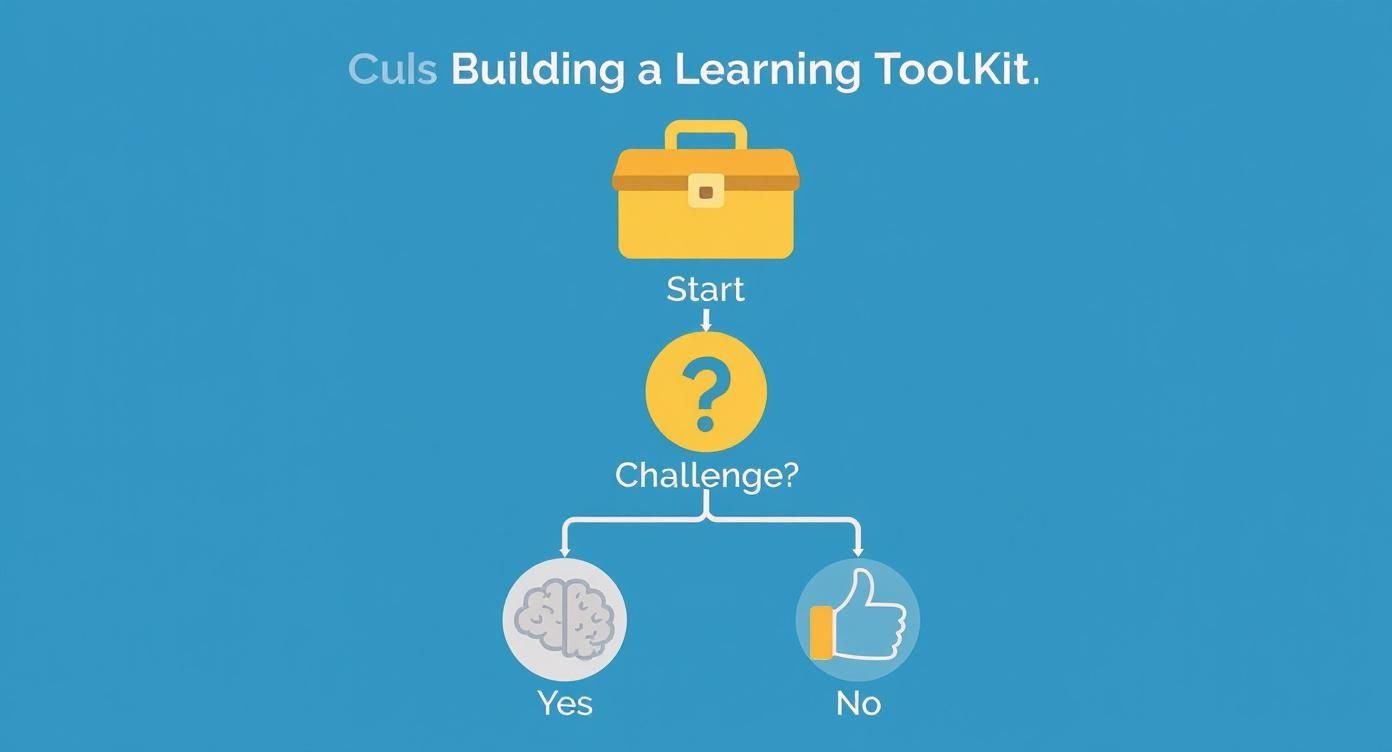
As you can see, it all starts with pinpointing the specific hurdle you're facing. Once you know the problem, you can find the right technological support to help you clear it.
Putting Technology into Practice
Let’s imagine a real-world scenario. A student has to proofread a five-page essay. After reading it on a screen for the tenth time, their eyes start to glaze over. It's so easy to miss small but important errors in grammar or flow.
By using a text-to-speech tool to listen to their own writing, the student engages a different sense. Awkward phrasing, clunky sentences, and typos become much more obvious when heard aloud.
This is exactly where an app like Speak4Me comes in. It can turn your emails, articles, or study guides into clear audio, making content easier to digest and proofreading far more effective. If you want to make your study sessions more productive, you can learn more about using text-to-speech for studying in our detailed guide.
Assistive Technology Comparison for Learning Support
To make sense of the options, it helps to see them laid out side-by-side. This table breaks down some common types of assistive technology and shows which learning challenges they're best suited to address.
Technology Type | Primary Function | Best For (Learning Challenge) |
|---|---|---|
Text-to-Speech (TTS) | Reads digital text aloud | Dyslexia, reading comprehension, focus issues |
Speech-to-Text (Dictation) | Converts spoken words into text | Dysgraphia, challenges with writing/typing |
Mind-Mapping Software | Visually organizes ideas and concepts | ADHD, executive function, brainstorming |
Audiobooks/Players | Provides spoken versions of books | Auditory learning, visual processing issues |
Word Prediction Software | Suggests words as you type | Spelling difficulties, writing speed |
Choosing the right tool is about finding what works for your unique brain. It’s not about finding a shortcut; it's about working smarter. Technology provides the support needed to bridge the gaps, allowing your abilities to take center stage without being held back by the mechanics of reading or writing.
Ready to see how technology can support your daily tasks? Download Speak4Me free on iOS and start listening today.
Creating an Inclusive and Supportive Environment
The environment you're in—whether it's a classroom, an office, or even your home—plays a huge part in your ability to learn and succeed. While personal strategies and tools are essential, the people around you and the spaces you use can either throw up roadblocks or help build a path forward. Two of the most powerful things you can do are to build a strong support system and learn how to advocate for your own needs.
It all starts with clear communication. Being able to confidently explain what you need to do your best work is a skill that will serve you for life. This isn't about making excuses; it's about creating the right conditions for you to shine.
Advocating for Your Needs
Learning to speak up for yourself doesn't happen overnight. It can feel awkward at first, but you can start small. You don't need to give a long, detailed explanation—just a simple, direct request.
Here are a few ways you could phrase things at school or work:
When you need more time: "I do my best work when I have a little extra time to process things. Would it be possible to get an extension on this?"
When you need quiet: "Background noise makes it tough for me to focus. Is there a quiet space I could use to work on this?"
When you need clear instructions: "It would be a huge help if I could get these instructions in writing to look back on."
These aren't massive asks, but they can make a world of difference in your performance and confidence. For teachers and managers, understanding these needs is crucial. Our guide on how to help dyslexic students has more specific strategies that are often helpful for a wide range of learners.
Fostering True Inclusion
Real inclusion is more than just making a few accommodations here and there. It's about fundamentally shifting the environment to be more accessible and understanding for everyone. This means educating colleagues and classmates, offering materials in different formats (like audio and text), and building a culture where asking for help is seen as a sign of strength, not weakness.
Success isn't just about individual effort. It's about creating an ecosystem where everyone has the support they need to thrive. When you make an environment better for one person, you often make it better for all.
The scale of this is massive. Globally, about 1.3 billion people live with a significant disability, which includes learning disabilities. This number reminds us that challenges often come from a mismatch between a person's needs and the environment they're in, whether that's due to unhelpful attitudes or inaccessible information. The World Health Organization's findings on disability and health dig deeper into how these external factors play a role.
Having a supportive network makes the journey feel less lonely and far more empowering. And that network can include technology, too. A simple text-to-speech app can be like a listening ear, taking the strain out of reading and freeing up your mental energy for the important stuff.
Download Speak4Me free on iOS and add a helpful voice to your support system.
Developing Emotional Resilience and a Growth Mindset
Let's be honest. Learning how to overcome learning disabilities isn't just about finding the right academic tricks or tech tools. It’s also about building emotional strength. The daily grind of working harder on tasks that seem effortless for others can be incredibly frustrating and can really wear down your self-esteem.
That's why building a solid inner foundation is just as vital as any external strategy you might use.
It all starts with a conscious shift in focus. Instead of getting stuck on the things you struggle with, make an effort to find and celebrate what you're great at. Maybe you're a fantastic creative problem-solver, a natural leader with high empathy, or a brilliant visual thinker. Acknowledging these talents isn't just about feeling good; it's about fundamentally changing how you see yourself—based on your strengths, not your challenges.
Embracing a Growth Mindset
One of the most powerful shifts you can make is adopting what's known as a growth mindset. This is the core belief that your abilities aren't fixed; they can be developed through dedication and hard work. It completely reframes how you see challenges, turning them from dead-ends into opportunities.
So, instead of thinking, "I'm just bad at this," you start asking, "What can I learn from this?" It's a small change in wording, but it makes a world of difference. Setbacks become learning experiences, not proof of failure.
Think about it: every successful person with a learning disability, from Richard Branson to Whoopi Goldberg, shares one key trait—resilience. They didn't see their unique way of thinking as a flaw. They saw it as a different perspective that drove their creativity and grit.
Practical Steps for Building Resilience
Developing this kind of mental toughness doesn't happen overnight. It's an active process, built through daily habits that support your emotional well-being and help you handle the stress that comes with school or work.
Here are a few simple but effective things you can start doing today:
Practice Mindfulness: Just a few minutes of mindfulness or deep breathing each day can work wonders for the anxiety that often tags along with difficult tasks. It helps you stay in the moment instead of getting carried away by "what-if" worries.
Set Realistic Goals: Big goals can feel overwhelming. Break them down into small, manageable steps. Each time you tick one off, you get a little win that builds momentum and proves you're making progress. It’s a huge confidence booster.
Reframe Negative Thoughts: When you catch yourself in a negative thought loop, stop and challenge it. Is that thought really true, or is it just the frustration talking? Try to consciously replace it with a more balanced and encouraging perspective.
These mental strategies are the bedrock of resilience. When you combine them with tools designed to lessen your cognitive load, you've got a seriously powerful setup for success.
For example, using an app like Speak4Me to listen to your assigned readings can free up a ton of mental energy. Instead of wrestling with the text, you can put that energy toward actually understanding the ideas and maintaining that positive, growth-oriented mindset.
Ready to free up your mental energy to focus on building resilience? Download Speak4Me free on iOS and let technology handle the reading.
Putting Your Plan into Action
So, where do you go from here? We've walked through a lot of ground together, from figuring out your unique learning style to building a solid support system. The key takeaway is that managing a learning disability isn't a one-and-done fix; it's an ongoing journey of strategy, self-advocacy, and finding what works for you.
Think about all the pieces we've covered: understanding how you learn best, creating a personalized toolkit, using technology to your advantage, and leaning on your network. Each one is a vital part of the puzzle.
Now it's time to make a move. The thought of trying everything at once can be paralyzing, so don't even go there.
The secret is to start small. Just pick one thing—one strategy or one tool that genuinely clicked with you—and focus on weaving that into your daily life.
A really practical first step? See what technology can do for you right now. It's a fantastic way to get some quick wins, reduce that feeling of daily friction, and build the momentum you need to keep going. When you find the right supports, you free up so much mental energy to focus on what truly matters.
Ready to add a powerful new tool to your kit? Let technology do some of the heavy lifting. Download Speak4Me free on iOS and see how much easier it can be to engage with written content.
Got Questions? We've Got Answers
When you're figuring out how to manage a learning disability, a lot of questions pop up. It's completely normal. Let's tackle some of the most common ones I hear from people just starting this journey.
Can a Learning Disability Really Be "Overcome"?
That's a great question, and the answer is yes, but maybe not in the way you think. A learning disability is a lifelong condition—it doesn't just disappear.
"Overcoming" it means you learn to work with your brain's unique wiring, not against it. It's about building a toolkit of smart strategies, finding the right support, and leaning into your strengths so you can thrive in school, at work, and in life. It's less about a cure and more about empowerment.
What's the Single Most Important First Step?
If you do just one thing, start here: get to know your own learning profile inside and out.
This is all about identifying what comes easily to you and where you consistently hit roadblocks. A formal evaluation is the gold standard for this, as it gives you a detailed map of your brain's processing style. But even just honest self-reflection is a powerful first move. Knowing your starting point is the foundation for everything else.
One of the biggest myths out there is that a learning disability has anything to do with intelligence. It absolutely doesn't. It's simply a difference in how your brain takes in and processes information, which is why a one-size-fits-all approach never works.
How Does Technology Like Speak4Me Actually Make a Difference?
Think of assistive technology like Speak4Me as a way to free up your brain's bandwidth.
For someone with dyslexia, for example, the act of decoding words on a page can be exhausting. Listening to that same text with a text-to-speech app removes that barrier. Suddenly, you can focus all your energy on understanding the actual ideas and information, not just struggling with the words themselves. It helps make learning more efficient and way less frustrating.
Ready to see how a tool like this can fit into your own strategy? Speak4Me helps you listen to articles, notes, and study materials, turning reading into a more accessible experience.
Download Speak4Me free on iOS and give it a try.
Try Speak4Me for Free
