How to Study Efficiently: Top Strategies for Better Learning
Studying efficiently isn't about brute force—it's about being strategic. The real difference between students who struggle and those who succeed often comes down to their approach. It’s a shift from passively rereading notes to actively engaging with the material, all built on a bedrock of smart, consistent habits.
Building Your Foundation for Efficient Study
Before you even think about complex memory hacks or the latest productivity app, you need to get the basics right. So many students try to skip this part, jumping straight into advanced techniques, only to find they don't stick. This initial groundwork isn't about memorizing formulas; it's about creating a sustainable system that keeps you from burning out and makes studying feel like a natural part of your week.
Think of it like building a house. You can't put up the walls and roof before you've poured a solid foundation. These core habits are that foundation. Without them, even the most brilliant study methods will eventually collapse under pressure.
Set Clear and Motivating Academic Goals
Vague goals are useless. "Study more" is a classic example—it has no direction and no finish line, which is why it almost always fails. You need specific, measurable targets that give your study sessions a real sense of purpose. This is how you turn a chore into a mission.
Get Specific: Don't just say, "get better at math." A better goal is, "Achieve an 85% or higher on the next calculus exam by completing all weekly practice problems." See the difference?
Break It Down: A goal like "write a 15-page history paper" can feel impossibly huge. Instead, break it into bite-sized tasks: "finish research by Friday," "complete the outline by Monday," and "write two pages per day."
Connect to Your Why: Take a moment to remember why you're doing this. Is it to land a dream job, get into a specific graduate program, or just master a skill you love? Tying your daily grind to a bigger ambition is a powerful motivator.
Design a Distraction-Free Study Space
Your environment has a massive impact on your brain. Trying to focus in a cluttered, noisy room is an uphill battle. A clean, organized space, on the other hand, immediately signals to your brain that it's time to get down to business.
The whole point is to create a space so dedicated to learning that just sitting down in it helps you slip into a state of focus. Get rid of the visual and digital clutter to give your brain a fighting chance.
This infographic lays out how a well-organized study environment is the first real step toward a productive learning session.
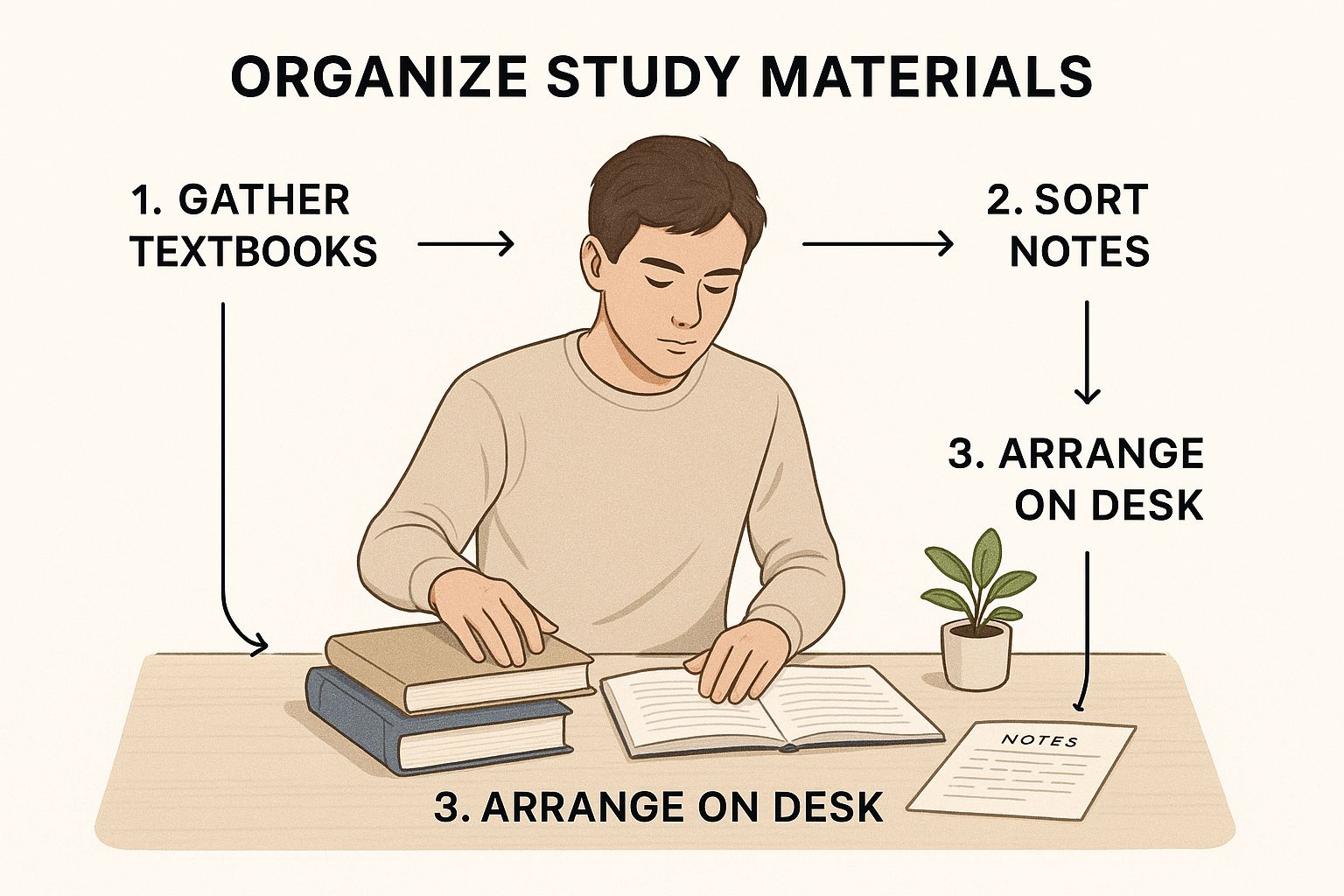
A tidy desk isn't just about aesthetics; it actually reduces your cognitive load, which frees up precious mental energy you can use for learning.
Research overwhelmingly supports the link between consistent habits and academic success. A meta-analysis covering 15 different studies found that students with regular routines simply perform better. If you want to boost your overall output, you can find great tips on how to improve work efficiency. Another study even showed that structured habits were directly tied to better goal attainment for college students. You can learn more about these findings on study habits and performance.
Embrace Consistency Over Cramming
Let's be clear: all-nighters are the enemy of real learning. Sure, cramming might get you through an exam, but that information is gone almost as quickly as it came because it never makes it into your long-term memory. The real secret is spreading your effort out with small, consistent study sessions. This method, often called spaced practice, is proven to be far more effective for creating lasting knowledge. You can dive deeper into these strategies in our article on how to retain information better.
Here’s a practical way to build that consistency. Convert your study notes into audio using a tool like Speak4Me. This lets you review material while you're on the move—during your commute, at the gym, or while doing chores. It's an effortless way to fit quick review sessions into your day. Ready to build a smarter study habit? Download Speak4Me free on iOS and start turning your texts into powerful learning tools.
To wrap it all up, here’s a quick-reference table summarizing these foundational principles.
Your Quick Guide to Studying Efficiently
Principle | Why It Works | Actionable Tip |
|---|---|---|
Set Specific Goals | Provides clear direction and motivation, turning vague intentions into a concrete plan. | Instead of "study more," aim for "complete 3 practice exams with an 80% score by Friday." |
Create a Dedicated Space | Signals to your brain it's time to focus and reduces the mental energy wasted on ignoring distractions. | Choose one spot—a desk, a library corner—and use it only for studying. Keep it clean and quiet. |
Study Consistently | Leverages spaced repetition to move information from short-term to long-term memory. | Schedule short, 25-minute study blocks several times a week instead of one massive 4-hour session. |
Mastering these basics will make every other study technique you learn far more effective.
Master Your Schedule for Peak Productivity
If you want to study smarter, it’s not just about what you do—it’s about when you do it. As a student, your time is your most precious asset. Learning to protect it is the first real step toward getting things done without the stress. A good schedule shifts you from constantly reacting and putting out fires to proactively controlling your day.
This means ditching the "I'll study when I feel like it" approach. We've all been there, and we all know it leads straight to procrastination and late-night cramming sessions. The goal here is to build a plan that’s structured enough to keep you on track but flexible enough to work with your natural energy, not against it.
Find Your Personal Productivity Window
Ever feel like a genius in the morning but can’t string a sentence together after 3 PM? That’s not just you. Everyone has a unique biological clock that determines when they’re at their sharpest. Some of us are early birds, firing on all cylinders before lunch, while others are night owls who only truly wake up when the sun goes down.
Trying to tackle complex material when your brain is in a fog is like trying to swim upstream. You’ll get exhausted and won't make much progress. The trick is to figure out your prime time and guard it fiercely for your most demanding work.
Become an energy detective: For one week, just pay attention. Jot down when you feel most alert and focused, and when you start to feel that mental drag.
Match tasks to your energy: Once you've identified your peak hours, block them out for the heavy hitters—like that calculus homework or your organic chemistry chapter.
Use the lulls wisely: Save the low-brainpower tasks for your energy slumps. This is the perfect time to organize your notes, answer emails, or even do a load of laundry.
This one change can make a huge difference. You're applying your best brainpower where it counts the most, which makes every study session more impactful.
Implement Proven Time Management Techniques
Okay, so you know when you’re most productive. Now you need a system for structuring that time. Two of the most battle-tested methods are Time Blocking and the Pomodoro Technique. They’re popular for a reason: they fight decision fatigue and give you a clear roadmap for your day.
Time Blocking is exactly what it sounds like. Instead of a messy to-do list, you schedule every single task into a specific block on your calendar. Think "9:00-10:30 AM: Study Chapter 4 of Psychology," not just "study psychology." This forces you to be realistic about how much time you actually have and helps you avoid the trap of multitasking.
The Pomodoro Technique is your best friend when you just can't get started. You work in hyper-focused 25-minute sprints, separated by short breaks. The magic is in its simplicity. Anyone can convince themselves to focus on something for just 25 minutes.
The whole point of these techniques is to put your time on autopilot so you can free up your brain to actually learn. When you don't have to waste mental energy figuring out what to do next, you can dive deeper into your work.
Overcoming the Procrastination Hurdle
Even with the world's best schedule, procrastination can still sneak in. It’s usually not about being lazy. More often, it's an emotional reaction to feeling overwhelmed or anxious about a huge task. In fact, research shows that most students fall back on cramming because of poor time management, not because they don't want to learn.
The best way to fight this is to make big, scary tasks small and manageable. Break that massive research paper into baby steps. Your first step doesn't have to be "write the paper." It can be "Find three academic sources." Then, "Read the intro of one source." Each tiny win builds momentum, making the next step feel that much easier.
If you're looking for more ways to get ahead, check out our guide on how to be more productive.
By truly mastering your schedule, you’re not just getting more done—you're winning back your free time. A solid plan gives you permission to relax without feeling guilty because you know your study time is already handled. You can even get creative and use tools that fit into your new schedule. For example, why not turn your assigned readings into audio files? You can listen while you commute or cook dinner, turning downtime into productive review time.
Ready to take control of your schedule and make every minute count? Download Speak4Me free on iOS to turn your study materials into on-the-go audio lessons.
Use Active Learning to Actually Retain Information
One of the biggest traps you can fall into when studying is just reading your notes over and over again. It feels productive, but it's a passive activity that does next to nothing for your long-term memory. Your brain barely has to work, which is why information tends to go in one ear and out the other.
To really learn how to study well, you have to shift from being a passive observer to an active participant.
This is where active learning comes in. These strategies force your brain to engage with the material, wrestle with it, and build strong, lasting connections. Think of it like this: you can watch someone lift weights all day, or you can pick them up yourself. Only one of those actually builds muscle.
Test Yourself with Active Recall
Active recall is just a fancy term for trying to pull information out of your brain without looking at your notes. Every time you force yourself to remember something, you strengthen that neural pathway, making it easier to recall the next time.
Simply rereading your notes creates an "illusion of competence"—you recognize the material, but you can't actually explain it from scratch.
Here are a few simple ways to start using active recall today:
Try Practice Questions: When you finish a chapter, cover up the text and try to answer the review questions purely from memory.
Use the Blank Sheet Method: After a lecture or reading session, grab a blank piece of paper. Write down everything you can possibly remember about the topic. Then, compare it to your actual notes. You'll instantly see where the gaps in your knowledge are.
Do Flashcards the Right Way: Don't just mindlessly flip cards over. Force yourself to say the answer out loud before you check. This adds a crucial layer of active engagement.
The core idea is simple: stop just putting information into your brain and start practicing pulling it out. It will feel harder at first, but that difficulty is exactly what makes it so effective.
Master Concepts with the Feynman Technique
Named after the Nobel Prize-winning physicist Richard Feynman, this technique is a brilliant way to check if you truly understand a topic. The rule is simple: if you can't explain something in simple terms, you don't really get it yet.
Here’s how it works in four steps:
Pick a concept. Write its name at the top of a blank page.
Explain it simply. Pretend you're teaching it to a kid. Use plain language and avoid jargon.
Find your knowledge gaps. Whenever you get stuck or have to use a complicated term, that’s your weak spot. Go back to your notes or textbook to fill in that gap.
Review and simplify again. Rework your explanation until it's crystal clear and concise.
This process forces you to confront the fuzzy areas in your understanding. You can even take it a step further by using a tool like Speak4Me to record yourself explaining the concept. Hearing your own explanation played back makes any gaps in your logic glaringly obvious.
Beat the Forgetting Curve with Spaced Repetition
Your brain is built to forget information it doesn't think is important. Scientists call this the "forgetting curve"—it shows how quickly we lose new information if we don't review it.
The solution is spaced repetition. Instead of cramming, you review material at increasing intervals. For instance, you might review a concept after one day, then three days, then a week, and so on. This signals to your brain that the information matters and should be stored in long-term memory.
Digital flashcard apps are perfect for this because they automate the whole schedule for you. But you can also create a manual system with a calendar. The key is consistency. A short, 15-minute review session each day is far more powerful than one multi-hour cram session before a test.
By making these strategies a core part of your routine, you'll stop wasting time on passive rereading and start building knowledge that actually sticks.
Ready to make active learning a seamless part of your study routine? Download Speak4Me free on iOS and start practicing your recall by explaining concepts out loud today.
Making Technology Your Study Ally
Your phone can be your biggest enemy or your most powerful study partner. Honestly, it comes down to how you use it. The secret to studying efficiently is forcing technology to work for you, not the other way around. Instead of getting sucked into a social media vortex, you can turn your devices into dedicated tools that actually help you learn.
We're talking about more than just a basic notes app. The right tech can handle the boring stuff, break down complicated ideas, and help you squeeze in study time wherever you can find it.
Turn Your Notes into an Audiobook
One of the smartest ways to use tech is to bring more of your senses into the game. If you're an auditory learner, staring at a textbook for hours is a recipe for a headache. But what if you could listen to that same chapter while you're walking across campus or on the treadmill?
This is where text-to-speech comes in. It’s a total game-changer. Tools like Speak4Me can take any digital text—your typed-up notes, a beast of a PDF, an online article—and turn it into natural-sounding audio. Suddenly, you can review material without being glued to a screen, reinforcing key concepts while you’re on the move. We have a whole guide on using text-to-speech for studying if you want to dive deeper.
Let Digital Tools Do the Heavy Lifting
Beyond just listening, technology can automate some of the most powerful study techniques out there. It’s one thing to know you should use spaced repetition, but it’s another thing entirely to actually do it consistently.
Digital Flashcards: Forget manually sorting paper cards. Apps like Anki or Quizlet use smart algorithms to show you the exact card you need to see right before it slips from your memory. It makes reviewing incredibly efficient.
Focus Timers: If you get distracted by notifications (who doesn't?), focus apps are a lifesaver. They can block distracting websites and apps, creating a little digital sanctuary so you can actually concentrate.
Reference Managers: For anyone writing a research paper, trying to keep track of sources is a nightmare. This is where you should explore some of the best reference managers for annotations and note-taking. They make organizing citations and notes so much easier.
The point isn't to download a million apps. It's about finding one or two that solve a real problem for you—whether that’s tuning out distractions, putting your review on autopilot, or making your study materials easier to get through.
Be Intentional with Your Tech
Building better study habits is also about creating a better learning environment, and your tech is a huge piece of that puzzle. In fact, research shows that something as simple as using mobile tech to send educational reminders can make a real difference in student success. Where phones are everywhere, these little tech-based nudges really work.
The first step is simply to be deliberate. Before you sit down to study, make a conscious decision about what role your phone or laptop will play. Are you using a specific app? Listening to your notes? Or is it time to put it on silent and stick it in another room?
When you make that choice upfront, you take back control. You turn a potential distraction into a genuine asset.
A great place to start is by turning some of your reading material into audio you can listen to anywhere. Download Speak4Me free on iOS and see how much more you can get done.
How Your Well-Being Impacts Brain Performance
It's one of the biggest mistakes I see students make: sacrificing sleep, living on junk food, and skipping any form of exercise just to squeeze in more study time. This feels productive, but it's a classic trap of working harder, not smarter. Your brain isn't a computer you can just leave on indefinitely; it's a biological machine, and its performance is directly tied to your physical and mental health.
Ignoring your well-being isn't a clever shortcut to better grades—it's a fast track to burnout. Truly efficient studying happens when your mind is sharp and focused, and that all starts with taking care of yourself. This isn’t about luxury; it’s about giving your brain the basic resources it needs to actually process, store, and recall information.

Prioritize Sleep for Memory Consolidation
Let's be clear: sleep isn't just downtime. It's an absolutely critical part of the learning process. While you’re asleep, your brain is busy consolidating memories—basically, it's transferring everything you learned from your fragile short-term memory into more stable long-term storage.
When you consistently get 7-9 hours of quality sleep, you’re giving your brain the time it needs to organize and lock in the day's information. Pulling an all-nighter, on the other hand, completely sabotages this process. Sure, you might cram enough to scrape by on a test, but you won't actually retain much of it a week later.
Think of sleep as the 'save' button for your brain. Without it, much of the hard work you put into studying is simply lost.
Try to build a consistent sleep schedule, even on weekends. This helps regulate your body's internal clock, which leads to much better sleep quality and makes it easier to wake up feeling genuinely rested and ready to learn.
Fuel Your Brain with the Right Nutrition
The food you eat has a direct and almost immediate impact on how well you can think. It's wild, but your brain uses about 20% of your body's total calories, so the quality of that fuel really matters. A diet packed with processed foods, sugar, and unhealthy fats is a recipe for brain fog, fatigue, and terrible concentration.
On the flip side, a balanced diet full of brain-boosting foods can seriously improve your focus, memory, and overall mental clarity.
Complex Carbs: Think oatmeal, brown rice, and whole-wheat bread. These give you a steady release of glucose, which is your brain's main source of energy. No sugar crashes here.
Lean Proteins: Things like fish, chicken, and beans provide the amino acids your brain needs to produce neurotransmitters—the chemicals that carry signals between brain cells.
Healthy Fats: Omega-3 fatty acids are a big one. You'll find them in fatty fish, walnuts, and flaxseeds. They're crucial for brain health and have been linked to better memory.
Hydration: This is so simple, but so important. Even being mildly dehydrated can mess with your attention and memory. Just keep a water bottle with you and sip on it all day.
Manage Stress to Avoid Cognitive Burnout
Chronic stress is absolute poison for your brain. When you're constantly stressed out, your body floods itself with cortisol, a hormone that, over time, can actually interfere with memory and other cognitive functions. Finding healthy ways to manage that stress isn't just a nice idea—it's non-negotiable for effective learning.
Mindfulness and meditation are powerful tools for this. Just taking a few minutes to focus on your breathing can calm your nervous system and dramatically improve your ability to concentrate. Another game-changer is regular physical exercise, which is one of the best stress relievers out there. It gets more blood flowing to the brain and releases endorphins, which naturally boost your mood.
Remember, taking a real break isn't a sign of weakness—it's a strategic move to protect your mental energy for the long haul. You can even get creative and combine your breaks with some light review. For instance, Speak4Me can assist by letting you listen to your notes while you go for a relaxing walk.
This approach lets you step away from the desk while still reinforcing what you’ve learned. Ready to make your well-being a core part of your study plan? Download Speak4Me free on iOS to turn your study materials into audio lessons you can take anywhere.
How AI Tools Are Changing the Game for Students
The way we study is fundamentally shifting, and artificial intelligence is at the heart of it. AI isn't some far-off idea anymore; it's here now, offering practical ways to make learning more personal, efficient, and honestly, a lot less of a grind.
Think of it this way: AI is becoming a personal tutor that understands you. It can pinpoint where you’re struggling and then create custom quizzes to help you nail those tricky concepts. This kind of targeted support means you can stop wasting time on what you already know and focus your brainpower on actually thinking critically and solving problems.
Getting Smarter Support for Your Studies
The real magic of AI is how it handles all the tedious stuff. It can take a dense, 20-page research paper and give you a summary in seconds. It can turn your lecture notes into a deck of flashcards automatically. Some tools can even give you instant feedback on a practice essay.
This frees you up to spend less time on grunt work and more time actually engaging with the material.
The global education market is even projected to hit nearly $10 trillion by 2030, and much of that growth comes from integrating AI tools like these. They're making a real difference. If you're curious about the trends, you can discover more insights about the future of education on HolonIQ.
The goal isn't just to study more, but to understand more deeply. AI tools handle the logistics of learning, like summarizing and organizing, so you can focus on making connections and building real knowledge.
By tapping into these tools, you can seriously upgrade your study methods. For instance, an app like Speak4Me can read your digital textbooks aloud. Suddenly, that passive reading becomes an active listening session, letting you absorb information while giving your eyes a break.
This move toward intelligent, automated help is making effective studying possible for everyone. Ready to see what AI can do for your study routine? Download Speak4Me free on iOS and start turning your reading lists into audio lessons.
Answering Your Top Questions About Studying Smarter
Even when you've got a solid plan, a few nagging questions always seem to pop up. Let's tackle some of the most common ones I hear from students so you can get past the hurdles and into a real, effective study groove.
What's the Ideal Length for a Study Session?
This is a big one, and the answer usually surprises people: shorter is often better. Forget those marathon, multi-hour library sessions. All the evidence points to focused bursts of 25-50 minutes being the sweet spot.
After that, you absolutely need to take a 5-10 minute break. This is the core idea behind the famous Pomodoro Technique. It works because it respects your brain's natural attention span, keeping you sharp and preventing that dreaded mental burnout. The goal isn't just to put in the hours; it's to make those hours count.
Should I Stick to One Subject or Mix It Up?
It feels counterintuitive, but mixing things up is a powerful strategy for long-term memory. This technique is called interleaving, and it's a game-changer.
Instead of grinding through three hours of just math, try this:
One hour of math
One hour of physics
One hour of chemistry
Your brain has to work a little harder to switch gears and pull up different information, which actually strengthens your understanding of each topic. It might feel tougher in the moment, but you’ll be amazed at how much more you remember when the test rolls around.
How Do I Force Myself to Study a Boring Subject?
We've all been there. The textbook is dry, the topic feels pointless, and your motivation is at zero. The trick is to find a way to connect with the material.
Try to find a real-world hook. How does this boring history lesson relate to a movie you love? How does that dry economic theory explain why your favorite video game costs what it does?
Active learning also makes a huge difference. Don't just read—do something with the information. Draw a mind map, explain the concepts out loud to your dog, or even pretend you're teaching it to a friend. You can also turn dense text into an audiobook with an app. Hearing the material instead of just reading it can make it feel much more engaging.
Ready to make even the most challenging subjects more manageable? With Speak4Me, you can turn any text into an audio lesson, perfect for staying focused or learning on the move. Download Speak4Me for free on iOS and start studying smarter today.
Try Speak4Me for Free
