Top Study Strategies for ADHD That Boost Focus in 2025
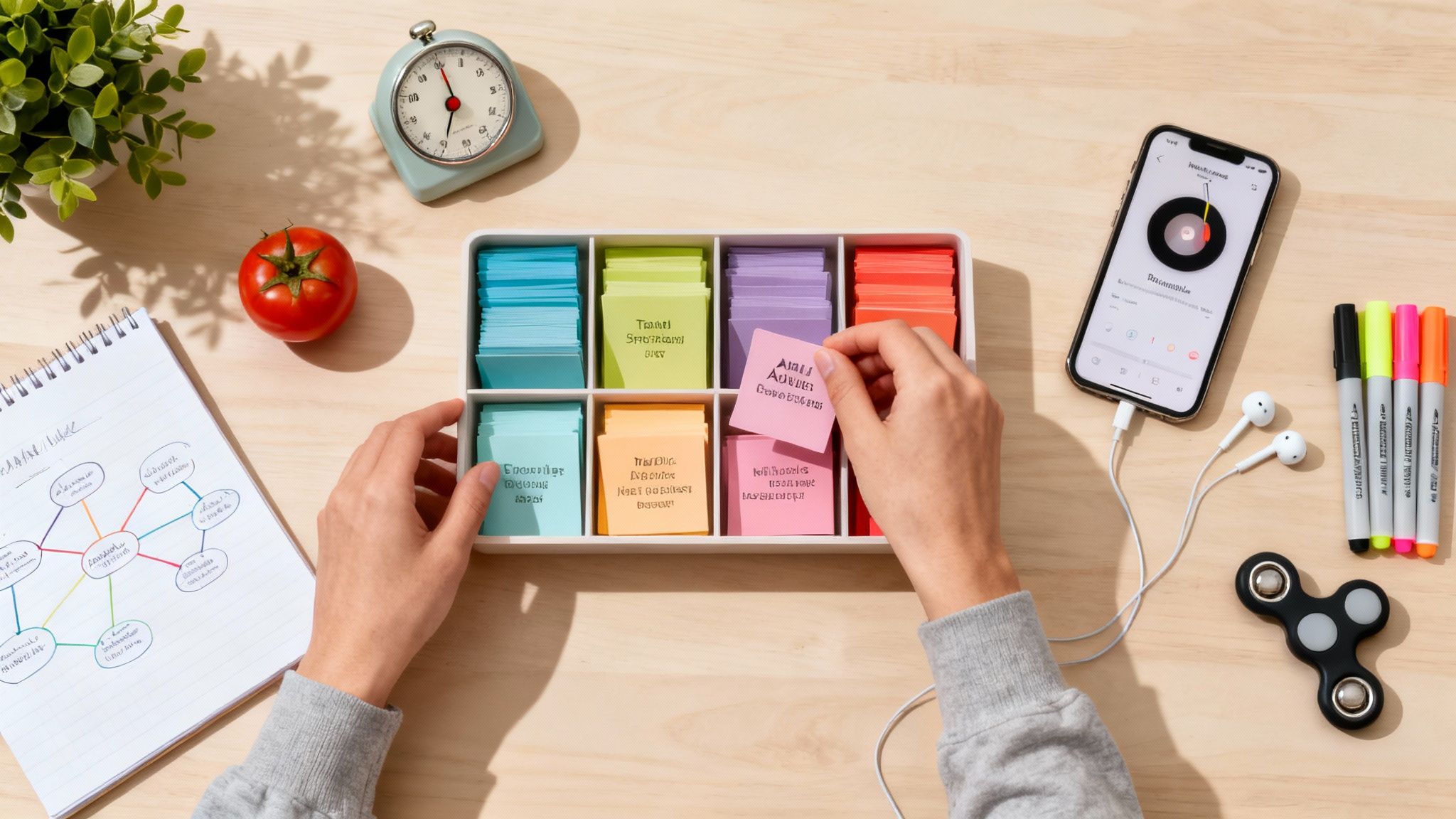
Studying with ADHD can feel like trying to solve a puzzle with the wrong pieces. The frustration of rereading the same paragraph, the magnetic pull of distractions, and the mental exhaustion from simply trying to focus are all too common. Traditional study methods often don't align with how the ADHD brain works, leading to burnout instead of breakthroughs. But what if you could work with your brain, not against it?
This guide explores 8 powerful, science-backed study strategies for ADHD designed to leverage your unique cognitive style. This new approach is about providing empowering strategies for neurodiverse learners that deliver real results. Forget one-size-fits-all advice; these are actionable techniques that address the core challenges of ADHD, from executive dysfunction to working memory limitations. We'll cover everything from body doubling and active recall to interest-based learning and movement integration.
We'll also show you how pairing these methods with a tool like Speak4Me, which transforms text into speech, can create a multisensory learning experience that supports focus and makes information stick. Ready to turn study sessions from a battle into a victory? Let’s dive in.
1. Pomodoro Technique with ADHD Modifications
The Pomodoro Technique is a time management method that breaks work into focused intervals, traditionally 25 minutes long, separated by short breaks. This classic approach gets a powerful upgrade for the ADHD brain by shortening the work sprints to better align with natural attention spans. This modified version is one of the most effective study strategies for ADHD because it works with your brain's need for novelty and frequent rewards, not against it.
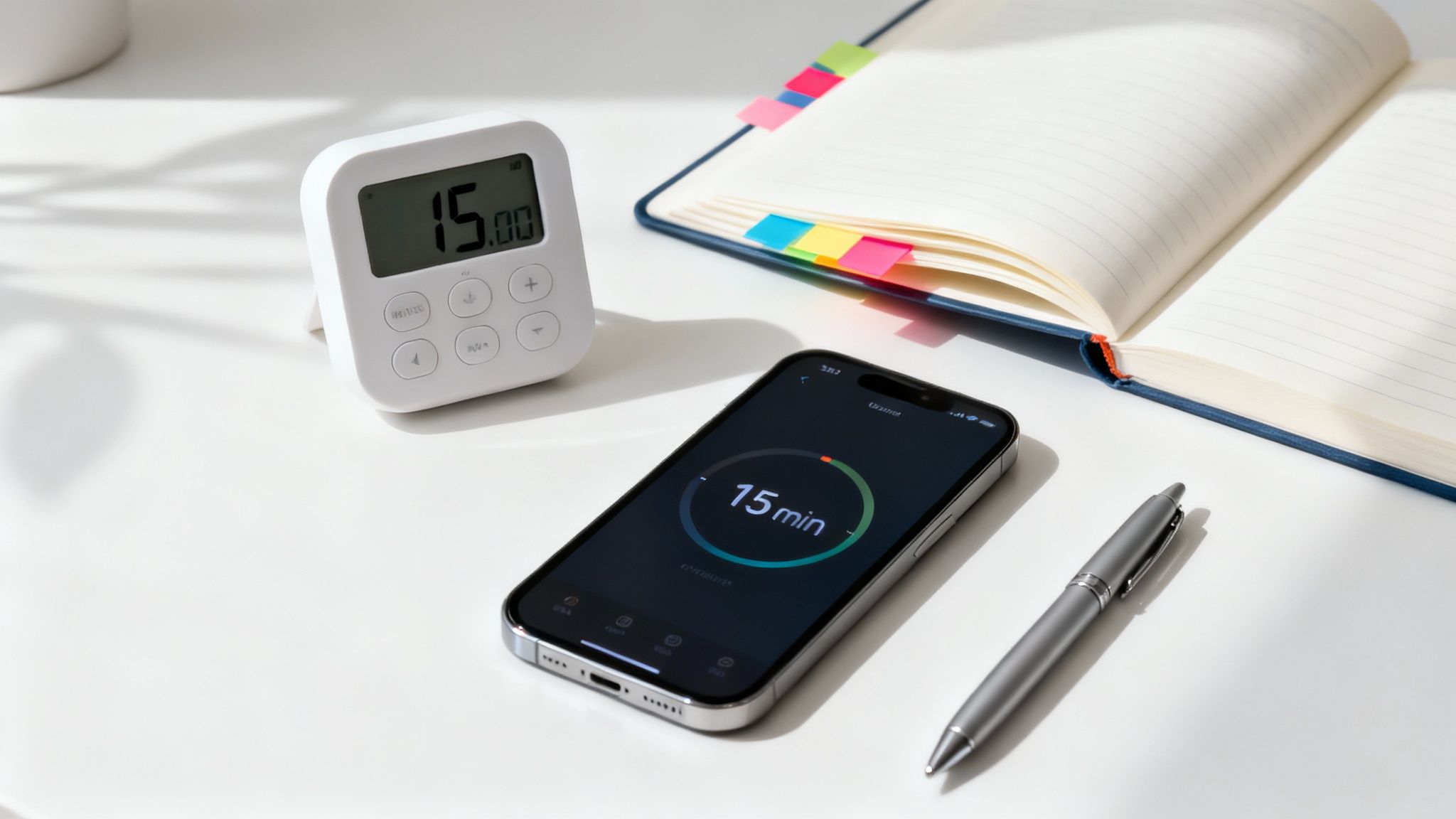
The goal is to leverage short bursts of hyperfocus while avoiding the mental burnout that comes from trying to concentrate for too long. Instead of a marathon study session that leaves you exhausted, you engage in a series of manageable sprints.
How It Works for ADHD Brains
This method directly addresses executive function challenges common with ADHD, such as task initiation and sustained focus. The short, defined interval makes starting a task feel less overwhelming. Knowing a break is just a few minutes away provides a built-in reward, which helps maintain motivation and dopamine levels.
A college student, for instance, might use 15-minute intervals to write an essay. Instead of facing a daunting two-hour block, they tackle eight small, achievable 15-minute segments, making the entire process feel more manageable and less prone to procrastination.
Key Insight: The modified Pomodoro Technique transforms overwhelming tasks into a series of small wins, creating momentum and reducing the anxiety often associated with studying.
Actionable Tips for Implementation
Start Small: Begin with 10- or 15-minute focus intervals and 5-minute breaks. You can gradually increase the time as you build your focus stamina.
Use Visual Timers: A visual timer, like those found in many productivity apps, shows time passing, which is often more helpful for ADHD brains than a simple digital countdown. For more helpful tools, explore some of the best productivity apps for ADHD.
Move During Breaks: Use your 5-minute breaks for physical activity. Stretching, jumping jacks, or a quick walk can reset your brain and boost focus for the next interval.
Track Your Sprints: Use a notepad or a simple app to check off each completed "Pomodoro." This visual proof of progress is incredibly motivating.
Speak4Me Integration: Supercharge your focus sprints by having Speak4Me read your study materials aloud. This assists with the cognitive load of reading and can help you absorb information more effectively. Listen at 1.5x or 2x speed to cover more material within your timed interval.
Ready to make studying less of a battle? Download Speak4Me free on iOS and turn your study material into audio you can conquer in short, focused bursts.
2. Body Doubling (Parallel Working)
Body doubling is a productivity strategy where you work alongside another person, either physically or virtually, who is also focused on their own tasks. This simple presence creates a sense of gentle accountability and social motivation. It's one of the most powerful study strategies for ADHD because it uses the brain's responsiveness to external social cues to help initiate and sustain focus, making solitary tasks feel less isolating and overwhelming.
The goal is not collaboration but parallel work. The other person acts as an "anchor," helping you stay on track simply by being there. This external support helps quiet the internal distractions that often derail a study session.
How It Works for ADHD Brains
This method directly counters executive function challenges like task initiation and distractibility. The presence of a "body double" provides a low-pressure form of accountability that can make starting a dreaded assignment much easier. It creates an environment of shared focus, which can be calming and help mirror productive behavior.
For example, two university students with ADHD might meet at the library to work on different assignments. They don't talk or help each other, but the shared silent purpose helps both of them stay focused for longer than they would alone. Similarly, remote workers use platforms like Focusmate for virtual sessions to achieve the same effect.
Key Insight: Body doubling turns the abstract goal of "studying" into a concrete, scheduled event with a social component, making it easier to commit to and follow through on.
Actionable Tips for Implementation
Set Clear Expectations: Before starting, agree on the rules. Will the session be completely silent? Are brief check-ins okay? This prevents misunderstandings.
Use Virtual Platforms: Explore services like Focusmate or Flow Club for structured virtual body doubling sessions with people from around the world.
State Your Goals: Begin each session by telling your partner what you plan to accomplish. This simple act increases your commitment and provides a clear objective.
Find Your Space: For in-person sessions, choose a location that minimizes distractions, like a quiet corner of a library, a coffee shop during off-hours, or a dedicated co-working space.
Speak4Me Integration: During a body doubling session, use Speak4Me with headphones to have your textbooks or research articles read aloud. This allows you to absorb material audibly while still benefiting from the visual presence of your study partner, creating a multi-sensory learning experience that supports focus.
Ready to find your focus anchor? Download Speak4Me free on iOS and pair powerful auditory learning with the accountability of a study partner.
3. Active Recall with Multisensory Engagement
Active recall is a powerful learning method where you actively retrieve information from your memory instead of passively rereading it. This technique gets a crucial upgrade for the ADHD brain when combined with multisensory engagement, which involves using movement, sound, and touch. This approach is one of the most effective study strategies for ADHD because it turns studying into an active, stimulating experience that holds attention and strengthens memory.

The goal is to engage different parts of your brain simultaneously, creating stronger neural pathways for the information you're learning. By moving, speaking, or manipulating objects while studying, you satisfy the ADHD brain’s need for novelty and stimulation, making it easier to stay focused and encode information.
How It Works for ADHD Brains
This strategy directly supports ADHD-related challenges with working memory and sustained attention. Passively reading text can quickly lead to zoning out, but actively recalling information while pacing or gesturing keeps the brain engaged. This dual stimulation helps prevent under-stimulation and boredom, which are common triggers for distraction.
For example, a history student could create a physical timeline on their floor with index cards. By walking along the timeline and explaining the events aloud, they combine movement (kinesthetic), speech (auditory), and sight (visual), making the connections between events more concrete and memorable.
Key Insight: Combining active recall with physical movement transforms studying from a passive, boring task into an engaging, full-body experience that improves focus and retention.
Actionable Tips for Implementation
Walk and Talk: Pace around your room while explaining a concept aloud as if you were teaching it to someone else.
Use Gestures: Create hand gestures or full-body movements to represent key vocabulary words or complex ideas. For example, act out a biological process.
Draw from Memory: Read about a topic, then put your notes away and try to draw the concept or diagram from memory on a whiteboard.
Teach an Audience: Explain what you've learned to a pet, a plant, or even an imaginary classroom. The act of verbalizing solidifies your understanding. To explore more memory-boosting techniques, you can learn how to retain information better.
Speak4Me Integration: Use Speak4Me to create your own active recall prompts. Record yourself asking questions about your study material, then play the audio back and pause after each question to answer it aloud. This creates a dynamic, self-testing study session you can do anywhere.
Ready to make your study sessions more active and effective? Download Speak4Me free on iOS and create custom audio quizzes that keep your brain engaged.
4. The 2-Minute Rule and Task Chunking
This dual strategy combines two powerful concepts to dismantle procrastination at its source. The 2-Minute Rule, popularized by David Allen, states that if a task takes less than two minutes to complete, you should do it immediately. Task chunking involves breaking down large, intimidating projects into their smallest possible components, making each step feel ridiculously easy to start.

For the ADHD brain, this combination is a game-changer. It directly combats the task initiation paralysis that often comes from feeling overwhelmed. By making the first step absurdly small and actionable, you remove the mental barrier to getting started.
How It Works for ADHD Brains
This method short-circuits executive dysfunction by eliminating the complex decision-making process of how to begin. Instead of facing a vague goal like "write thesis chapter," you're presented with a clear, simple action like "open the document." This creates immediate momentum and provides a quick dopamine hit from completing a task, no matter how small.
A high school student might chunk "study for biology test" into tiny tasks like "review 5 vocabulary terms" and "read 2 pages of notes." Each action is a separate, achievable goal, reducing the anxiety that triggers avoidance and making it one of the most practical study strategies for ADHD.
Key Insight: By making tasks too small to fail, you trick your brain into starting. This momentum often carries you through several more chunks than you originally planned.
Actionable Tips for Implementation
Make Chunks Absurdly Small: If you still feel resistance, your chunks aren't small enough. "Write essay" becomes "open document," then "write one sentence," then "find one source."
Use Specific Action Verbs: Define your chunks with clear actions. Instead of "work on paper," use "write introduction paragraph" or "outline section one."
Create a "Task Parking Lot": When a small, distracting task pops into your head during a study session, write it down on a separate list to tackle later. This keeps you focused without losing the idea.
Combine with Pomodoro: A single 15-minute focus interval can be used to complete two or three small chunks, creating a powerful sense of accomplishment.
Speak4Me Integration: Use Speak4Me to quickly process small chunks of reading. Have it read a 2-page section of your textbook or a short article you found for research. This turns a reading chunk into a low-effort listening task, helping you check off more items on your list with less cognitive strain.
Ready to break down overwhelming study tasks into simple, manageable steps? Download Speak4Me free on iOS and listen your way through your task list, one chunk at a time.
5. External Working Memory Systems (Second Brain)
An external working memory system, often called a "second brain," is a strategy where you offload thoughts, tasks, and information onto an external platform instead of relying on your own memory. This method is one of the most powerful study strategies for ADHD because it directly assists with working memory deficits, a core challenge of ADHD. It frees up your cognitive resources to focus on learning and problem-solving, not just remembering.
The goal is to create a trusted, centralized hub for everything you need to track. This reduces the mental clutter and anxiety that comes from trying to hold deadlines, ideas, and to-do lists in your head, preventing important information from slipping through the cracks.
How It Works for ADHD Brains
This strategy provides the external structure that ADHD brains often crave. By immediately capturing information, you bypass the working memory bottleneck that makes it hard to hold and manipulate multiple pieces of information. This system acts as a reliable scaffold, supporting executive functions like planning, organization, and task initiation.
A law student, for example, might use a tool like Notion to create a database for all their case briefs, lecture notes, and assignment deadlines. Instead of panicking about what's due, they can trust their system to remind them, allowing them to focus fully on understanding complex legal concepts.
Key Insight: A second brain doesn't just store information; it creates a reliable external executive function partner, reducing cognitive load and building confidence in your ability to manage your academic life.
Actionable Tips for Implementation
Choose One System: Pick one primary tool (like a notebook, Todoist, or Notion) and commit to it. Consistency is more important than finding the "perfect" app.
Capture Everything, Instantly: Make a habit of writing down or dictating any task, idea, or deadline the moment it occurs. The faster the capture, the more likely you are to use the system.
Use Voice-to-Text: Leverage your phone's voice-to-text feature for the quickest possible capture of fleeting thoughts or complex ideas without stopping what you're doing.
Schedule Daily Reviews: Set aside 10-15 minutes each day to review and organize what you've captured. This turns a random collection of notes into an actionable plan. For more ways to improve recall, explore these memory techniques for studying.
Speak4Me Integration: Use Speak4Me as your primary capture tool. Quickly record voice notes for ideas, assignment details, or summaries of what you just read. Later, listen back to these notes to process and organize them into your main second brain system, ensuring no brilliant thought is ever lost.
Ready to build a system you can finally trust? Download Speak4Me free on iOS and start capturing your thoughts effortlessly to build your second brain.
6. Interest-Based Nervous System Approach (IBNS Study Matching)
The term "attention deficit" can be misleading. Many experts, like Dr. William Dodson, suggest the ADHD brain operates on an "Interest-Based Nervous System." This means focus isn't determined by importance but by genuine interest, novelty, challenge, or urgency. This approach is one of the most powerful study strategies for ADHD because it stops you from fighting your brain and starts leveraging its natural motivation system.
Instead of forcing yourself through traditional study methods, you design a system that aligns with these neurological triggers. The goal is to make the material engaging enough that your brain wants to pay attention, activating a state of hyperfocus on demand.
How It Works for ADHD Brains
This strategy directly tackles the core ADHD challenge of motivation and task initiation. When a task is boring, the ADHD brain struggles to produce enough dopamine to get started and stay engaged. By linking study material to your interests or creating artificial urgency, you essentially create the neurochemical conditions needed for focus.
For example, a history student might reframe ancient battles as strategic video game campaigns, connecting dry facts to a passionate interest and boosting retention. A biology student could set up a reward system where completing a chapter unlocks thirty minutes of a favorite hobby, creating an immediate and compelling incentive.
Key Insight: IBNS Study Matching reframes studying from a chore into a challenge or a game, tapping into the ADHD brain's natural reward-seeking behavior to drive engagement and learning.
Actionable Tips for Implementation
Identify Your Triggers: Determine what motivates you most: novelty, passion, competition, or urgency. Design your study sessions around these specific triggers.
Create Artificial Urgency: Set short, self-imposed deadlines. Schedule a study session where you have to "teach" the material to a friend, creating accountability.
Connect to Passions: Find a way to link the subject matter to something you already love. Relate physics concepts to your favorite sci-fi movie or economic theories to your online business idea.
Gamify Your Learning: Use apps like Habitica to turn study tasks into a role-playing game. Set up timed challenges with classmates to see who can solve problems the fastest.
Speak4Me Integration: Add a powerful layer of novelty by having Speak4Me read your notes or textbooks in different voices and speeds. This simple change can make familiar material feel new again, recapturing your brain’s interest. Turn a tedious reading assignment into an engaging podcast-style listening session.
Ready to align your studies with your brain's natural strengths? Download Speak4Me free on iOS and transform any text into audio that sparks your interest.
7. Implementation Intentions and Visual Cue Systems
This strategy combines specific "if-then" planning with environmental triggers to bypass the ADHD brain's executive function challenges. Implementation intentions are pre-made decisions in the format, "When X happens, I will do Y." This removes the need for in-the-moment decision-making, which can be a major hurdle when you have ADHD.
By pairing these intentions with visual cues in your environment, you design a system that prompts desired behaviors automatically. This is one of the most powerful study strategies for ADHD because it makes studying feel less dependent on willpower and motivation, which can be inconsistent. You’re essentially outsourcing the reminders to your environment.
How It Works for ADHD Brains
This method directly supports weak executive functions like task initiation, planning, and working memory. An implementation intention automates your response to a specific cue, reducing the mental energy needed to start studying. The visual cue acts as a physical, external reminder, ensuring the plan isn't forgotten.
For example, a student might create the intention: "When my 8 PM alarm sounds, I will go to my designated study corner." They then pre-arrange their textbooks and laptop in that corner. The alarm is the trigger, and the visible materials remove the friction of getting started, making the transition into study mode nearly seamless.
Key Insight: This system creates automatic behavioral triggers that don't rely on memory or motivation. Your environment does the heavy lifting, prompting you to follow through on your study goals.
Actionable Tips for Implementation
Be Specific: Write your intentions in the "When [situation], I will [action]" format. For instance, "When I finish breakfast, I will immediately open my history textbook."
Stack Your Habits: Attach a new study habit to an existing, solid routine. If you always have a cup of coffee in the morning, your intention could be, "When I pour my coffee, I will review my class notes for 10 minutes."
Use Physical Triggers: Place visual cues where you will physically encounter them. Put your textbook on your chair so you have to move it to sit down, or place your flashcards on top of your phone.
Color-Code Your System: Assign a different color to each subject for folders, notes, and pens. This creates an instant visual association that helps with organization and recall.
Speak4Me Integration: Create an implementation intention around listening. For example, "When I get on the bus for my commute, I will open Speak4Me and listen to my psychology lecture notes." This turns downtime into productive, automated study sessions, helping you stay on top of your coursework with minimal effort.
Ready to build an environment that supports your focus? Download Speak4Me free on iOS and create automatic listening habits that make studying easier.
8. Movement-Integrated Learning (Kinesthetic Study)
Instead of fighting the urge to fidget or move, Movement-Integrated Learning embraces it as a fundamental tool for focus. This approach intentionally incorporates physical activity into study sessions, recognizing that for many with ADHD, movement is not a distraction but a requirement for attention regulation and information processing. It's one of the most powerful study strategies for ADHD because it aligns with the nervous system's need for stimulation to stay engaged.
This method transforms passive learning into an active, whole-body experience. By channeling the need for physical output, the brain is freed up to concentrate, absorb, and retain information more effectively.
How It Works for ADHD Brains
Kinesthetic learning directly supports the ADHD brain's executive functions by boosting dopamine and norepinephrine, neurotransmitters crucial for focus and alertness. Physical activity helps regulate the brain's arousal system, preventing the under-stimulation that leads to distraction and procrastination. The movement provides a constant, low-level sensory input that satisfies the brain's craving for stimulation, allowing the cognitive parts of the brain to focus on the academic task.
A law student, for example, might read dense legal cases while walking slowly on a treadmill. This simple act of movement can extend their focus from a frustrating 20 minutes to a productive 90-minute session, simply because their brain's need for physical engagement is being met.
Key Insight: For the ADHD brain, sitting still can be more distracting than moving. Integrating controlled physical activity is a strategy to fuel focus, not hinder it.
Actionable Tips for Implementation
Pace and Recite: When memorizing facts, vocabulary, or formulas, walk around your room and recite the information aloud.
Use Active Seating: Swap your static chair for an exercise ball or a wobble stool to allow for subtle, continuous movement while you work at your desk.
Try Tactile Fidgets: Use fidgets that don't require visual attention, like putty, spinner rings, or textured stones, to keep your hands busy and your mind focused.
Schedule Movement Bursts: Set a timer to do 2-5 minutes of high-intensity exercise like jumping jacks or push-ups between study blocks to reset your attention.
Speak4Me Integration: Combine movement with auditory learning for maximum effect. Have Speak4Me read your notes or textbook chapters while you walk, stretch, or use a stationary bike. This allows you to absorb course material while satisfying your brain’s need for physical activity, making study sessions more sustainable and productive.
Ready to turn restless energy into academic success? Download Speak4Me free on iOS and listen to your study materials on the move.
Study Strategies for ADHD: Side-by-Side Comparison
Technique | Implementation Complexity 🔄 | Resource Requirements ⚡ | Expected Outcomes 📊 | Ideal Use Cases 💡 | Key Advantages ⭐ |
|---|---|---|---|---|---|
Pomodoro Technique with ADHD Modifications | Moderate - requires consistent timer setup and adjustment 🔄 | Low - timer app or device | Increased focus in short bursts; reduced procrastination 📊 | Tasks overwhelming in long blocks; maintaining study rhythm | Manages overwhelm; prevents burnout; external time structure ⭐ |
Body Doubling (Parallel Working) | Low to Moderate - coordinating partner/schedule 🔄 | Medium - requires partner or app | Improved task initiation; sustained focus; reduced isolation 📊 | Overcoming task paralysis; boring or tedious tasks | Gentle accountability; reduces loneliness ⭐ |
Active Recall with Multisensory Engagement | Moderate - planning multisensory methods 🔄 | Low to Medium - materials plus space | Stronger memory retention; engagement; focus maintenance 📊 | Memorization-heavy subjects; exam prep; combating passive study | Enhances memory; engages multiple senses; active learning ⭐ |
The 2-Minute Rule and Task Chunking | Low to Moderate - upfront task breakdown and planning 🔄 | Low - planner or note system | Increased momentum; reduced overwhelm; frequent task completions 📊 | Large projects; overcoming procrastination | Lowers initiation barrier; builds confidence; simple wins ⭐ |
External Working Memory Systems (Second Brain) | Moderate to High - system setup and maintenance 🔄 | Medium - apps, notebooks | Reduced anxiety; reliable task tracking; frees cognitive load 📊 | Managing complex schedules; multiple projects; memory deficits | Eliminates mental burden; centralizes info; prevents forgetfulness ⭐ |
Interest-Based Nervous System Approach (IBNS) | High - requires self-awareness and creative adaptation 🔄 | Low to Medium - tools for gamification or novelty | Increased motivation; sustainable engagement; reduced procrastination 📊 | Difficult or boring subjects; chronic procrastination | Works with ADHD wiring; boosts intrinsic motivation ⭐ |
Implementation Intentions and Visual Cue Systems | Moderate - upfront effort on planning and environment setup 🔄 | Low to Medium - visual cues, planners | Automatic behavioral triggers; reduced decision fatigue 📊 | Building routines; overcoming initiation problems | Reduces reliance on willpower; prevents forgotten tasks ⭐ |
Movement-Integrated Learning (Kinesthetic Study) | Moderate - requires space and movement integration 🔄 | Low to Medium - fidgets, alternative furniture | Improved focus; dopamine regulation; better retention 📊 | Managing hyperactivity; memorization; problem-solving | Channels energy productively; supports nervous system regulation ⭐ |
Start Studying Smarter, Not Harder, Today
Navigating academia with ADHD can feel like an uphill battle, but it doesn't have to be. The eight powerful study strategies for ADHD we’ve explored are not just simple tips; they are frameworks designed to work with your brain's unique wiring, not against it. By moving beyond generic advice, you can build a personalized toolkit that transforms overwhelming study sessions into manageable, productive periods of learning.
The journey to effective studying begins with experimentation and self-compassion. Whether it’s the structured focus of a modified Pomodoro session, the quiet accountability of body doubling, or the dynamic engagement of movement-integrated learning, each method offers a new way to approach your work. Remember, the goal isn't to force your brain to study like everyone else. It's to find the specific combination of tools and environments that allows your natural curiosity and intelligence to shine.
Key Takeaways for Lasting Success
Mastering these concepts is about more than just better grades; it's about building sustainable habits that reduce stress and boost confidence. Here are the most important takeaways to carry forward:
Embrace Your Brain's Needs: Stop fighting your natural tendencies. If you need to move, try kinesthetic study. If you get distracted easily, use the 2-Minute Rule to get started. Honoring your brain’s need for novelty, interest, and movement is the first step.
Externalize Everything: Your working memory is a precious, limited resource. Use external systems like digital notes, visual cues, and implementation intentions to offload the mental burden of remembering what to do, when, and how. This frees up cognitive energy for actual learning.
Make Learning Active and Multisensory: Passive reading is rarely effective for an ADHD brain. Techniques like Active Recall, paired with auditory tools like Speak4Me, engage multiple senses. This creates stronger neural pathways, making information easier to remember and understand.
By consistently applying these study strategies for ADHD, you are not just studying for an exam; you are building a foundation for lifelong learning. You are proving to yourself that you are capable, resilient, and fully equipped to succeed. The next step is to choose one strategy from this list and try it during your next study block. Don't aim for perfection, just progress.
Ready to enhance your focus and make studying more accessible? Speak4Me can transform any text into clear, high-quality audio, supporting multisensory learning and helping you absorb information on your terms. Download Speak4Me free on iOS and start listening your way to better grades today.
Try Speak4Me for Free
