Your Guide to Text to Speech AI Voice Technology

Ever had a long article you wished you could just listen to instead of read? That’s the simple idea behind a text to speech AI voice. It’s a smart digital narrator that can read any text out loud, but with a human-like touch that makes it incredibly natural and easy to listen to.
What Is a Text to Speech AI Voice
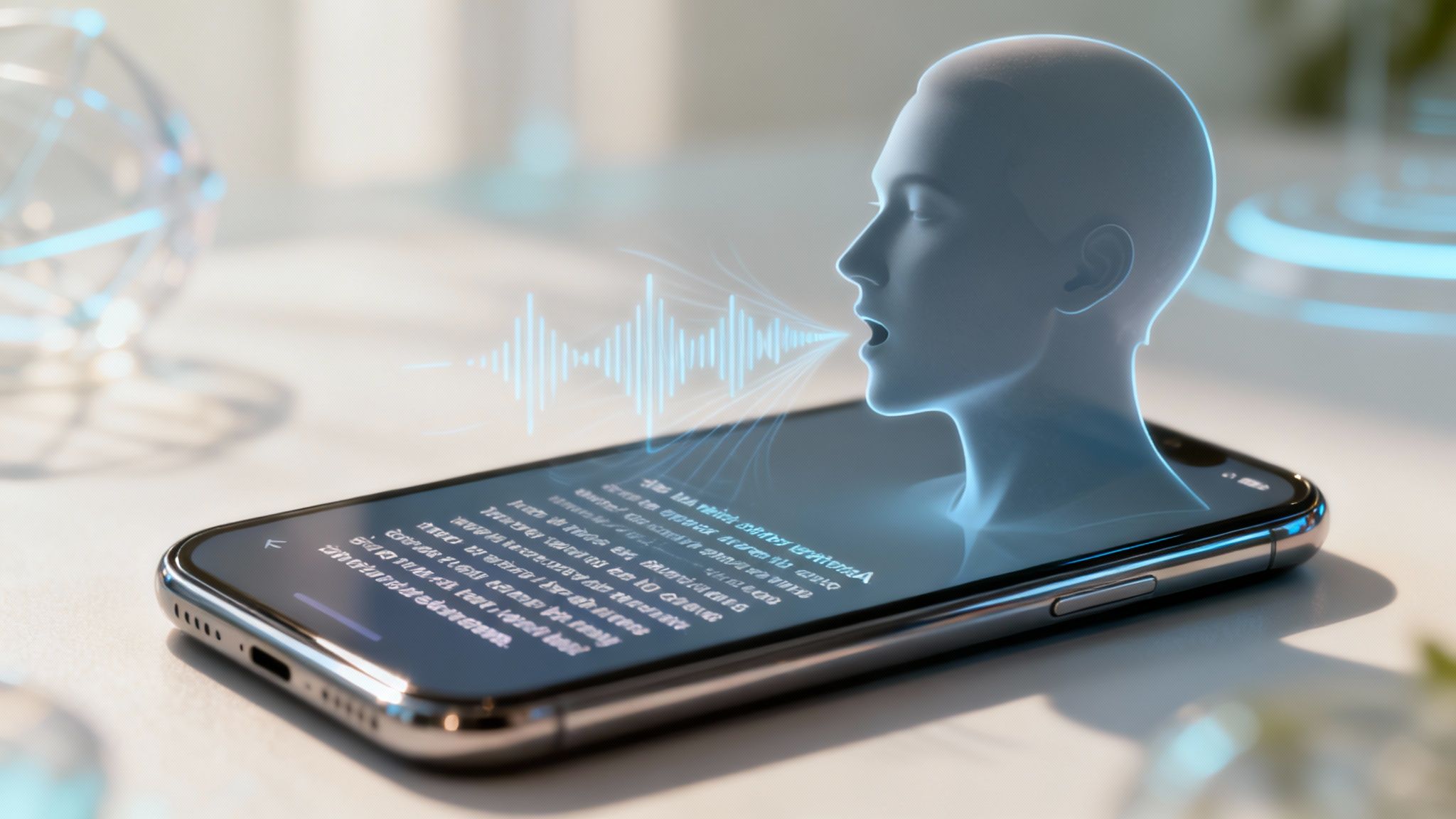
Think back to the old, clunky computer voices of the past—flat, robotic, and hard to follow. Today's AI-powered voices are a world away from that. They don't just pronounce words one by one; they actually understand them in context.
By analyzing punctuation, sentence structure, and the surrounding text, the AI can add the right inflection, pauses, and emotional tone. The end result is audio that sounds less like a machine and more like a person having a conversation with you.
Beyond Simple Reading
The real magic here is the AI's ability to interpret meaning. This is what elevates modern text-to-speech from a novelty to a genuinely useful tool for everyday life.
To get a better sense of the mechanics, it helps to understand what text to speech technology is and how it works. In a nutshell, sophisticated algorithms break text down into its basic phonetic sounds and then intelligently stitch them back together into smooth, fluid speech.
This is how an app like Speak4Me can tackle almost any kind of content you throw at it. Whether it's a dense technical document, a casual blog post, or a critical work email, the AI voice adjusts its delivery to fit the material, making it easier and more pleasant to absorb information.
Key Features of Modern Text to Speech AI Voice Systems
So, what separates a great AI voice from a basic text reader? It comes down to a few core capabilities that are now standard in high-quality systems. This table gives a quick rundown of what makes them so effective.
Feature | Description | Primary Benefit |
|---|---|---|
Natural Intonation | The voice's pitch rises and falls naturally, just like in human conversation. | Makes listening more engaging and less fatiguing. |
Contextual Awareness | The AI can tell the difference between a question and a statement, adjusting its tone. | Ensures the correct meaning of the text is always conveyed. |
Emotional Nuance | In stories or articles, the voice can add subtle tones like excitement or seriousness. | Creates a more immersive and compelling listening experience. |
Multi-Language Support | Top-tier systems can speak multiple languages and accents with authentic pronunciation. | Makes content accessible to a global audience. |
These features work together to create an audio experience that feels authentic and human.
By turning text into natural-sounding audio, a text to speech AI voice opens up new ways to learn, multitask, and stay informed without being glued to a screen.
This isn't some far-off concept anymore; it's a practical tool you can use right on your phone. It’s perfect for different learning styles, supports those with reading difficulties, and gives busy people a way to stay productive on the go. The goal is simple: make information accessible to everyone, everywhere. Ready to experience it? Download Speak4Me free on iOS and hear the difference.
How AI Learns to Speak Naturally
Have you ever wondered how a text to speech AI voice can sound so convincingly human? It’s not magic. It’s a fascinating learning process, much like how a person learns to read a story aloud with real feeling and expression. It’s a journey from simply seeing words on a page to creating nuanced, audible speech.
The very first step is something called Natural Language Processing (NLP). Before an AI can even think about speaking, it has to understand. NLP is the AI's brain, letting it break down sentences to get the real meaning—the grammar, the feeling, and the context. This is how the AI knows the difference between "I read that book" (past tense) and "I will read that book" (future tense), and can adjust its delivery to match.
From Understanding to Generation
Once the AI gets what the text is about, the next phase kicks in: speech synthesis. This is where powerful neural networks do the heavy lifting. Think of these as complex systems trained on enormous libraries of human speech. They analyze countless hours of audio from real people, learning all the subtle patterns of pitch, tone, and pace that make a voice sound engaging instead of flat.
This two-step process is the secret sauce. It’s what prevents that dreaded robotic monotone and instead produces speech that is genuinely expressive. It can handle tricky sentences and even pick up on the emotional cues buried in the writing. If you're curious about the finer details, you can explore our guide on achieving a more natural sounding text-to-speech output.
This visual breaks down the core two-stage process that powers the AI voices we hear today.
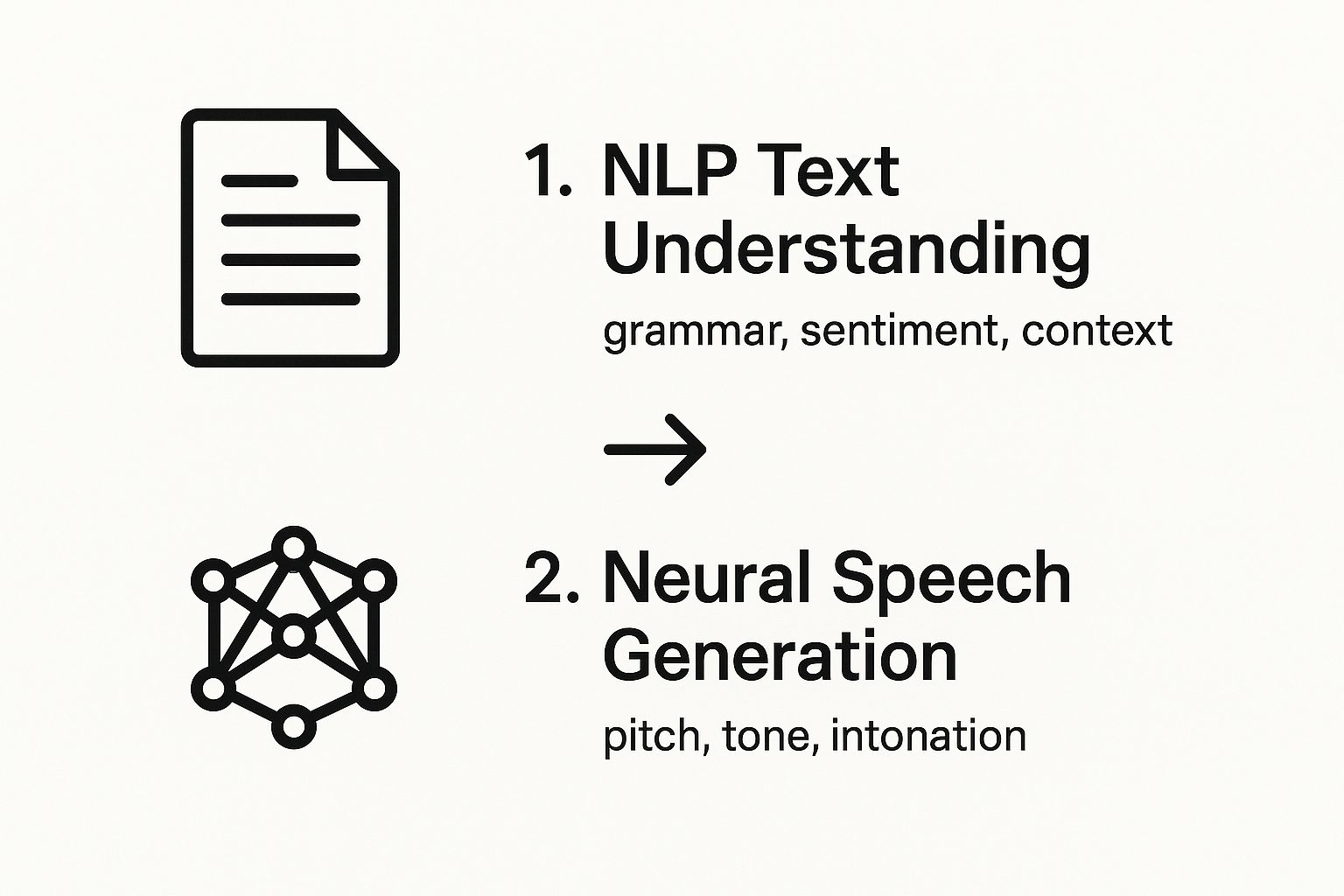
As you can see, it's that powerful combination of deep text comprehension and advanced audio generation that creates a truly human-like voice.
The Technology Behind the Voice
This incredible capability is driving huge growth. By 2025, the global TTS market is expected to hit USD 3.97 billion, and it's projected to rocket to USD 8.32 billion by 2030. That’s a staggering growth rate of 15.96%. This boom is all thanks to new neural models that can produce more emotionally rich speech, making the listening experience so much better. Making an AI's output feel natural is a major focus, which often involves rewriting AI text to sound human to properly convey intent.
The goal is no longer just to read words aloud, but to communicate the meaning and emotion behind them. This is what separates modern AI voices from their predecessors.
This is exactly how an app like Speak4Me can tackle anything you throw at it, from a quick email to a dense academic paper, and deliver it with clarity. The AI interprets the purpose of the text and creates a compelling audio experience every single time.
So, what are the key ingredients in this learning process?
Phoneme Prediction: The AI learns to break words into their smallest sound units (phonemes) to get the pronunciation just right.
Prosody Modeling: This is all about learning the rhythm, stress, and intonation of natural speech. It's what makes the voice flow smoothly instead of sounding choppy.
Emotional Synthesis: By analyzing the text for sentiment, the AI can add subtle emotional tones—like a hint of excitement for an exclamation point or a more serious tone for a formal document.
Ultimately, this training turns static text into a dynamic audio experience, making information easier to consume and more accessible for everyone. The technology just keeps getting better, with AI voices that are becoming almost impossible to distinguish from a human narrator.
Putting AI Voices to Work in Your Daily Life
The idea of a text to speech AI voice might sound a bit sci-fi, but the reality is that it’s already part of daily life for millions of people. This isn't just niche tech anymore; it's a genuinely useful tool that can help you get more done, learn better, and access information in a whole new way.
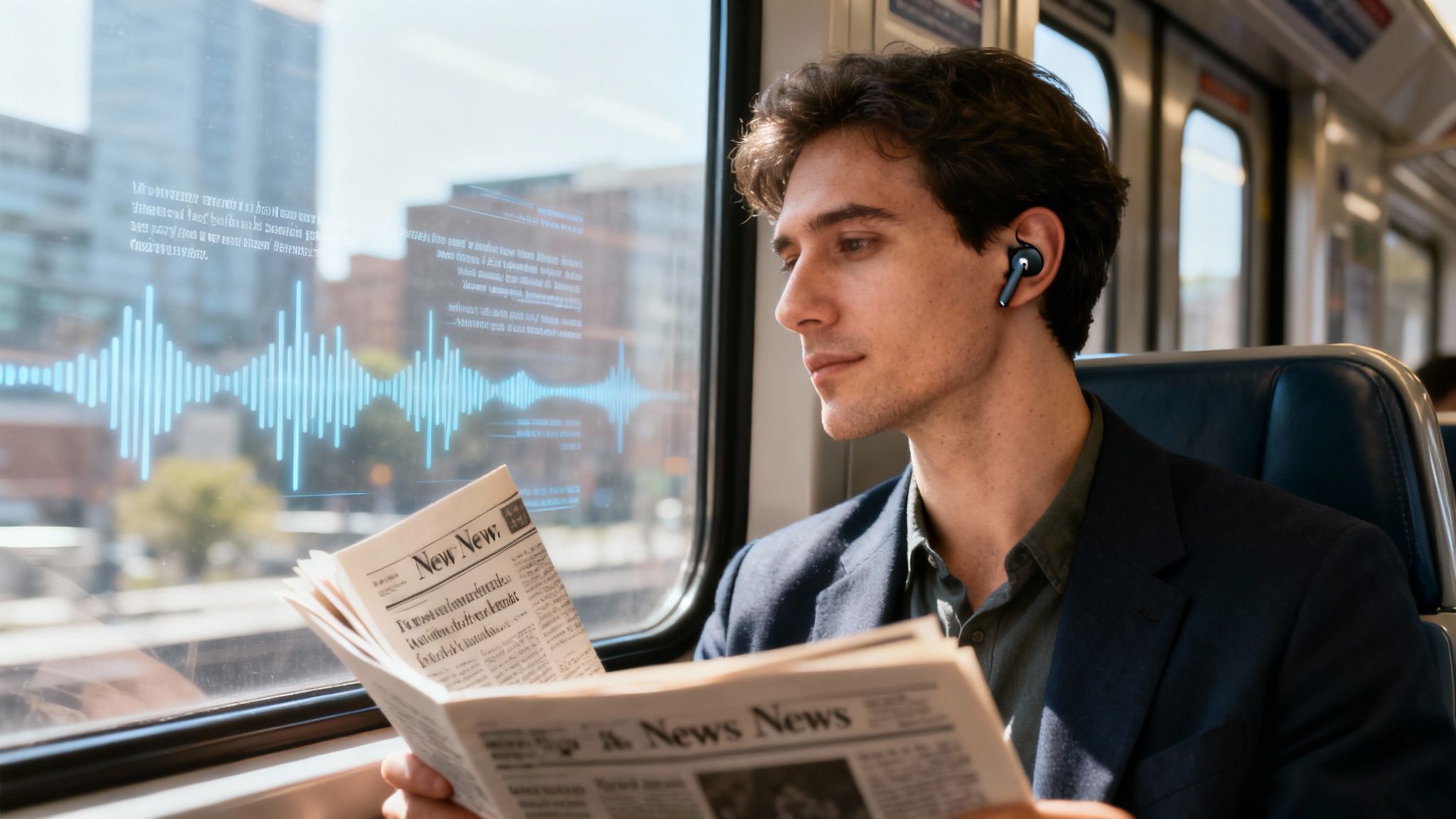
Think about your morning commute. Instead of trying to skim headlines while stuck in traffic, what if you could just listen to them? Or when you’re making dinner, you could have a work email or that new recipe read out loud, keeping your hands and eyes free. These are the small, practical ways AI voices are already making a difference.
Unlocking Productivity and Multitasking
Let's be honest, we all have parts of our day where our eyes are busy but our minds aren't—driving, working out, or doing chores. This is prime time for text-to-speech. It lets you consume content without having to stare at a screen.
With an app like Speak4Me, you can transform any written text into your own personal podcast. Long reports, articles you bookmarked for later, even pages from a physical book—they can all become audio. It’s a fantastic way to fly through your reading list and absorb information while you’re on the move.
A Powerful Tool for Learning and Accessibility
Beyond simple convenience, a text to speech AI voice is a critical tool for accessibility. For anyone with a visual impairment, it’s a direct line to the written word, opening up digital content that would otherwise be inaccessible. It reads websites, books, and messages, fostering independence and equal access to information.
It’s also a game-changer for people with reading difficulties like dyslexia. Hearing text read aloud while you follow along can dramatically improve comprehension and help the information stick. That combination of seeing and hearing the words at the same time reinforces learning, making studying less of a chore and much more effective.
By turning written materials into audio, text-to-speech technology plays to different learning styles and makes education more inclusive. It helps auditory learners shine and gives everyone a break from screen fatigue.
Curious about which tool is right for you? Take a look at our guide to the best text-to-speech tools available to find a perfect match.
For Creators and Professionals
The benefits spill over into the professional world, too. Content creators can produce high-quality voiceovers for videos or e-learning courses without booking a studio or hiring a voice actor. It’s a huge time and money saver, making the entire content creation process much smoother.
The use of AI voice generators is growing fast, thanks in large part to how common they've become in our smartphones and smart speakers. In 2024, 60% of smartphone users were regularly using voice assistants, a big leap from 45% in 2023. This shows just how comfortable people are getting with AI voices.
This comfort level makes it a great option for creating scalable voiceovers for videos and training materials—a solid alternative to hiring traditional voice talent.
Professionals are also discovering another clever use: proofreading. Hearing your own writing read back to you is a surprisingly effective way to catch typos, clunky sentences, and other mistakes your eyes just skim over. It gives you a completely fresh perspective on your own work.
Whether you're a student drowning in research papers, a busy professional juggling a dozen tasks, or a creator trying to make engaging content, a text-to-speech AI voice is a practical solution. It’s all about making your day a little easier and your time a lot more productive.
Ready to see how easily this can fit into your routine? Download Speak4Me free on iOS and start turning your text into speech.
The Future of Digital Voice Technology
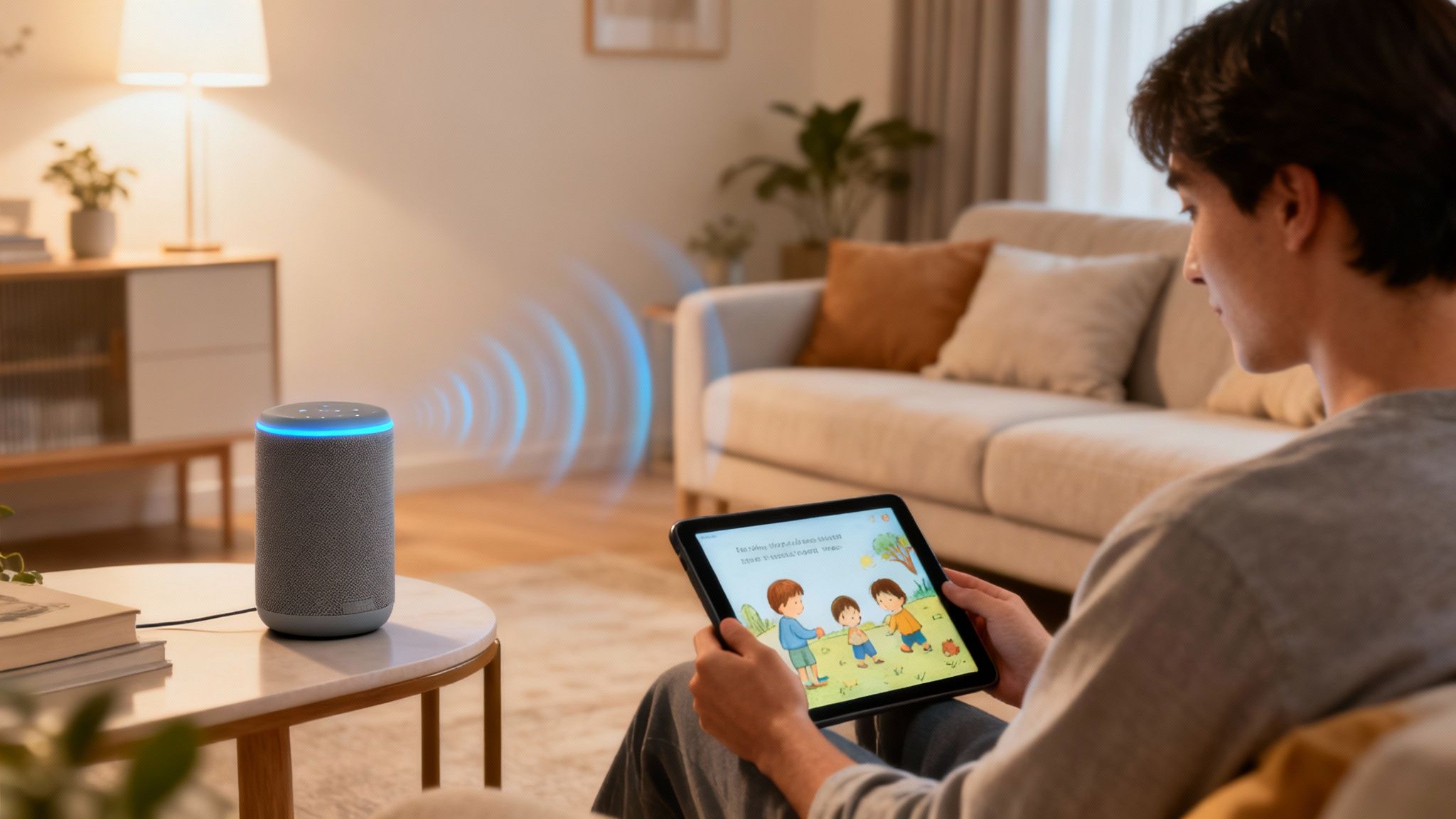
The market for text to speech AI voice technology is growing at a staggering rate, changing the very way we connect with our devices. This isn't just a small step forward; it's a huge leap, kicked into high gear by the explosion of smart devices and a universal need for more accessible content. As technology weaves itself deeper into our lives, the demand for a natural, effortless voice interface has become undeniable.
The numbers really tell the story. The global text-to-speech market was valued at around USD 4.0 billion in 2024 and is expected to hit USD 7.6 billion by 2029. That's a compound annual growth rate of 13.7%. This boom is powered by everything from smart speakers and government-backed accessible education programs to the integration of TTS into our cars and business software. You can discover more insights about these market projections if you're curious about the data.
From Simple Narration to Real Conversation
So, where is all this heading? The future of voice AI is about much more than just making voices sound human. It's about making them emotionally aware. The next generation of TTS will be defined by its knack for understanding context and shifting its vocal style to match.
Think about an AI that can read a bedtime story in a gentle, soothing voice, then pivot to a crisp, authoritative tone for a business presentation. That kind of flexibility will make AI voices essential in almost every situation, making it harder and harder to tell the difference between a human and a generated voice.
Key Developments Shaping What's Next
This journey is being fueled by a few key breakthroughs that are redefining what's possible with a text to speech AI voice. These aren't just minor updates; they're game-changers.
Emotional Intelligence: Soon, AI will pick up on subtle emotional cues in a text—like excitement, sarcasm, or worry—and actually reflect them in its speech.
Contextual Awareness: The AI will know the why behind the text. Is it for a training video? A podcast? It will adjust its pacing and tone to fit the audience and situation.
Personalization and Voice Cloning: We're moving toward more control, including the ability to create unique voices from scratch or even clone your own voice for a personalized digital assistant.
Real-Time Adaptation: AI voices will be able to adapt mid-conversation, responding to what you say with a more natural, back-and-forth rhythm.
The end goal is to shift from a one-size-fits-all narrator to a dynamic conversational partner—one that understands not just what to say, but how to say it.
As this technology becomes a standard feature in our cars, homes, and offices, having a powerful TTS tool is no longer a luxury—it's a necessity. Using an app like Speak4Me today puts you right at the front of this wave, giving you instant access to incredibly natural-sounding voices.
Don't just read about the future; hear it for yourself. Get started and explore the next era of voice technology, all from your phone. Download Speak4Me free on iOS and discover the difference.
Key Benefits of Using a TTS App
Bringing a text to speech AI voice into your daily routine offers some surprisingly powerful and immediate perks. It can completely change how you get through your day and manage information.
The biggest win? A serious productivity boost. Think about all that "dead time" in your day—commuting, working out, or cooking dinner. Now you can use it. Instead of just listening to music, you can have articles, reports, or emails read to you, keeping your hands and eyes free for other tasks.
Suddenly, those idle moments become chances to learn or catch up. You could finish your morning news briefing before you even get to your desk or listen to study notes while out for a walk. It’s a simple change that lets you absorb more information in less time, making every minute feel more valuable.
Enhancing Accessibility and Learning
Beyond just getting more done, a good text to speech app is a game-changer for accessibility. For someone with a visual impairment, it’s a vital connection to the digital world, reading everything from websites to personal documents aloud. It's also a fantastic support tool for people with reading challenges like dyslexia, turning text into audio to make comprehension easier and less frustrating.
Listening can also be a powerful way to learn. It taps directly into auditory learning styles, which can help a lot with remembering information. And here’s a pro tip: have your own writing read back to you. It's an amazing way to proofread and catch clunky sentences or typos your eyes just skim over.
Reducing Screen Fatigue and Improving Focus
Let's face it, we spend a ton of time staring at screens. Digital eye strain is a real issue for a lot of us. A text to speech AI voice gives your eyes a much-needed rest from the bright glare of your phone or computer.
By turning long articles or documents into audio, you can absorb all the same information without adding to your screen time. This is not only better for your eyes but can even help you sleep better.
Switching from reading to listening can also help you concentrate. When you're just listening, you cut out a lot of the visual clutter and distractions on your screen, making it easier to really sink into the material. An app like Speak4Me puts all these benefits right at your fingertips, offering a whole new way to interact with the written word.
TTS Voice Quality Comparison
Not all TTS voices are created equal. For years, the robotic, monotone computer voice was what everyone pictured. But modern AI has changed everything, making the listening experience feel incredibly natural.
Here's a quick look at how far we've come:
Attribute | Traditional TTS (Robotic) | Modern Text to Speech AI Voice |
|---|---|---|
Pacing and Flow | Monotone and choppy, often with unnatural pauses. | Varies pace and rhythm to match the text's context. |
Intonation | Flat delivery that lacks any emotional or contextual tone. | Uses rising and falling tones to convey questions or statements. |
Clarity | Can mispronounce complex words or names. | Accurately pronounces a wide vocabulary with near-human precision. |
Engagement | Fatiguing to listen to for more than a few minutes. | Engaging and easy to follow, suitable for long-form content. |
As you can see, the leap in quality is huge. Today's AI voices are smooth, clear, and genuinely pleasant to listen to, which is what makes TTS apps so practical and useful in our daily lives.
Ready to find a smarter, healthier, and more efficient way to get through your reading list? Download Speak4Me free on iOS and start listening today.
How to Start Using a Text to Speech AI Voice
Getting started with a text to speech AI voice is surprisingly simple. You don't need to be a tech wizard; if you can send a text, you have all the skills you need. These tools are designed to be intuitive, putting powerful audio creation in your hands in just a few seconds.
The first step is simply picking the right app. For a smooth start, you can grab an app like Speak4Me right from the App Store. Installation takes a moment, and once it's on your iOS device, you’re ready to roll. There are no confusing settings or hoops to jump through.
Your First Conversion From Text to Audio
Once you open the app, you'll find a clean, straightforward layout. The main feature is front and center: a text box waiting for your words. You can either type directly into it or paste text you've copied from anywhere else—an email, a news article, a PDF, you name it.
With your text in place, just tap a button. The app gets to work instantly, processing the words and playing them back in a clear, natural-sounding voice. This immediate feedback is what makes a text to speech AI voice so useful for everyday life, whether you're quickly proofreading an important email or just want to listen to an article while you're busy with other things.
Here's a quick look at the Speak4Me app page to show you how easy it is to find.
This visual just reinforces how accessible these powerful AI tools have become.
Experiencing the Benefits Firsthand
Honestly, the best way to grasp how helpful this technology is is to try it for yourself. We've talked about all the benefits—from boosting productivity to making information accessible to more people—and an app like Speak4Me is the perfect way to see them in action.
The entire point of modern text-to-speech is to remove barriers. The setup should be effortless so you can focus on what really matters—listening to your content, your way.
Ready to turn your text into audio? Go ahead and Download Speak4Me free on iOS. If you want a bit more detail on the process, check out our guide on how to easily convert text to speech and find a new way to get through your reading list.
Got Questions About AI Voices? We've Got Answers.
As text to speech AI voice technology becomes a part of our daily lives, it's totally normal to be curious about how it all works. Let's clear up some of the most common questions people have.
Why Do New AI Voices Sound So Much Better Than Old Robot Voices?
Think of the difference between a flip book animation and a modern CGI movie. The old-school computer voices used a method called concatenative synthesis, which was basically just cutting and pasting pre-recorded words together. That’s why they always sounded so disjointed and robotic.
Today’s AI voices are built differently. They use smart neural networks to create speech from the ground up. The AI doesn't just read words; it understands the context, the punctuation, and the natural rhythm of a sentence. This allows it to generate speech with realistic emotion and flow, making it sound incredibly human.
Can I Use an AI Voice for My Business or YouTube Channel?
That's a fantastic question, and the answer really boils down to the service's specific rules. Most everyday TTS apps are meant for your own personal use.
Here’s a simple way to think about it:
Personal Use: Listening to an article while you cook, having your emails read aloud, or using an app like Speak4Me for studying.
Commercial Use: Creating a voiceover for an advertisement, a public announcement, or any content you plan to make money from. This usually requires a commercial license to make sure you have the legal rights to the voice.
Rule of thumb? Always double-check the terms and conditions before using an AI voice for any commercial project.
How Can One App Speak So Many Different Languages and Accents?
It all comes down to the training. A great text to speech AI voice learns from massive libraries of audio recorded by native speakers from all over the world. When you select a specific language or accent, the AI taps into that specific training model.
This is what allows the technology to capture the unique pronunciation, cadence, and subtle nuances of each language. The AI knows that the flow of Spanish is completely different from the rhythm of Japanese, for example. It’s how an app like Speak4Me can offer such a rich variety of authentic voices, making content more accessible and engaging for everyone, no matter where they are.
Ready to hear just how clear and convenient a top-tier AI voice can be? Speak4Me puts this incredible technology right in your pocket. Download Speak4Me free on iOS and start listening today.
Try Speak4Me for Free
