Text to Speech Realistic Voices That Sound Human
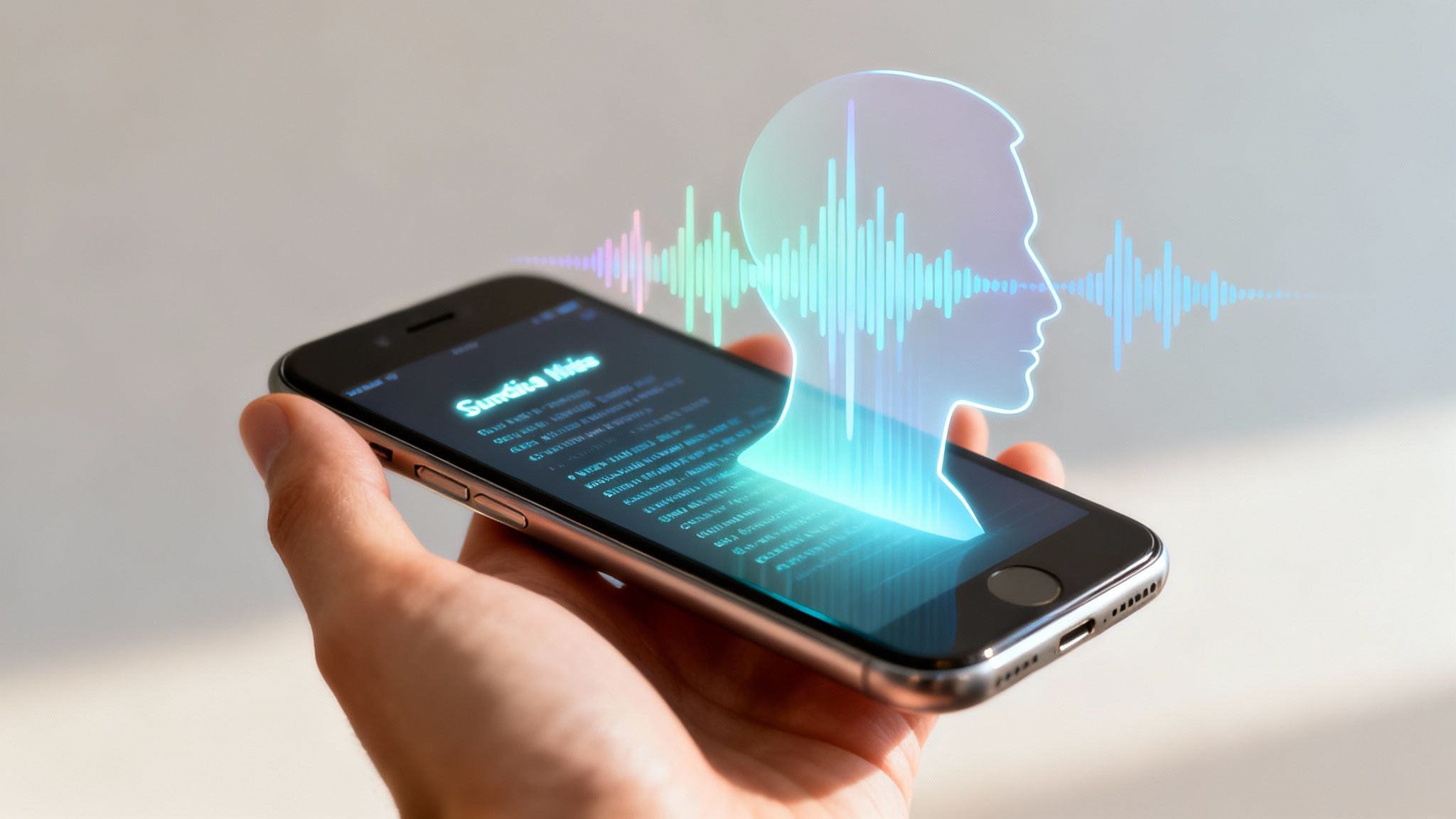
Think back to those clunky, robotic computer voices from not too long ago. Now, forget them. The text to speech realistic voices we have today are so natural they're often impossible to tell apart from a real person. This isn't science fiction; it's the result of advanced AI that can turn simple text into clear, expressive, and incredibly lifelike audio.
The New Era of Digital Voices
The jump from that flat, robotic drone to smooth, human-like narration is a huge deal. Old-school text-to-speech (TTS) systems worked by chopping up and sticking together pre-recorded words. This method, called concatenative synthesis, is why they always sounded so disjointed and lacked any real rhythm or emotion.
Today's technology works in a completely different way, using neural networks and deep learning. Instead of just gluing words together, modern AI models actually learn the subtle details of human speech. They process enormous amounts of audio data to grasp things like pitch, tone, pacing, and the tiny pauses that make a conversation feel authentic.
Beyond Robotic Monotony
This new way of doing things has opened up a world of possibilities. It’s no longer just about making sure words are understandable; it's about giving them personality and expression. A key development in this new era is the emergence of sophisticated AI Voice Agents that can communicate in a truly natural way.
These improvements are completely changing how we interact with digital content. Here are a few key benefits of modern, realistic voices:
Greater Engagement: Let's be honest, lifelike voices are just easier to listen to. They hold your attention way better than a monotone robot, making things like audiobooks and presentations far more interesting.
Improved Accessibility: For anyone with visual impairments or reading difficulties, natural-sounding voices can assist in making information much more pleasant and effective to take in.
Enhanced Productivity: Imagine listening to reports, emails, or study notes while you're on a walk or at the gym. It turns downtime into productive time.
This technology does more than just read words aloud—it turns static text into dynamic, useful audio. It’s about conveying meaning and emotion in a way that actually connects with you.
Putting Advanced Voices in Your Pocket
What used to require heavy-duty computers and specialized software is now available to anyone. Tools like Speak4Me put the power of high-quality voice generation right onto your phone. You can take almost any text—a web article, a PDF, an email—and turn it into engaging audio that sounds surprisingly human.
In this guide, we'll dig into how these voices are created, what features you should look for, and how you can start using them in your everyday life. Of course, the best way to really get it is to hear it for yourself. Go ahead and experience the future of audio by converting some of your own text.
Ready to hear how natural AI can sound? Download Speak4Me free on iOS and give your reading experience a major upgrade.
How AI Learns to Speak Like a Human
Ever wonder what’s going on behind the scenes to make a digital voice sound truly human? It’s not magic, but it’s a lot like training a very gifted student. The old-school text-to-speech systems were clunky. Think of them as cutting up words from a newspaper and pasting them together to make a sentence—it sounded choppy, robotic, and completely unnatural.
Today's AI, however, uses something called neural text-to-speech (TTS), and it's a whole different ballgame. Imagine an AI model that sits and listens to thousands of hours of crystal-clear human speech, all recorded by professional voice actors. It’s not just memorizing words. It's learning the subtle rhythm of conversation, the natural pauses, the emotional tones, and all the little inflections that make speech feel real.
This deep learning process is what allows the AI to generate brand-new audio that flows perfectly, with just the right intonation for whatever text you give it. This is the sophisticated engine that powers the incredibly text to speech realistic voices you find in apps like Speak4Me, turning static words on a page into audio that actually connects with you.
From Data to Dialogue
So, how does it all come together? The journey from a block of text to lifelike speech has a few key stages. It helps to think of it like an actor getting ready for a performance. First, they need the script—that's your text. Then, they need to figure out how to deliver those lines with the right pacing and emotion.
AI follows a similar, but much larger-scale, process. It all boils down to a few critical ingredients:
Massive Datasets: The foundation of any good AI voice is a massive library of high-quality audio. We're talking thousands of hours of recordings from professional voice actors, which gives the AI a deep well of linguistic patterns to draw from.
Neural Networks: These are complex systems, loosely modeled on the human brain, that dig through all that training data. They spot the connections between written words and the actual sounds of speech, learning the unspoken rules of pronunciation, pitch, and rhythm on their own.
Predictive Generation: When you type in some new text, the AI uses everything it’s learned to predict the most natural-sounding way to say it. It then generates a completely unique audio waveform from scratch.
This infographic gives you a good look at the core elements that make a high-quality neural TTS system tick.
As you can see, it's that powerful mix of huge training datasets, a complex model, and a high "naturalness" score that sets modern AI voices leagues apart from their robotic ancestors.
The Growing Demand for Realistic Voices
This incredible leap forward in voice AI certainly hasn't gone unnoticed. The technology is quickly becoming essential in all sorts of industries, from the car you drive to tools that help make content more accessible. The global market for TTS was valued at around USD 3.87 billion and is expected to more than double in the next few years, thanks to its sheer usefulness. This boom is driven by everything from accessibility laws that mandate voice-enabled content to the rise of voice assistants in cars that help drivers keep their eyes on the road. If you're curious about the numbers, you can read the full research on the text-to-speech industry for a deeper dive.
The goal of modern TTS isn't just to be understood; it's to be indistinguishable from human speech. It’s about creating an experience that is natural, pleasant, and emotionally resonant for the listener.
This is exactly why a tool like Speak4Me is so practical. It puts this powerful technology right in your hands, making it easy to create high-quality audio for studying, getting work done, or simply making text easier to consume. The voices are designed from the ground up to be clear, natural, and easy to listen to for hours on end.
But really, hearing is believing. The best way to grasp how far this technology has come is to experience it yourself.
Ready to give it a try? Download Speak4Me free on iOS and transform your text into speech that truly connects.
What to Look for in a TTS Solution
When you're on the hunt for a text-to-speech app, it's easy to get overwhelmed. But not all of them are built the same, especially if your main goal is finding text to speech realistic voices. To make sure you get truly lifelike audio, you need to know which features actually matter.
Think of it like casting a movie. A great voice library is your pool of talented actors, each ready for a specific role. But you're the director, and you need simple, intuitive controls to guide their performance—without needing a sound engineering degree. Let’s break down the key features that bring it all together.
A Diverse and High-Quality Voice Library
The heart of any great TTS tool is its collection of voices. A handful of generic, robotic-sounding options just won't do. You need variety to match the feel of your content, whether it's for a high-stakes business presentation, an online course, or just catching up on articles.
When you’re testing out a TTS solution, keep an eye out for these specific qualities:
Male and Female Voices: Having a solid mix of both male and female voices is the bare minimum. This gives you the basic flexibility to pick a voice that best represents your brand or message.
Variety of Tones and Styles: The best libraries go much further than just gender. They offer voices with distinct personalities—some sound authoritative and serious, while others are warm and friendly. This lets you find the perfect voice for any situation.
Exceptional Clarity: No matter the style, every single voice must be crystal clear and easy to understand. The audio should be crisp and clean, with no weird digital static or background hiss that makes listening a chore.
A strong library ensures you can always find a voice that truly connects with your listeners. To learn more about what separates a good voice from a great one, check out our guide on natural-sounding text-to-speech.
Intuitive Customization Controls
Having a library of amazing voices is a great start, but it's only half the story. You also need the power to tweak the performance to get it just right. The best TTS tools give you simple, straightforward controls to adjust the audio without needing a manual.
Look for these key customization options:
Speed Adjustment: The ability to speed up or slow down the reading pace is crucial. You might want to fly through a document for a quick review but prefer a slower, more deliberate pace for absorbing dense information.
Pitch Control: Changing the pitch can subtly alter a voice's tone, making it sound more energetic and upbeat or more calm and soothing, depending on what you need.
Pause Insertion: This is a fantastic feature for adding dramatic effect or a more natural cadence to the narration. It's especially useful for scripts, presentations, or storytelling.
These controls put you in the director's chair, giving you the power to make the final audio sound exactly how you imagined it.
Multi-Language and Accent Support
In our connected world, your content often needs to resonate with a global audience. This is where multi-language support becomes a must-have. A top-tier TTS solution should offer voices in a wide range of languages, and even different regional accents within those languages.
A solution with broad language support doesn't just translate words; it speaks them with cultural and regional authenticity. This is vital for creating content that feels local and relatable to listeners everywhere.
This feature is a game-changer for anyone learning a new language, businesses expanding internationally, or creators with followers around the globe. It ensures your message isn't just understood, but delivered in a way that feels familiar and comfortable.
Comparing Essential Features in Modern TTS Apps
To help you size up your options, here’s a quick table breaking down the must-have features and how a solution like Speak4Me stacks up.
Essential Feature | Why It Matters for a Realistic Experience | How Speak4Me Delivers |
|---|---|---|
Realistic Voice Quality | Voices should sound human, with natural intonation, not robotic. This is the #1 factor for an immersive listening experience. | Leverages advanced AI to produce ultra-realistic voices that capture the nuances of human speech. |
Voice Variety | A diverse library of male/female voices, tones, and styles allows you to match the voice to the content perfectly. | Offers a wide selection of voices across different genders and personalities to suit any need. |
Customization Controls | The ability to adjust speed, pitch, and add pauses gives you full control over the final audio output. | Provides simple sliders for speed and pitch, plus intuitive controls for inserting pauses where needed. |
Multi-Language Support | Essential for global audiences, ensuring content is accessible and culturally relevant in different languages and accents. | Supports dozens of languages and accents, making it easy to create content for listeners worldwide. |
Choosing the right tool comes down to finding this blend of a high-quality voice library and easy-to-use controls. Speak4Me was designed around these core principles from day one.
Ready to hear the difference for yourself? Download Speak4Me free on iOS and explore the full range of features.
How Realistic Voices Can Change Your Everyday Life
The magic of realistic text-to-speech voices isn't just for tech gurus or big companies. It’s for everyone. This technology has quietly moved from a cool novelty to a genuinely useful tool that can make your day more productive, accessible, and even a little easier. It’s all about turning the words on your screen into something you can listen to anywhere.
Think about a student listening to lecture notes while walking to class, or a busy professional catching up on industry reports during their morning commute. These aren't futuristic scenes anymore. They’re happening right now, thanks to high-quality TTS making information portable and convenient.
Get More Done by Listening
One of the biggest wins with realistic text-to-speech is the freedom to multitask. When you convert something you need to read into audio, you free up your eyes and hands for other things. Suddenly, that time you spend driving, cooking, or working out becomes productive.
Proofread with your ears. You’ll be amazed at what you catch. Hearing your own writing read back to you makes awkward sentences, typos, and other mistakes jump out in a way they just don't on the page.
Absorb information faster. Many of us can listen faster than we can read. With adjustable playback speeds, you can power through articles and long emails in a fraction of the time it would take to read them.
Stay in the loop, on the go. Listen to the news, industry blogs, or research papers without being glued to your screen. You can stay informed without ever breaking your stride.
This isn’t just a niche trend. The market for AI-generated voices is booming, projected to leap from USD 6.4 billion to a massive USD 54.5 billion by 2033. With over 135 million Americans already listening to spoken audio every single day, it's clear that turning text into audio is becoming a must-have in everything from education to marketing.
A Game-Changer for Learning and Accessibility
Beyond productivity, realistic voices are leveling the playing field in education and accessibility. The natural sound and clear pronunciation of modern TTS make it an incredible support tool for all kinds of learners.
For someone with a reading disability like dyslexia, having a text read aloud can be the difference between frustration and understanding. It assists in opening up a new way to access information. Likewise, if you're learning a new language, hearing a native-sounding voice pronounce words and phrases is an amazing way to sharpen your skills.
Realistic text-to-speech is more than a convenience. It's about building a world where information is open to everyone, no matter how they learn or what their abilities are.
A Powerful Tool for Creators
The benefits for content creators are just as exciting. Not long ago, getting a professional voice-over for a video or podcast meant booking a studio and hiring an actor. Now, you can get a polished result in minutes, right from your phone.
This completely changes the game for creators working with a tight budget, empowering them to produce high-quality narrated content quickly and affordably. If you're making videos, our guide on using a voice over generator can show you how to add that professional touch. With a tool like Speak4Me, a versatile audio studio is always in your pocket.
Whether you want to streamline your workflow, make learning a little easier, or just give your eyes a well-deserved break, this technology can effortlessly fit into your life. Download Speak4Me free on iOS to discover how it can help you.
Choosing the Perfect Voice for Your Content
The right voice can make or break your message. Think about it—an upbeat, friendly voice is perfect for a social media ad, but you'd want a calm, authoritative tone for a training video. Finding the best of the many text to speech realistic voices isn't about one "perfect" voice, but about finding the right one for the job at hand.
It’s a lot like picking a font. You wouldn't use a playful script for a serious business proposal, right? In the same way, the voice you choose sets the entire mood and directly impacts whether your audience tunes in or tunes out.
Know Your Audience and Your Goal
Before you start browsing voice samples, first ask yourself: who am I talking to? Are you making an audiobook for kids? A corporate training module? A podcast for car enthusiasts? Each audience comes with a different set of expectations.
A warm, patient voice works wonders for a children's story, while a crisp, professional one adds credibility to a business presentation. Figuring this out first helps you cut through the noise and narrow your options down from dozens to just a few solid choices.
The most realistic voice isn't just one that sounds human. It's one that feels right for the context, aligning with your brand and what you want your listener to feel.
Match the Voice Personality to Your Brand
Every voice has its own distinct personality. Some feel young and energetic, others sound wise and thoughtful. The trick is to find a voice that mirrors your brand’s own identity. If your brand is all about innovation and energy, a dynamic, upbeat voice will reinforce that. If you're built on trust and reliability, a steady, clear voice is a much better fit.
Listen for a few key characteristics:
Pacing: Is the voice quick and exciting, or is it slow and deliberate? The right pace makes your message easy to follow.
Tone: Does it sound formal and serious, or more casual and conversational? Make sure the tone fits the occasion.
Pitch: A higher pitch can bring a sense of excitement, while a lower pitch often sounds more authoritative and grounded.
The best way to figure this out is to just dive in and experiment. To get you started, our guide on how to change voices in Speak4Me walks you through the practical steps of testing and picking the best voice for any project.
Test and Listen for Resonance
Ultimately, you have to hear the voice in action. Short, generic samples won't cut it. Take a real paragraph from your script and generate it using your top two or three voice candidates. Then, just listen.
Which one sounds the most natural? Which one keeps you engaged? Does the voice put emphasis in the right places? Sometimes a voice that sounds great in a three-second clip just doesn't hold up over a few minutes of content. Taking a little extra time to test your options is what separates a good result from a great one.
Speak4Me has a whole library of high-quality voices ready for you to try. It makes it easy to experiment and find that perfect match, whether it's for a polished presentation or a quick personal message.
Ready to find the right voice for your words? Download Speak4Me free on iOS and hear the difference for yourself.
What's Next for AI Voice Technology?
If you think today's AI voices are impressive, just wait. We're only scratching the surface of what's possible with voice synthesis, and the technology is getting better at a dizzying speed. The stiff, robotic voices of yesterday are a distant memory, replaced by text to speech realistic voices that can deliver words with genuine nuance and personality.
What does the future sound like? Imagine an AI voice that can shift its tone based on the context of what it’s reading. It could sound genuinely thrilled when announcing good news or appropriately somber when narrating a sad story. We're also on the cusp of a new era for branding, where companies can develop unique "sonic identities"—a voice that's instantly recognizable as their own across all their audio content.
The Market is Exploding
You don't have to take my word for it; just follow the money. The AI voice generator market, recently valued at USD 4.76 billion, is projected to rocket to an incredible USD 77.5 billion by 2035.
What's fueling this growth? It's a perfect storm of demand. Audiobooks are more popular than ever, and AI provides a way to narrate them at scale. At the same time, new uses are popping up in surprising places, like therapeutic tools that help patients through voice interaction. If you want to dive deeper into the numbers, you can learn more about AI voice generator trends and projections.
This isn't just about making things more convenient. AI voice is becoming a core component of entertainment, education, healthcare, and customer service. It’s also having a major impact on related industries. For instance, it's fascinating to see the parallels in AI integration in publishing trends.
While the future holds incredible promise for hyper-personalized and emotionally intelligent AI voices, the technology available today is already remarkably powerful and accessible to everyone.
You Can Experience the Future Right Now
While it's exciting to think about what's coming, the tools we have today are already game-changers. Applications like Speak4Me put the power of high-quality AI voice generation right in your pocket. You no longer need a recording studio or a degree in audio engineering to turn text into crystal-clear, natural-sounding audio.
Honestly, the best way to grasp where this technology is headed is to try it for yourself. When you use a tool that's at the forefront of this evolution, you can see firsthand how it can completely change how you create and consume content.
Why wait? The audio revolution is already here. Hear the future for yourself and download Speak4Me free on iOS to get started.
Got Questions? We've Got Answers
Diving into the world of realistic text-to-speech voices can spark a few questions, especially if you're just getting started. Let's clear up some of the most common ones so you can feel confident about how this technology works.
Are Realistic TTS Voices Hard to Use?
Not in the slightest. Modern tools like Speak4Me are built to be incredibly user-friendly. You just type or paste your text, pick a voice you like, and hit play. It’s that simple.
Forget about complex software or technical know-how. These tools are designed for everyone, from content creators to students.
Can I Use These Voices for YouTube or Podcasts?
Great question. The answer usually comes down to the specific app's terms of service. Most high-quality TTS solutions offer commercial rights, especially with their paid plans. This means you’re free to use the audio for professional projects like videos, podcasts, or online ads.
Just be sure to double-check the usage rights to make sure your project is covered. It’s always better to be safe!
How Many Languages Are Usually Available?
This really varies from one platform to another. Top-tier text-to-speech tools often provide a huge selection of languages and even regional dialects, helping you connect with a global audience.
An app like Speak4Me, for example, offers a diverse library, so you can find the perfect voice whether you're creating content for listeners in London, Lisbon, or Lima.
The real magic of multi-language support isn't just about translation. It’s about delivering your message with cultural authenticity. A voice that sounds local and familiar is way more effective at connecting with people.
What’s the Difference Between Free and Paid Voices?
Think of the free version as a test drive. It’s a great way to get a feel for the app's basic features without any commitment. You'll likely run into a few limitations, like fewer voice options or a monthly word count cap.
When you upgrade to a paid plan, you unlock the good stuff. This is where you'll find the most advanced, ultra-realistic voices that are nearly indistinguishable from a human. Paid plans also typically give you higher usage limits and the commercial license you’ll need for any professional work.
Ready to hear the difference for yourself? Give your words a voice and discover just how clear and engaging Speak4Me can be.
Download Speak4Me free on iOS at https://apps.apple.com/us/app/id894460403 and start listening today.
Try Speak4Me for Free
