What is Active Listening: Improve Your Communication

So, what is active listening, really? It's far more than just keeping quiet while someone else is talking. Think of it as a conscious choice—a decision to fully concentrate, understand, respond to, and actually remember what's being said. You're not just hearing words; you're absorbing the entire message.
What Active Listening Looks Like in Practice

Let's break down the difference between hearing and listening. Hearing is passive. It’s a physical process where sound waves hit your eardrums. It's automatic.
Listening, on the other hand, is an active skill. It demands focus and deliberate effort. It’s like the difference between having background music on while you work and truly sitting down to analyze a song's lyrics and instrumentation. One just happens; the other takes work.
Most of us like to think we're good listeners. But if we're being honest, how often are we just waiting for our turn to speak? We spend that time forming our own arguments or planning our next sentence instead of actually absorbing what the other person is trying to tell us. This is probably the single biggest roadblock to genuine connection.
Passive Hearing vs Active Listening
It's easy to mistake one for the other, but the intent behind them is worlds apart. This table breaks down what separates simply hearing noise from truly listening to understand.
Behavior | Passive Hearing | Active Listening |
|---|---|---|
Attention | Divided, easily distracted | Focused, fully present |
Goal | To reply or wait for a turn to speak | To understand the speaker's perspective |
Body Language | Disengaged, looking away, fidgeting | Engaged, eye contact, nodding |
Response | Jumps in, interrupts, offers unsolicited advice | Asks clarifying questions, paraphrases, reflects |
Outcome | Misunderstandings, frustration | Mutual respect, trust, clear communication |
Seeing the contrast makes it clear: active listening is a choice that requires a complete shift in your approach to conversation.
From Hearing to Truly Understanding
Mastering active listening is a game-changer for anyone looking to how to improve communication skills. It’s not about agreeing with everything the other person says. It's about respecting them enough to make sure they feel fully heard and understood. This simple shift can cool down tense situations and build a foundation of trust.
It all comes down to a few key mindset adjustments:
Put your own agenda on the back burner. Make space for their thoughts, not just your own.
Ask questions to clarify. Don't just fill in the blanks with your own assumptions.
Watch for non-verbal cues. So much is communicated through body language and tone of voice.
When you focus on these things, you get past the surface-level words and connect with what the person actually means. This is also deeply connected to learning, as picking up on these nuances is a huge advantage for anyone with an auditory learning style.
Active listening isn’t about waiting to talk; it’s about creating a space where the other person feels safe enough to share their complete thoughts without interruption or judgment.
Of course, as you get better at listening, you'll also want to articulate your own thoughts more clearly. For practicing and refining your responses, an assistive tool can be a huge help. Download Speak4Me free on iOS to organize your ideas and communicate more effectively.
The Five Core Components of Active Listening
Knowing the definition of active listening is one thing, but actually doing it is another. To really get good at it, you need to break it down into its core parts. Think of it like learning to drive a car—you don't just get in and go. You have to master the steering, the pedals, and checking your mirrors, all at the same time. These five components are the individual skills that, together, make you a great listener.
Each one builds on the last, creating a solid foundation that can genuinely change the way you connect with people. Let’s move from just hearing words to truly understanding them.
1. Pay Full Attention
This sounds like a no-brainer, but it's where most of us fail. Paying full attention means giving the speaker your entire focus. It’s about consciously pushing away not just the external distractions, like your phone buzzing, but the internal ones too—like figuring out what you’re going to say next.
Ever tried to have a serious conversation with someone who keeps glancing at their phone? It makes you feel completely unimportant. When you give someone your undivided attention, you’re sending a powerful message: "You matter, and I'm here with you."
2. Show That You're Listening
Next, you have to let the speaker know you’re actually tuned in. This isn't about interrupting them. It's about using small, non-verbal cues to show you’re following along and that their message is landing. This small bit of encouragement makes the speaker feel more comfortable and willing to share.
These are often tiny but powerful actions:
Nodding: A simple nod shows you’re absorbing what they're saying.
Making Eye Contact: This signals that your focus is on them, not on what’s happening around you.
Using Small Verbal Cues: Simple phrases like “I see,” “uh-huh,” or “right” work wonders. They confirm you’re still engaged.
3. Provide Thoughtful Feedback
This is where you start to interact more directly. It’s about checking that you’ve understood what they've said by reflecting their thoughts back to them. This is more than just repeating their words like a parrot.
The real magic is in paraphrasing their key points in your own words. You could say something like, “Okay, so if I’m hearing you right, you’re feeling stressed because the project deadline suddenly got moved up.” This not only proves you were listening but also gives them a chance to correct you if you got it wrong.
4. Defer Judgment
To be a truly active listener, you have to keep an open mind. That means putting your own opinions, biases, and judgments on hold for a moment. If you jump in with a counter-argument before the speaker has even finished their thought, you’ll shut the conversation down completely.
When you defer judgment, you create a safe space for the other person to be honest and open without fearing criticism. You’ll get your turn to share your perspective, but first, your job is to simply understand theirs.
5. Respond Appropriately
Finally, once you’ve listened, understood, and really processed what’s been said, it’s your turn to respond. A good response is thoughtful, respectful, and actually addresses what the speaker shared. It builds on the conversation instead of just pushing your own agenda.
Putting together a clear and helpful response is an art. If you ever struggle to organize your thoughts and want to make sure your reply is as strong as your listening, a dedicated tool can be a huge help. Download Speak4Me free on iOS to get assistance structuring your ideas for better communication.
Why Active Listening Is a Workplace Superpower
We often think of listening as a passive activity—something we just do while someone else is talking. But active listening is something entirely different. It’s not just about being quiet; it’s a powerful skill that can completely change the dynamics of a workplace.
Think of it as a tool that cuts through the daily chaos. It helps prevent those costly misunderstandings that derail projects and builds a culture where people actually collaborate instead of just working alongside each other. When your team members feel genuinely heard, everything shifts. You stop co-working and start co-creating.
This isn't just a "nice-to-have" soft skill. It has a real, measurable impact on the bottom line. Teams that practice active listening are quicker on their feet, more creative, and better at bouncing back from setbacks. They solve problems more effectively because they get to the root of the issue, not just the symptoms.
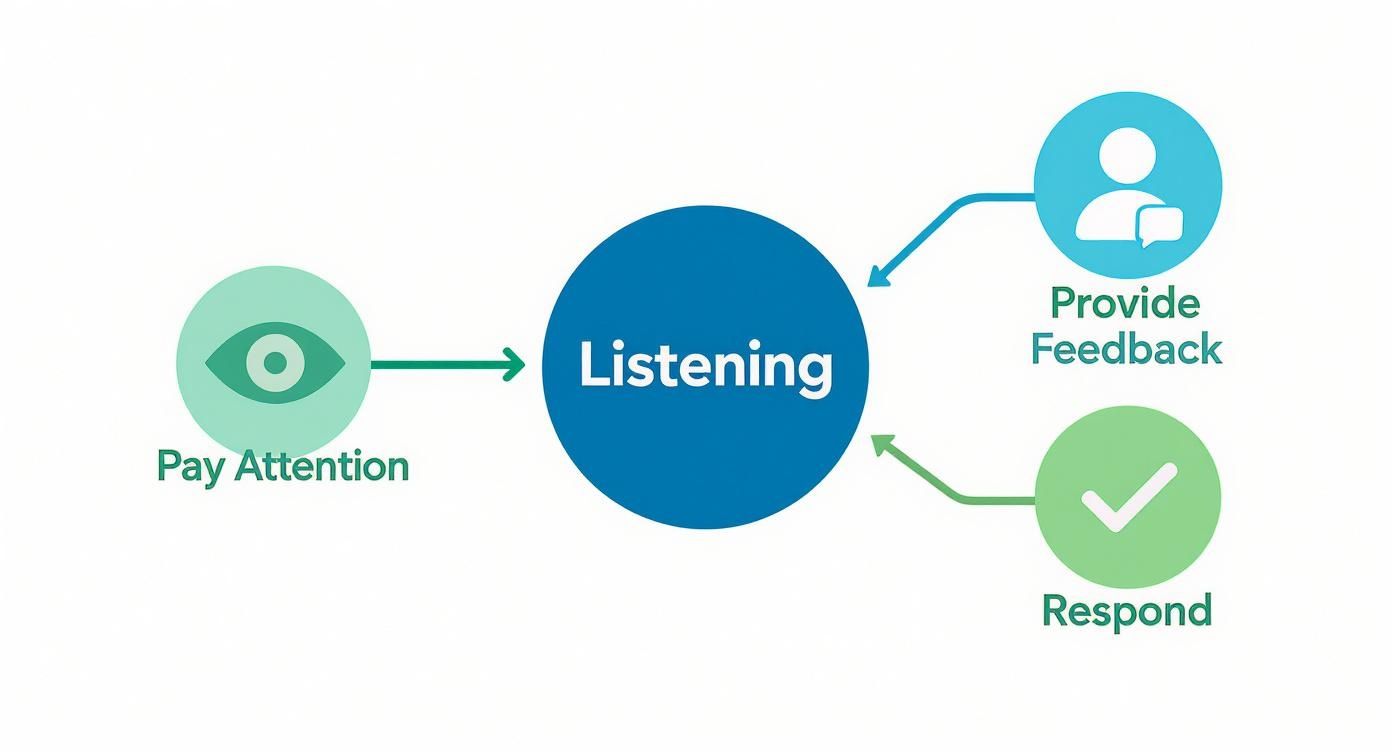
As you can see, the process isn’t just about hearing words. It’s about paying full attention, offering feedback to show you’re engaged, and then responding in a way that truly moves the conversation forward. It’s an active, multi-step engagement, not just silence.
Building Stronger Teams and Leaders
When active listening becomes the standard, it creates an environment of psychological safety. People feel comfortable enough to pitch wild ideas, own up to mistakes without pointing fingers, and give honest feedback. This kind of open atmosphere is exactly where high-performing teams are born and is essential for figuring out how to improve workplace productivity.
For anyone in a leadership role, this skill is absolutely essential. A global report on listening statistics found that 64% of HR professionals see active listening as a critical leadership trait. Yet, the same data shows that over half of all managers aren't great listeners. That’s a huge disconnect, but it’s also a huge opportunity.
When managers are trained to listen actively, employee satisfaction can jump by as much as 30%. The return on investing in this skill is crystal clear.
Active listening moves communication from a one-way broadcast to a two-way connection. It’s the difference between telling people what to do and inspiring them to contribute their best work.
Resolving Conflict and Boosting Morale
Let's face it—conflict is going to happen at work. But how you handle it is what matters. Active listening is a fantastic de-escalation tool because it makes everyone involved feel respected and understood. Conversations stop being arguments and start being productive problem-solving sessions.
This has a powerful ripple effect on team morale. When people know their concerns won’t be dismissed, they feel more valued and engaged in their work. That feeling translates directly into higher satisfaction, lower turnover, and a much more positive and productive workplace for everyone.
The High Cost of Not Listening in Business
When communication falls apart in business, the fallout is a lot messier than just hurt feelings. Poor listening isn't a minor soft-skill issue; it's a direct hit to your bottom line, team morale, and the success of your projects. The costs, both the ones you see on a spreadsheet and the ones you don't, can pile up fast, turning small misunderstandings into full-blown crises.
Think about that big project that went completely off the rails. Chances are, it started with a single requirement that was misheard in a kickoff meeting. Or what about that star employee who just quit? It probably happened after months of feeling like their feedback was going into a black hole, leaving them feeling completely invisible and unappreciated. These aren't just one-off bad days; they're symptoms of a culture that doesn't value listening.
The Financial Drain of Miscommunication
The numbers don't lie—the financial toll of poor listening is staggering. A single misunderstood instruction can easily lead to wasted hours, busted budgets, and deadlines that fly by unmet. When that’s happening all over the company, the costs multiply exponentially.
Research paints a pretty clear picture: for large companies, ineffective communication can rack up costs as high as $62.4 million every year. That’s not pocket change. In fact, over 60% of all workplace mistakes can be traced back to a communication breakdown.
But here’s the good news: active listening is proven to slash those misunderstandings by about 40%, which directly cuts down on expensive mistakes and team conflicts. If you want to dive deeper, you can discover more insights on communication failures at Jobera.com. The data makes a compelling argument for treating listening not as a nice-to-have, but as a core business skill.
Beyond the Balance Sheet
The damage goes way beyond the financials. A workplace where people feel ignored is a breeding ground for low morale and high turnover. When your team members feel like their ideas are shot down before they even finish their sentence, their engagement tanks. They stop bringing their best ideas to the table and, eventually, they just stop caring.
This kicks off a pretty toxic cycle with some serious consequences:
Trust Disintegrates: Without a foundation of respect, collaboration falls apart. It’s that simple.
Innovation Stalls: Why bother speaking up with a great idea if no one is going to listen?
Conflict Escalates: Small misunderstandings simmer under the surface, turning into resentment and unresolved disputes.
The true cost of not listening is measured in lost potential. It's the innovative idea that was never shared, the critical problem that wasn't flagged, and the star employee who walked away.
Of course, preventing these costly mistakes isn't just about listening; it's also about making sure your own messages are crystal clear. Before you can truly hear others, you have to communicate your own thoughts without creating confusion. Download Speak4Me free on iOS to help you shape clear, concise messages that minimize the chance of being misunderstood from the start.
Practical Techniques to Become a Better Listener Today

Knowing the theory of active listening is one thing, but real improvement happens when you start putting it into practice. The great news is you don't need some formal training course to get started. You can begin applying a few simple, powerful techniques in your very next conversation. Remember, the goal is progress, not perfection overnight.
Think of these strategies as tools in your conversational toolkit. You can pull them out anytime you want to build a stronger connection, get clarity on a topic, or just show someone that you're truly tuned in. By consciously using these methods, you turn listening from a passive activity into an engaging, two-way street.
Confirm Your Understanding by Paraphrasing
One of the most effective habits you can build is paraphrasing. This is simply restating what the other person said, but in your own words. It’s not about repeating them like a parrot; it’s about capturing the core of their message to make sure you got it right.
For instance, if a team member tells you, “I’m swamped with these new reports and the deadline is tomorrow,” a good paraphrase would be, “So, it sounds like the tight deadline on these new reports is the biggest pressure point for you right now, is that right?” This immediately shows you’re listening and gives them a chance to correct you if you’ve misunderstood.
Paraphrasing is like holding up a mirror to the speaker's thoughts. It validates what they're feeling and ensures you're both on the same page before moving on.
Invite More Detail With Open-Ended Questions
If you want to go deeper than surface-level chatter, start using open-ended questions. Unlike questions that can be answered with a simple "yes" or "no," these invite the speaker to elaborate, share details, and really explore what they're thinking.
So, instead of asking, “Are you upset about the project?” (which will likely get you a one-word answer), try something like, “How are you feeling about the recent changes to the project?”
Here are a few more to try:
“Can you walk me through what happened?”
“What was that experience like for you?”
“How did you arrive at that conclusion?”
Questions like these open the door to a much richer, more meaningful conversation.
Show You're Engaged by Summarizing
Similar to paraphrasing, summarizing is about condensing the main points of the conversation. This is especially useful in longer discussions or meetings to make sure everyone leaves with the same understanding. A quick summary shows you were paying attention and helps lock in the key takeaways.
You could say, “Okay, just to recap, we’ve agreed to push the deadline, reassign the design tasks, and touch base again on Friday. Did I miss anything?” This simple step is a game-changer for preventing misunderstandings down the road. It also requires you to concentrate, which is a skill in itself. For more on that, check out our guide on how to improve focus.
These listening skills are also critical in a business setting. Research shows that companies practicing continuous employee listening perform better. In fact, companies with high employee engagement—which is built on a foundation of good listening—are 21% more profitable than their competitors. To truly get the most out of any conversation, you have to improve English listening skills beyond just hearing the words.
As you get better at listening, you'll also want to make sure your responses are clear and thoughtful. Download Speak4Me free on iOS to get help articulating your ideas and rounding out your communication skills.
Common Barriers to Active Listening and How to Overcome Them
Even when we have the best intentions, becoming a genuinely active listener isn't something that happens overnight. We all have ingrained habits and distractions that get in the way of truly hearing what someone is trying to tell us. The first step to getting better is simply recognizing what these roadblocks are.
These barriers can be internal, like the constant monologue running in our heads, or external, like the incessant ping of a smartphone. The trick is to figure out what trips you up so you can consciously work on it. By tackling these common pitfalls head-on, you can pave the way for much more meaningful conversations.
Internal Roadblocks and How to Manage Them
More often than not, the biggest obstacle to listening isn't the noise in the room—it's the noise inside our own minds. This internal chatter can completely derail a conversation before we even realize what's happening.
Here are a few of the biggest mental hurdles:
Planning Your Reply: This is probably the most common one. Instead of actually absorbing what the other person is saying, our brain is already busy crafting the perfect comeback. We're just waiting for a pause to jump in. This turns a potential connection into a competition.
Personal Biases: We all see the world through our own filters, shaped by our experiences and beliefs. The moment someone says something that bumps up against one of our biases, we might mentally tune them out or start building a counterargument, completely missing the heart of their message.
Emotional Triggers: A certain word or topic can set off a strong emotional reaction, making it nearly impossible to listen with an open mind. When our emotions hijack the conversation, our ability to think clearly and process information takes a nosedive.
Overcoming these internal barriers often starts with a simple, conscious pause. Before you jump in to speak, just take a breath. That tiny moment of silence is incredibly powerful—it gives you a chance to actually process what was said, quiet your knee-jerk reaction, and respond thoughtfully instead of just reacting.
External Distractions and Practical Solutions
While our internal world presents a huge challenge, the outside world is full of its own interruptions. Our environment today is practically engineered to fracture our attention.
The most obvious external barriers are environmental and technological. Think about a phone buzzing on the table during a serious talk. It’s a subtle but clear signal that something else might be more important. In the same way, trying to have a deep, meaningful conversation in a loud, chaotic coffee shop is basically setting yourself up to fail.
The solution is to create an intentional listening space. This might mean putting your phone on silent and placing it completely out of sight. It could be choosing a quiet corner for an important chat or simply turning away from your computer screen to give someone your full, undivided attention.
One of the toughest internal barriers is the scramble to organize your thoughts while someone else is talking. A dedicated tool can make a world of difference by helping you quiet that 'internal monologue' and prepare your ideas ahead of time. Download Speak4Me free on iOS to help structure your thoughts before you even open your mouth.
Got Questions About Active Listening?
Even after you get the hang of the basics, some real-world situations can feel a bit tricky. Let's tackle some of the most common questions people have when they start putting active listening into practice.
How Can I Actively Listen Over Email or Text?
This is a great question. When you lose all the non-verbal cues like tone of voice and body language, you have to lean entirely on the words. The core idea of active listening, however, stays the same.
Instead of just skimming a message and firing off a quick reply, slow down. Read the entire message, maybe even twice, to really absorb what they’re saying. You can show you’ve been "listening" by directly mentioning their key points in your response. For example, start with something like, "It sounds like the main issue is with the project deadline, I get that." Acknowledging their perspective before you add your own is a game-changer in written communication.
Are Introverts Naturally Good at This?
Yes, absolutely. In fact, many introverts find that active listening plays directly to their strengths. Their natural tendency to think before they speak is a huge asset here.
It's a common misconception that you have to be a big talker to be a great communicator. Introverts often excel because they:
Notice the details: They're wired to pick up on the subtle nuances in a conversation that others might miss.
Ask better questions: Because they process things more deeply, they often ask thoughtful, open-ended questions that really move the conversation forward.
Remember, active listening isn't about being the loudest person in the room. It’s about being the most present, and that's a space where introverts often shine.
What's the Real Difference Between Active and Empathetic Listening?
It's easy to mix these two up because they are so closely linked. Think of it like this: active listening is about the head, and empathetic listening is about the heart.
Active listening is focused on one thing: accurately understanding the message. The goal is pure clarity. Did you get the facts right? Do you understand their point of view?
Empathetic listening takes it a step further. It includes all the skills of active listening, but its main goal is to connect with the emotions behind the words. You're not just trying to understand their situation; you're trying to understand how they feel about their situation.
Getting these nuances right takes time and practice, and so does figuring out the perfect way to respond. If you want a little help organizing your thoughts so you can communicate with more clarity, Speak4Me can support you. Download Speak4Me free on iOS and see how it can sharpen your communication skills.
Try Speak4Me for Free
