What Is Cognitive Overload? Your Guide to Mental Clarity

You know that feeling when your brain just... stalls? When you're trying to absorb one more piece of information, but it feels like there's no more room? That’s cognitive overload.
It’s the mental equivalent of having way too many browser tabs open at once. Your mind gets sluggish, thinking becomes a chore, and making even simple decisions feels impossible.
What's Really Happening When You Feel Overloaded?
Ever found yourself trying to listen to a podcast while simultaneously replying to a work email and keeping one ear on a conversation nearby? That’s a perfect recipe for cognitive overload. This isn't a personal flaw or a sign of weakness; it's just a hardwired limitation of the human brain.
Think of your working memory—the part of your brain juggling what you’re focused on right now—like a computer's RAM. It has a set amount of space. If you try to run too many heavy-duty programs at the same time, the whole system slows to a crawl and might even crash.
That's exactly what happens to your brain when it’s hit with too much information, too many choices, or instructions that are way too complicated. The result? Mental exhaustion, a scattered focus, and a serious dip in your performance. Learning to manage this mental traffic is crucial if you want to stay productive and avoid burnout.
The Science Behind the Brain Fog
The theory that really gets to the heart of this is called Cognitive Load Theory (CLT). It’s been around since the 1980s and breaks down how our limited working memory functions. CLT suggests that the total mental effort we exert—our "cognitive load"—is actually made up of three distinct types.
This image neatly illustrates the three kinds of cognitive load that add up to your total mental effort.
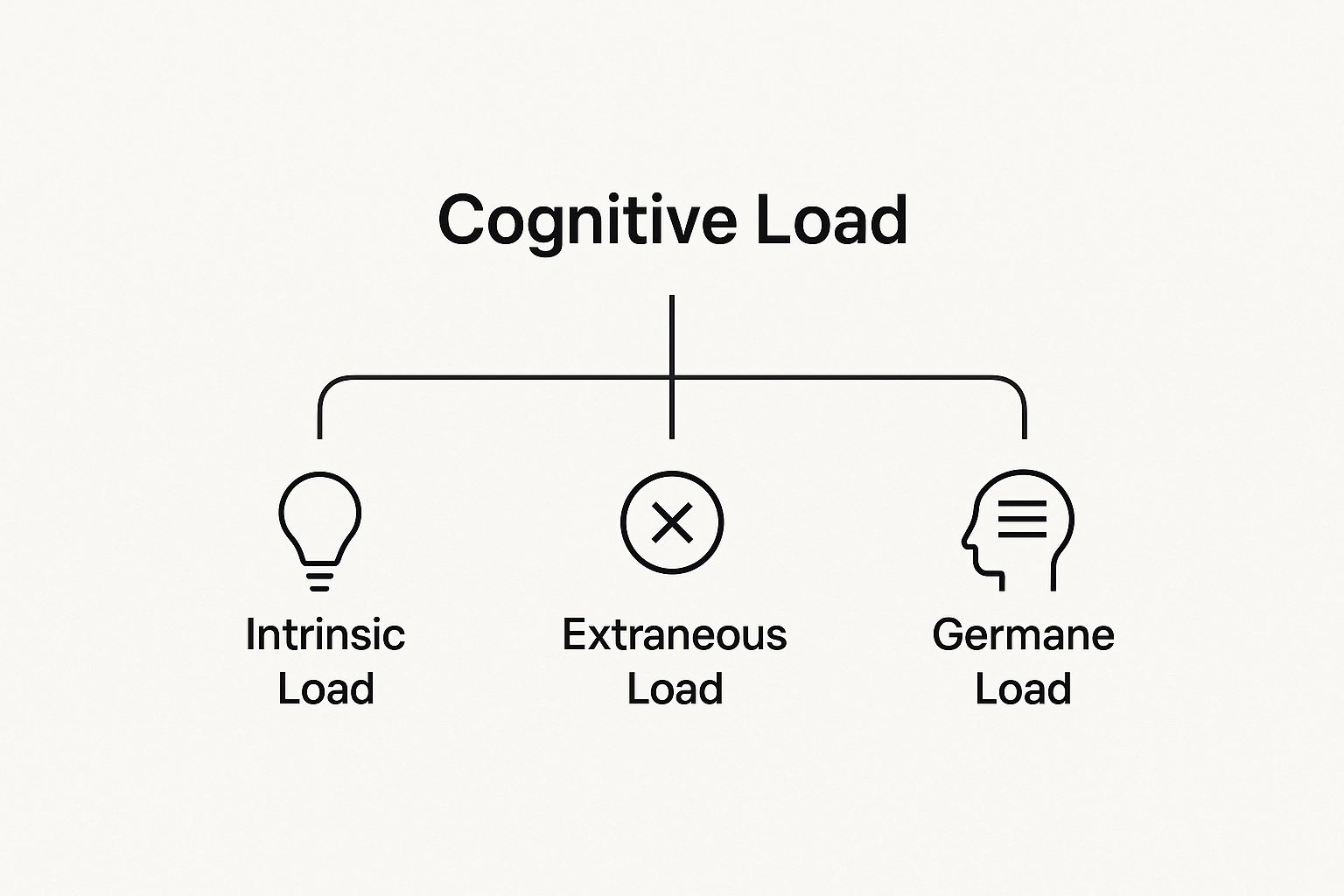
When you see it broken down like this, it becomes clear that not all mental effort is created equal. Some of it is just noise. The goal is to cut down on the "bad" load so you have more brainpower for the "good" stuff that actually helps you learn and solve problems.
This isn't just theory; it has a huge impact on our daily lives, especially at work. A study from Microsoft revealed that a staggering 68% of employees feel they don’t have enough uninterrupted focus time. That's a huge red flag for widespread cognitive overload in today's workplaces. You can read more about how cognitive overload affects work and its drain on company-wide productivity.
Cognitive overload happens when the demands on your working memory are greater than its capacity. By cutting out unnecessary mental strain, you free up your mind for what really matters: deep thinking, creativity, and solving real problems.
The good news is you don’t have to just live with it. You can take real steps to manage the strain, and using tools designed to simplify how you process information can be a game-changer. When you offload some of that mental work, you create more breathing room for focus and clarity.
Ready to lighten your mental load? Download Speak4Me free on iOS and start simplifying the way you take in information every day.
What's Really Causing Your Mental Fatigue?
Ever feel like your brain is just… full? That’s not a random feeling. Cognitive overload is a direct result of specific triggers bombarding us every single day. Pinpointing these causes is the first real step toward getting your focus back.

One of the biggest culprits is simply the sheer volume of information we’re expected to handle. Think about it: an overflowing inbox, a calendar packed with back-to-back meetings, and a never-ending stream of articles to read. Our brains are constantly trying to process more data than they were ever designed to manage.
This forces us into a state of constant multitasking. We might feel like we're being productive by juggling a dozen things at once, but the science says otherwise. Every time you switch tasks, your brain has to pay a "cognitive tax," which eats away at your limited mental energy and leads directly to mistakes and burnout.
The Hidden Stressors All Around Us
It's not just how much information you're getting, but also how it's presented. Clunky software, confusing instructions, or a messy digital desktop all create mental friction. This is what experts call extraneous load—it’s the brainpower you waste just trying to figure things out, instead of actually doing the work.
Look out for these common triggers in your own environment:
Constant Notifications: Every ping, buzz, and pop-up is a tiny interruption that shatters your concentration and forces your brain to constantly restart and refocus.
Information Over-Choice: Being faced with too many options—whether you're trying to choose a project strategy or just decide what to eat for lunch—can lead to total decision paralysis.
Complex or Vague Instructions: When directions aren't clear, your brain has to work overtime to fill in the gaps. This adds a heavy, and completely avoidable, burden to your working memory.
Once you start spotting these triggers in your day-to-day life, you realize cognitive overload isn't a personal failing. It’s a predictable response to an overly demanding environment. That mindset shift is everything when it comes to finding solutions that actually work.
The Physical Drain on Your Brainpower
Mental exhaustion isn't just in your head; it’s deeply tied to your physical well-being. Sleep deprivation is a huge factor. When you're running on fumes, your brain’s ability to filter distractions and manage information plummets.
Exploring the critical connection between sleep and mental health for teens really drives home how essential rest is for brain function, no matter your age. Chronic stress and poor nutrition also chip away at the resources your brain desperately needs to stay sharp.
A major source of this daily strain is the constant flow of text from emails and messages. Tools that change how you engage with this information can make a massive difference. Speak4Me, for instance, assists by reading your messages to you, which cuts down on screen time and the mental effort of non-stop reading.
If your inbox is a primary source of your stress, it’s a sign you need a better system. Download Speak4Me free on iOS and start lifting that daily cognitive weight.
How Overload Impacts Your Work and Wellbeing
Think of cognitive overload as more than just a fleeting moment of feeling frazzled. It's a persistent mental strain that acts like a dimmer switch on your performance, subtly at first, then becoming impossible to ignore. Its effects ripple through every corner of your professional and personal life, turning what should be simple tasks into monumental efforts.
When your working memory is constantly jammed full, there’s simply no room left for deep thinking or creative problem-solving. This inevitably leads to a noticeable dip in the quality of your work, a spike in careless mistakes, and a real struggle to meet deadlines you’d normally handle with ease.

The Toll on Your Productivity and Focus
The consequences of a mentally exhausted workforce are huge. In any professional setting, this overload shows up in several damaging ways:
Poorer Decision-Making: An overloaded brain loves shortcuts. The problem is, this often leads to impulsive or poorly thought-out choices.
Less Innovation: Creativity needs mental bandwidth. When all your cognitive energy is tied up just processing information, there’s nothing left for new ideas.
Stalled Learning: Trying to learn a new skill or absorb complex information feels nearly impossible. The new info simply has nowhere to "stick."
Beyond the Office Walls
The damage from cognitive overload doesn't magically stop when you clock out for the day. That chronic mental exhaustion bleeds into your personal life, chipping away at your overall wellbeing. It's one of the biggest drivers of burnout, a severe state of emotional, physical, and mental exhaustion.
When you consistently push your brain past its limits, you're not just risking a bad day at work—you're risking your long-term health. The constant stress can strain relationships, disrupt sleep, and leave you feeling perpetually drained and disconnected from the things you enjoy.
This persistent state of being overwhelmed makes it tough to be present with family and friends. You might find yourself more irritable, impatient, or simply too tired to engage, which can create distance in your most important relationships.
General Strategies vs How Speak4Me Helps
Luckily, you can take proactive steps to protect your precious mental resources. A huge source of daily cognitive strain is the relentless firehose of digital text from emails, articles, and messages. Tools that change how you process this information can offer immediate relief.
Here’s a look at some common strategies to reduce cognitive load and how Speak4Me assists.
General Strategy to Reduce Load | How Speak4Me Assists |
|---|---|
Reduce Visual Clutter | Converts busy text-filled screens into clean, manageable audio, eliminating visual distractions. |
Offload Information | Acts as an external memory aid. Instead of trying to hold information in your head, you can listen and re-listen as needed. |
Chunk Information | Lets you process information in bite-sized audio segments, making complex topics easier to digest without reading a wall of text. |
Engage in Single-Tasking | Encourages you to focus on one stream of information (audio) while you perform a simple physical task, like walking or commuting. |
Take Mindful Breaks | Listening instead of reading gives your eyes a much-needed break from screen fatigue, a major contributor to mental exhaustion. |
By transforming written content into clear audio, Speak4Me lets you listen instead of read. This simple shift reduces screen fatigue and frees up the mental energy you’d normally spend decoding text, helping you protect both your productivity and your personal wellbeing.
Ready to reduce the strain and reclaim your focus? Download Speak4Me free on iOS.
Proven Strategies to Prevent Cognitive Overload
That feeling of being mentally fried is exhausting, but it doesn't have to be your normal state. You can absolutely regain control over your focus with a handful of practical, easy-to-use strategies. By actively managing your mental bandwidth, you can stop overload before it even starts, clearing the way for clarity and deep work.
The first step is usually the simplest but also the most powerful: single-tasking. Instead of trying to juggle a dozen things at once, just pour all your attention into one. It’s that simple. Close the extra browser tabs, silence your phone, and give a single project the respect it deserves. This simple act drastically cuts down on the mental "switching cost" that saps your energy and leads to sloppy mistakes.

This focused approach is so critical because digital multitasking is one of the biggest culprits behind cognitive overload. Research actually shows that heavy media multitaskers—the folks constantly jumping between tabs, apps, and devices—often get worse at task-switching and have weaker working memories.
Structure Your Time and Tame Your Tech
Another incredibly effective tactic is to give your work sessions some structure. Time management methods like the Pomodoro Technique—where you work in focused 25-minute bursts followed by short breaks—can be a game-changer. This approach carves up your day, preventing the mental burnout that sets in after long, unstructured stretches of work.
But managing your time is only half the battle; you also have to manage your technology. This is all about putting yourself on a "digital diet" to cut through the constant noise.
Curate Your Notifications: Go into your settings and turn off every non-essential alert. Each ping and buzz is an interruption that shatters your concentration and eats away at your mental reserves.
Schedule Check-in Times: Stop living in your inbox. Set specific times each day to check and answer emails and messages. Batching them like this keeps your inbox from running your life.
Organize Your Digital Workspace: A cluttered desktop is a cluttered mind. Spend a few minutes organizing your files and apps. A clean, streamlined digital space reduces unnecessary mental friction.
The goal isn't to get rid of technology. It's to make it work for you, not against you. By setting clear boundaries and being intentional with your devices, you can dramatically lighten the load on your brain.
Offload the Burden with Smart Tools
One of the smartest ways to fight cognitive overload is to simply offload some of the mental work. This is where you can use technology to solve the very problems technology often creates. Instead of trying to hold every last detail in your head, let your tools do some of the heavy lifting.
For anyone trying to keep multiple plates spinning, learning strategies for managing multiple projects and avoiding burnout is essential for staying sane. These techniques usually involve breaking big tasks down and using external tools to keep track of everything.
This is where a tool like Speak4Me becomes such a powerful ally. The constant need to read and process text on a screen is a huge, often invisible, source of mental fatigue. Speak4Me completely changes that dynamic.
It turns any written content—emails, articles, you name it—into clear, natural-sounding audio. This lets you process information with your ears instead of your eyes, which can be a massive relief from screen fatigue.
By fundamentally changing how you interact with digital text, you free up precious cognitive resources. These small shifts can add up to huge gains in focus and efficiency. For more ideas on this, check out our guide on how to be more productive.
Your Questions About Cognitive Overload Answered
We’ve covered a lot of ground on what causes mental fatigue, how it affects us, and what we can do about it. But a few key questions always seem to pop up. Let's tackle them head-on to make sure you have a crystal-clear picture of what cognitive overload is and how to manage it.
Think of this as tying up the loose ends, giving you a complete toolkit for protecting your focus and mental energy.
Is Cognitive Overload the Same as Burnout?
That's a great question, and the distinction is really important. While they're definitely related, they aren't the same thing.
Think of cognitive overload as a temporary state—like your brain's "low battery" warning light turning on after a long day. It’s that feeling of being totally swamped after back-to-back meetings or trying to juggle too many tasks at once. It can happen to anyone, anytime.
Burnout, on the other hand, is a much deeper, long-term problem. It's what happens when that "low battery" warning is ignored for weeks, months, or even years, leading to a complete system shutdown. Persistent cognitive overload is a fast track to burnout, which is exactly why nipping it in the bud is so crucial.
Addressing daily cognitive overload is like recharging your phone before it hits 0% and shuts down. It's a small, preventative habit that stops a temporary strain from becoming a chronic, debilitating problem.
Can I Train My Brain to Handle More Information?
While you can't magically increase your brain's raw processing power—working memory has its limits—you can get a whole lot smarter about how you use the capacity you have. The goal isn't to cram more in, but to manage the flow of information and filter out the noise that drains your mental battery.
You can absolutely train yourself to manage information more effectively and sharpen your focus. Here’s how you can operate more efficiently:
Practice Mindfulness: A little meditation goes a long way. It strengthens your mental muscles, helping you control your focus and ignore distractions.
Prioritize Sleep: This one is non-negotiable. Sleep is when your brain files away important memories and cleans out the mental clutter that accumulates throughout the day.
"Chunk" Information: Instead of trying to swallow a huge topic whole, break it down into smaller, related pieces or "chunks." This makes it far easier for your brain to process and remember.
Ultimately, it’s not about having more brainpower; it's about using smarter strategies and the right tools.
What Is the Best Way to Reduce Cognitive Overload Right Now?
If you're feeling overwhelmed and need immediate relief, the single most effective thing you can do is single-tasking. I know, it sounds almost too simple to work, but its impact is huge.
Pick one thing. Just one. Then, silence all your notifications, close every unrelated browser tab, and commit a block of time to that single activity. This one simple move stops the constant context-switching that depletes your cognitive resources and causes you to make mistakes.
By giving one task your undivided attention, you’ll not only feel calmer but also produce much better work. To help maintain that focus, you can lean on tools that manage distractions for you. For instance, instead of stopping what you're doing to read a long email, you could have it read aloud to you. You can find more tips like this in our guide to boost your productivity with a text-to-speech app.
Using a tool like Speak4Me to listen to messages without breaking your concentration is a perfect way to support your single-tasking efforts and stay in the zone.
Ready to take control of your mental workload? Give your brain the backup it deserves. Speak4Me can help you process information without the strain, cut down on screen fatigue, and get your focus back.
Try Speak4Me for Free
