What is Differentiated Instruction? Strategies for Inclusive Classrooms

Think of your classroom. You've got 30 students, each with a unique way of seeing the world, different strengths, and areas where they need a little more help. The traditional "one-size-fits-all" lesson plan just doesn't cut it anymore, does it?
That’s where differentiated instruction comes in. It's less of a rigid method and more of a mindset—a way of teaching that truly sees every student as an individual. Instead of delivering a single lesson and hoping it sticks, differentiation is about making smart, flexible adjustments to what you teach, how you teach it, and how you let students show you what they know. This approach helps create a learning environment where every student is supported.
Unpacking the Core Idea of Differentiated Instruction
Let's use an analogy. A good coach wouldn't give every athlete on the team the exact same workout. The quarterback, the lineman, and the kicker all have different needs, right? The coach adjusts the training to build on each player's strengths and target their areas for growth.
That’s exactly what differentiated instruction looks like in the classroom. It's not about creating 30 completely separate lesson plans. That's a fast track to burnout. It's about being strategic—making thoughtful tweaks to help every student get to the same finish line, even if they take slightly different paths to get there.
Why It’s More Than Just a Buzzword
This isn't just another passing trend in education. It's a powerful and practical approach to creating a classroom where every student can actually thrive. When we acknowledge that one teaching style won't resonate with everyone, we open the door to deeper engagement, greater confidence, and real, meaningful learning.
Differentiated instruction has become a cornerstone in schools across the globe, especially in classrooms with a wide range of learners. Research consistently shows that when you tailor instruction to meet students where they are, you see a significant jump in both motivation and achievement. You can explore some of the research on international education approaches to see the data for yourself.
To truly get a handle on differentiated instruction, it helps to see how the theory breaks down into practice. Teachers typically adjust four key elements in the classroom to cater to student readiness, interests, and learning profiles.
Core Components of Differentiated Instruction at a Glance
Element | What It Means | Example |
|---|---|---|
Content | The information or skills students need to learn. | Offering reading materials at various complexity levels or providing a video summary alongside a text. |
Process | The activities students use to make sense of the content. | Allowing students to work in small groups, independently, or with a partner to solve a problem. |
Product | The way students demonstrate what they have learned. | Giving students the choice to write an essay, create a podcast, or design a presentation to show their understanding. |
Learning Environment | The overall feel and function of the classroom. | Creating quiet spaces for focused work, collaborative areas for group projects, and flexible seating arrangements. |
These four components work together, giving you a practical framework for making those small, impactful adjustments that help every student connect with the material.
Key Principles in Action
At its core, this whole approach is built on a few simple, yet powerful, beliefs.
Be Proactive, Not Reactive: Great teachers anticipate the range of needs in their classroom and plan for them from the get-go. It's about designing for diversity from the start, not scrambling to fix a lesson that isn't working.
Focus on Quality, Not Quantity: The goal isn't to pile on more work for advanced students or give less to those who are struggling. It's about ensuring every single student gets a task that is just the right amount of challenging and meaningful for them.
Keep the Student at the Center: This approach honors the fact that every learner brings their own background, interests, and readiness to the table. These aren't obstacles to overcome; they're assets to build upon.
A differentiated classroom is one that acknowledges students have important differences, and these become key elements in teaching and learning. It’s about building on commonalities while honoring individuality.
Ultimately, understanding differentiated instruction is the first step toward creating a classroom where every student feels seen, supported, and capable of success. Having tools that offer flexible ways to access information is a huge part of this. For a student who learns best by listening, an app like Speak4Me that assists with reading can be a game-changer.
Ready to give your students another way to connect with their learning? Download Speak4Me free on iOS and see the difference it can make.
The Four Elements of Classroom Differentiation
So, how do you take this big idea of differentiated instruction and make it work in a real classroom? It comes down to adjusting four key elements. I like to think of them as the four main dials you can turn to fine-tune your teaching for every single student.
By tweaking the Content, Process, Product, and Learning Environment, you're essentially creating multiple pathways for students to get to the same destination: mastering the learning goals. This isn't about throwing out your entire curriculum. It’s about making smart, intentional shifts that respect the mix of learners you have in front of you.
This image really helps break down these core elements.
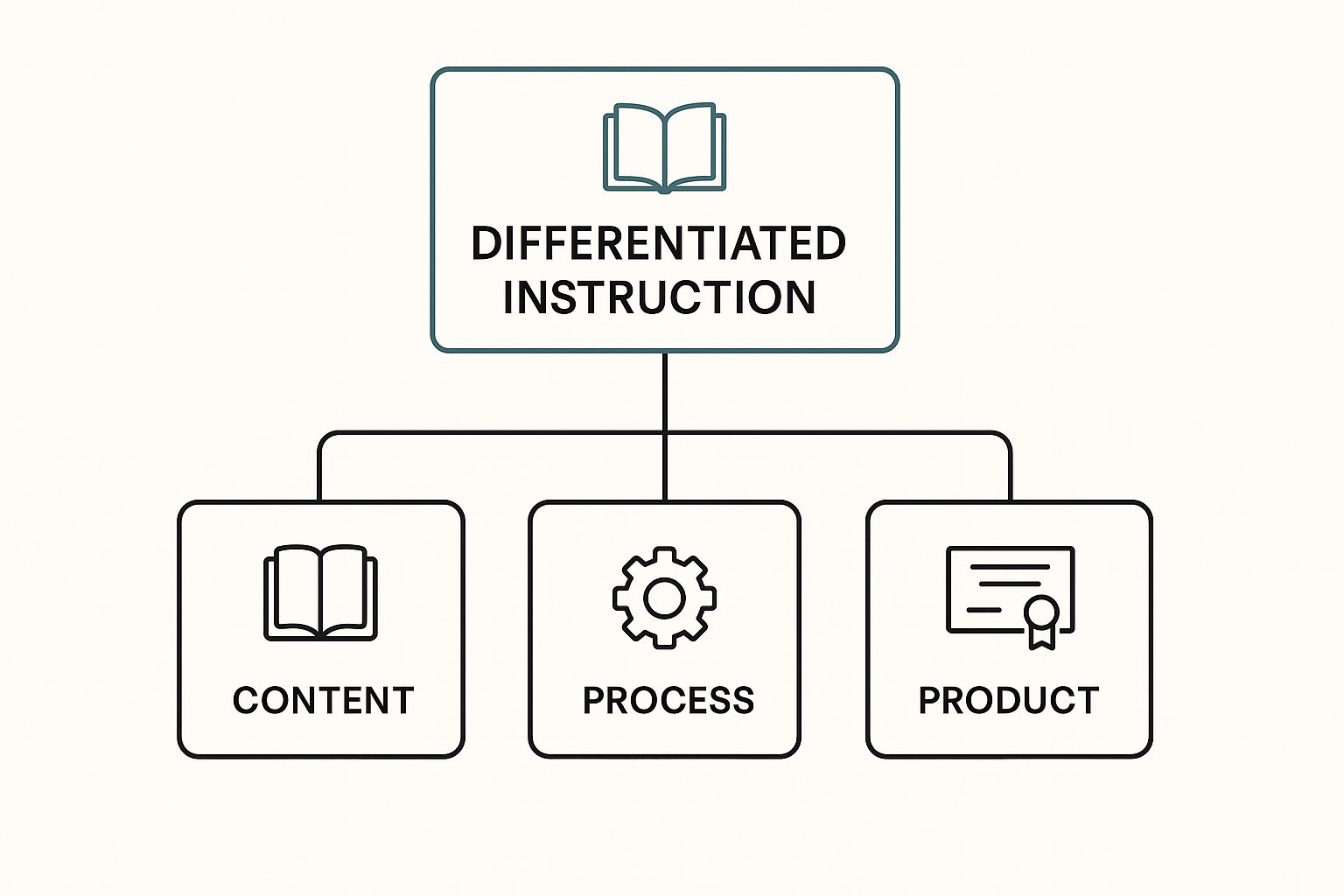
As you can see, the main levers we can pull as teachers are the Content, Process, and Product. Let’s look at what each one means in practice.
Differentiating the Content
Content is simply the "what" of learning—the information, ideas, and skills you want your students to walk away with. When we differentiate the content, our goal is to make sure every kid can access the core material, no matter their reading level or how they learn best.
This absolutely does not mean dumbing things down. It’s all about providing different doors into the same room.
Tiered Reading Materials: Maybe you have three different articles about the American Revolution, each written at a different reading level. Everyone learns about the same event, just through a text they can actually understand.
Audio and Visual Aids: For a student who struggles with reading but is a great listener, having an audio version of a text is a total game-changer. This is where a tool like Speak4Me is fantastic, as it can turn any digital text into spoken words.
Concept-Based Mini-Lessons: Sometimes, you just need to pull a small group aside to quickly re-teach a key concept before they dive into the main assignment. That’s a powerful way to differentiate content.
By changing up how students get the information, you remove roadblocks that might otherwise stop them from even starting the lesson.
Differentiating the Process
Process is the "how" of learning. It’s all about the activities students do to really grapple with the content and make sense of it. Let's be honest, a one-size-fits-all worksheet rarely works for an entire class.
Differentiating the process means giving students some control over their own learning journey. It’s the shift from saying "everyone complete this worksheet" to "here are a few ways you can explore this idea."
For example, after a science lesson on ecosystems, you could offer a few different ways for students to process the information:
For Hands-On Learners: Build a small diorama of an ecosystem.
For Collaborative Learners: Work in a small group to create a giant concept map on a whiteboard.
For Independent Learners: Use an app like Speak4Me to listen to extra articles and then write a summary of what they learned.
This kind of flexibility lets students play to their strengths, which naturally boosts their engagement and helps them remember the material long-term.
Differentiating the Product
Product is the final piece—it's how students "show what they know." In a lot of classrooms, this is a standard test or a five-paragraph essay. Differentiating the product means opening up the possibilities and offering students multiple ways to demonstrate that they've mastered the concepts.
Instead of just one final test on a novel, what if you offered a choice board?
Write a new final chapter from a different character’s point of view.
Create a podcast episode where you interview the main character.
Design a visual timeline of the plot's most important events.
Record a short video presentation summarizing the book's main themes.
You can still use the same rubric to grade each of these, because you’re focused on the core learning goals, not the format. This gives every student a real chance to shine. And it works. Research shows that when students are taught with strategies like tiered assignments, they show clear improvement. You can read the full research on these instructional impacts to see the data for yourself.
Give your students tools that support the unique ways they learn. Download Speak4Me free on iOS and give them a powerful option for auditory learning.
Why Differentiated Instruction Matters
Let's get straight to it: Differentiated instruction isn't just another buzzword or teaching trend. It’s a complete shift in how we approach the classroom, moving away from a one-size-fits-all model to one that genuinely works for every student. The real magic happens when this approach is put into practice, creating a space where kids feel confident, engaged, and ready to learn.
When teaching is flexible and responsive, the entire dynamic of the classroom changes for the better.

Think about it. We’re moving away from a system where some students are always struggling to keep up while others are bored and zoning out. Instead, we meet every single learner right where they are, giving them the perfect amount of challenge to stretch their skills without breaking their spirit. That simple act of recognition is incredibly powerful.
Boosting Student Engagement and Confidence
One of the first things you’ll notice in a differentiated classroom is how much more engaged students are. When activities feel relevant and kids have the right tools to access the material, they actually want to participate. Frustration goes down, and that "I can do this" feeling starts to blossom.
This builds academic confidence, which is the secret sauce for long-term success. A confident student is one who isn't afraid to tackle a tough problem, ask for help, or keep trying when they get stuck. The goal shifts from just getting the assignment done to actually understanding the concepts.
Differentiated instruction nurtures a growth mindset by showing students that their abilities aren't set in stone. It proves that with the right support and strategies, they can master complex ideas and reach their goals.
And the research backs this up. Reviews of multiple studies show that differentiated instruction consistently improves academic achievement. The effect sizes ranged from d = +0.51 to +0.74—clear proof that meeting diverse learning needs gets real results.
Fostering an Inclusive Classroom Culture
At its heart, a differentiated classroom is an inclusive one. It sends a powerful message to every student: you belong here, and your unique way of learning is valued. This sense of belonging is vital for a child's social and emotional health.
It reduces stigma. When it's totally normal for classmates to work on different tasks or use different tools, the shame sometimes tied to needing extra help just melts away.
It promotes collaboration. Using flexible groups means students learn to work with all kinds of peers, building their communication skills and empathy along the way.
It honors individuality. Kids see their own interests and learning styles reflected in their schoolwork, which makes them feel seen and respected as individuals.
This is where tools that support different ways of learning become so important. For educators wanting to help auditory learners or students who struggle with reading, exploring how tools can support them in educational settings is a great next step.
Empowering Teachers with Deeper Insights
The benefits aren't just for the students, either. When teachers differentiate, they naturally develop a much richer understanding of where each child is in their learning journey. They're not just waiting for a final test score; they’re gathering information every day through observation, conversations, and a variety of small assessments.
This allows for much more precise and effective teaching. An educator can spot a misconception the moment it pops up and provide targeted support right then and there. This proactive approach stops small learning gaps from turning into major roadblocks later on.
Ultimately, differentiation transforms the classroom into a vibrant, thriving learning community. When every student has what they need to succeed, the potential for growth is truly limitless.
Practical Strategies to Differentiate Your Classroom
Knowing the theory behind differentiated instruction is great, but putting it into practice is where the magic really happens. The good news? You don’t need to completely rebuild your curriculum from the ground up. Real differentiation comes from making small, deliberate shifts that open up learning for every single student.

Think of these strategies as a toolkit you can pull from, not a rigid checklist. They're designed to be low-prep and easy to implement right away, giving you the flexibility to meet your learners where they are. The goal is to make learning more accessible and engaging, not to create a mountain of extra work for yourself.
Implement Learning Stations or Centers
Learning stations are a fantastic way to differentiate the process of learning. You simply break up the classroom into different areas where small groups of students rotate through activities, all centered around the same core concept. The beauty is that each station can be designed for a different learning style or readiness level.
For example, after a lesson on ancient Egypt, you could have stations like this:
Station 1 (Visual): Students look at photos of artifacts and sketch their own interpretations in a journal.
Station 2 (Auditory/Tech): Learners grab a tablet and headphones to listen to a short podcast about daily life in ancient Egypt.
Station 3 (Kinesthetic): A hands-on activity where students try building a small pyramid out of blocks.
Station 4 (Teacher-Led): A small group huddles with you to review tricky vocabulary and ask questions.
This setup lets students interact with the material in multiple ways, solidifying their understanding while keeping them active and involved.
Offer Choice Through Learning Menus
A choice board, or learning menu, is one of the simplest and most powerful ways to differentiate the final product. It's basically a grid of activities, and students get to choose which tasks they complete. You can structure it like a tic-tac-toe board, where they have to complete three in a row.
Let's say you're wrapping up a science unit on the solar system. A choice board might offer options like these:
Write a short story about an astronaut's journey to Mars.
Build a physical model of the solar system.
Create a colorful infographic comparing two planets.
Record a short "news report" explaining a recent space discovery.
By giving students agency over how they demonstrate their knowledge, you tap into their personal interests and strengths. This not only increases motivation but also gives you a more authentic assessment of their understanding.
You can still use the same rubric to grade every option, focusing on the core learning objectives. This way, you ensure fairness while letting diverse talents shine.
Use Flexible Grouping Strategically
Flexible grouping is just what it sounds like: grouping students temporarily based on their specific needs for a particular task. Unlike static groups that stay the same for weeks, these groups are fluid. They can change from one lesson to the next, or even within a single class period. This is the key to providing targeted support without labeling students.
You might group students in several ways:
By Readiness: Pull together a small group that needs a bit more help with a concept while others tackle a more challenging extension activity.
By Interest: Let students who all want to dig deeper into a specific sub-topic work together.
By Learning Style: Pair auditory learners to talk through a concept, while visual learners work together on a mind map.
This dynamic approach ensures students get the support they need right when they need it, and they also get to collaborate with a wider variety of their peers. For some hands-on fun, you can also look into dynamic tools like those in these Top Augmented Reality Education Examples, which can add another layer of engagement for different groups.
Assistive technology can be a huge help here, especially for students who benefit from hearing text read aloud. Our guide on how simple tools can make a world of difference in making content accessible shows how tools can support students.
These strategies empower you to create a classroom that is responsive, engaging, and truly inclusive. The next step is leveraging tools that make this process even smoother. Empower your students with a tool that supports their individual learning journey. Download Speak4Me free on iOS and provide them with an essential resource for auditory learning.
How Speak4Me Brings Differentiated Learning to Life
Technology can be a real game-changer in the classroom, acting as a bridge to make learning click for every student. When you're trying to put the principles of differentiated instruction into practice, having the right tools isn't just helpful—it's essential. This is where a tool like Speak4Me becomes a teacher's best friend, directly supporting the core ideas of a truly differentiated classroom.
At its heart, Speak4Me is designed to help all kinds of learners by turning any digital text into clear, natural-sounding audio. It sounds simple, but this one function can completely change how students connect with their schoolwork. It helps level the playing field, making sure every student gets a fair shot at understanding the material.
Supporting How You Differentiate Content
One of the biggest challenges in any classroom is the huge range of reading levels. For a student who struggles with decoding words, or for an auditory learner who just thinks better when they listen, a page full of dense text can feel like hitting a brick wall. Speak4Me tackles this head-on by giving them another way to access the content.
The app can read just about any digital text aloud—articles, PDFs, websites, you name it. Suddenly, that tough science article or complex history chapter isn't so intimidating. Students can listen to the material and follow along, letting them focus on grasping the big ideas instead of getting tripped up by the words on the page.
By providing an auditory option for every text, Speak4Me gives students the power to tackle grade-level content on their own. It tears down a common barrier to learning, building confidence and cutting down on frustration.
Beyond just text, offering different types of media is key. Learning the basics of creating effective instructional videos, for instance, can open up even more doors for students who learn visually.
Enhancing How Students Process Information
Differentiation is also about how students make sense of information—the process. Speak4Me is a huge help here, too. It gives students a sense of ownership over their learning and lets them set their own pace.
A student can use Speak4Me to:
Review materials on their own: They can listen to a chapter a few times before a test without needing the teacher to read it to them.
Work at their own speed: Learners can easily pause, rewind, and listen again to tricky parts until the concept finally clicks.
Free up the teacher: When students can work more independently, it gives the teacher more time for what matters most—providing targeted help to small groups or individual kids who really need it.
This kind of flexibility is what it's all about. It lets students use a strategy that actually works for them, which is the heart and soul of differentiating the process. The app becomes a personal learning sidekick, ready to help whenever a student needs it.
The following table breaks down exactly how Speak4Me’s features support specific differentiation strategies in a practical, day-to-day classroom setting.
Using Speak4Me to Differentiate Your Classroom
Differentiated Strategy | How Speak4Me Assists | Classroom Application |
|---|---|---|
Varied Content Formats | Converts text-based materials (articles, PDFs, websites) into audio. | A student who struggles with reading fluency can listen to a history chapter while following along in the book, focusing on comprehension rather than decoding. |
Student Choice & Autonomy | Allows students to independently access and review materials at their own pace. | During a research project, students can use Speak4Me to listen to multiple online sources, pausing and replaying sections as they take notes. |
Tiered Assignments | Provides auditory support for texts of varying complexity, making higher-level content accessible. | The entire class reads the same complex scientific article, but some students use Speak4Me to listen to it, ensuring everyone can access the core concepts. |
Flexible Pacing | Students can control playback speed, pause, and rewind to match their processing needs. | An English Language Learner can listen to a passage multiple times to better understand pronunciation and sentence structure before a class discussion. |
Ultimately, putting the right tools in your students' hands helps create a classroom that feels fair and works for everyone.
Give your students the support they need to connect deeply with every lesson. Download Speak4Me free on iOS today and see the difference it can make.
Making Differentiated Instruction Work for You
So, what’s the big picture? We’ve seen that differentiated instruction is less of a rigid method and more of a mindset. It’s a student-first philosophy built on flexibility and a genuine respect for the fact that every learner walks a different path.
The goal isn't to create dozens of separate lesson plans from scratch—that’s a recipe for burnout. Instead, it’s about making smart, intentional adjustments to how you teach. By embracing this approach, you’re not just teaching a subject; you're building a truly inclusive classroom where everyone has a seat at the table.
We've walked through the four main dials you can turn—Content, Process, Product, and Environment—and seen how powerful those adjustments can be. If there's one thing to remember, it's this: you don't have to change everything all at once. The journey toward a more responsive classroom starts with a single step.
Starting Your Journey
The secret is to start small. You don't need a massive overhaul. Just try one new thing.
Maybe you introduce a choice board for your next project, letting students decide how to show what they’ve learned. Or you could try flexible grouping for a single math activity. These small shifts are manageable, and they make a real difference.
Technology can be your best friend here. The right tools offer built-in support that helps students work more independently and connect with the material in ways that just click for them.
By weaving in simple strategies and leaning on supportive technology, you can create a more engaging, inclusive, and effective learning space where every student feels seen and valued.
Of course, to feel confident trying these different approaches, we need to keep learning ourselves. Investing in your own growth by exploring resources on modern professional development for educators is crucial. When you grow as a teacher, every single one of your students benefits.
Using Technology to Make a Bigger Impact
Tools designed with diverse learners in mind can seriously lighten your workload.
Take text-to-speech technology, for example. It's a perfect way to differentiate content without any extra planning. It makes written material instantly accessible to auditory learners, students with dyslexia, or anyone who just struggles with a wall of text. By giving them this option, you can improve reading comprehension with text-to-speech and hand students more control over their own learning.
By focusing on small, steady changes and using tools that do the heavy lifting, you can build a classroom that’s both dynamic and deeply effective. The end goal is to create an environment where every student can thrive, building not just knowledge, but confidence and a real love for learning. And it all begins with that first small step.
Ready to empower every learner in your classroom? Start by giving them a voice. Download Speak4Me free on iOS and see for yourself what a difference it can make.
Common Questions About Differentiated Instruction
Even when you're fully on board with the idea of differentiated instruction, a few questions always pop up. It's completely normal. Working through these common hurdles is how you build the confidence to make it work in your own classroom.
Let's dig into some of the most frequent questions teachers ask. Answering these will give you a much clearer picture of what this looks like day-to-day.
Is Differentiated Instruction the Same as Individualized Learning?
This is a big one, and it’s easy to get them mixed up. The short answer is no, they aren't the same.
Individualized learning sounds like what it is: a completely unique, separate lesson plan for every single student. While that’s a noble idea, it’s practically impossible for one teacher to manage.
Differentiated instruction is much more manageable. Think of it like this: you have one destination (the learning goal), but you offer students a few different routes to get there. You’re still teaching one main lesson, but you use small groups, tiered assignments, and varied tasks to help everyone along the way. It’s about providing smart, flexible options, not creating 30 separate lessons from scratch.
How Can I Start Differentiating Without Getting Overwhelmed?
If you try to change everything overnight, you’ll burn out. The secret is to start small and be strategic.
Pick one thing. Just one. Maybe on your next history assignment, you let students show what they know by either writing a short summary or drawing an illustrated timeline. That's it. Or you could try using flexible grouping for just one 15-minute activity this week.
The goal is progress, not perfection. A single intentional change is a powerful starting point. Over time, these small shifts build into a truly responsive classroom culture.
Technology can also be a huge help here. Tools that offer built-in support, like an app that can read text aloud, give students a way to help themselves. This frees you up to work with the students who need you most.
How Do I Grade Fairly When Students Do Different Things?
Fairness in a differentiated classroom always comes back to the learning objective. You’re grading everyone on the same core skills and concepts, no matter which activity they chose to complete.
The best tool for this job is a solid rubric.
Focus on the Goal: The rubric should measure mastery of the essential skill, not the specific task.
Keep the Bar High: The standard for quality work is the same for everyone.
Be Transparent: Share the rubric with your students from the start. They need to know exactly what success looks like.
The differentiation happens in the support and pathways you offer to help students meet those high standards, not in lowering the standards themselves. This way, your grading stays fair, consistent, and meaningful for all your learners.
Give every student the tools they need to succeed and meet high expectations. With Speak4Me, you can provide instant auditory support, making content accessible and empowering independent learning.
Try Speak4Me for Free
