What Is Personalized Learning? Discover How It Transforms Education
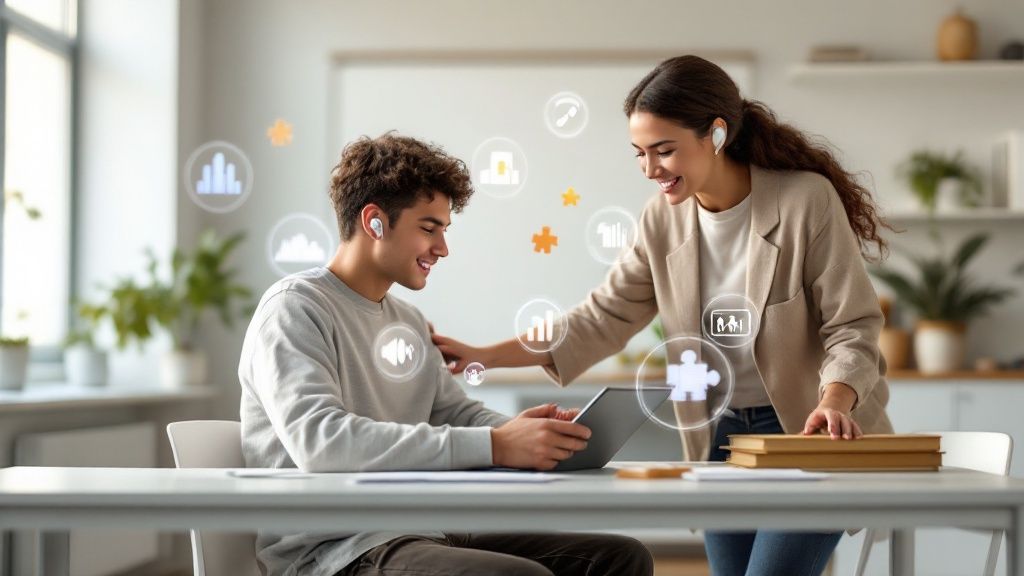
At its heart, personalized learning is a simple idea: education should adapt to the student, not the other way around. It’s an approach that customizes learning to fit each person’s unique strengths, specific needs, and individual interests. Instead of a one-size-fits-all classroom, it carves out a flexible path where every student can move forward at their own speed.
Defining Personalized Learning in Simple Terms
Think of it like hiring a personal trainer for your education. A great trainer wouldn't hand everyone the same workout plan. They'd start by assessing your current fitness, understanding what you want to achieve, and then designing a routine specifically for you. Personalized learning brings that same logic into the classroom.
It’s a big shift from the traditional model where every student is expected to learn the same thing, at the same time, in the exact same way. This student-first approach is all about figuring out what each learner needs to truly thrive. It’s more than just adding technology to a classroom; it’s a change in mindset that gives students more ownership over their own education. This very idea is at the core of new concepts like AI schooling, which redefines personalized education by placing individual needs front and center.
The Building Blocks of a Tailored Education
So, what does this actually look like day-to-day? A personalized learning environment is built on a few core ideas that all work together to make learning more effective and dynamic.
Student-Centered Paths: The material connects directly to a student's interests and academic goals, which makes it far more engaging and relevant.
Competency-Based Progression: Students only move on to the next topic after they’ve shown they've truly mastered the current one. This ensures no one gets left behind with gaps in their knowledge.
Flexible Environments: Learning doesn't have to happen in one place at one time. Students get a say in how, when, and where they learn.
This approach creates an ecosystem where a student's pace, interests, and the feedback they receive are all connected.
As you can see, it's not about one single strategy. It's about building a responsive and adaptive educational experience where every student has the support they need to succeed.
To better understand the shift, let's compare the two approaches side-by-side.
Traditional vs Personalized Learning at a Glance
This table breaks down the key differences between a standard classroom and a personalized one.
Aspect | Traditional Learning | Personalized Learning |
|---|---|---|
Pacing | Teacher-led, same for all students. | Student-led, based on mastery. |
Instruction | One-size-fits-all delivery. | Differentiated for individuals/groups. |
Student Role | Passive receiver of information. | Active participant in their learning. |
Curriculum | Rigid and standardized. | Flexible and customized to interests. |
Assessment | Standardized tests at set times. | Ongoing, real-time feedback. |
It's clear that personalized learning fundamentally changes the dynamic, putting the student firmly in the driver's seat.
Personalized learning acknowledges a simple truth: every student learns differently. By adapting the educational experience to fit the learner, not the other way around, we can unlock greater potential and foster a genuine love for learning.
Supporting these different learning styles is crucial. For auditory learners—students who absorb information best by listening—tools that turn text into speech can be a game-changer. For instance, an app like Speak4Me can convert any digital or physical text into clear audio, which helps make everything from textbooks to articles instantly more accessible. You can see more on how Speak4Me supports diverse learning needs in education.
The Core Principles of Personalized Education

Personalized learning isn't just one single tactic. It's more of a mindset, a framework built on a few core ideas that all work together. The big shift is moving away from the old-school, one-size-fits-all model and toward an environment that’s flexible and puts the student in the driver's seat.
The real heart of this approach is something called student agency. All that means is that learners get a real say in what they learn, how they learn it, and even when and where they do their work.
Instead of just sitting back and absorbing information, students are actively involved. This could be as simple as letting them pick a research topic they’re actually curious about. Or it could mean giving them the choice to show what they know through a traditional essay, a slide presentation, or even a hands-on project. That sense of ownership makes a huge difference in motivation.
Moving at the Speed of Understanding
Another key piece of the puzzle is mastery-based progression. It helps to think of it like leveling up in a video game—you can't get to the next stage until you've beaten the one you're on. Education can work the same way.
Students only move on to the next concept after they’ve shown they truly get the current one. This simple rule prevents small learning gaps from turning into major roadblocks later on, making sure every student has a solid foundation to build upon.
A few things make this flexible pacing possible:
Flexible Learning Paths: There isn't just one way to get to the finish line. Students are given different routes to learn the material, so they can pick what makes sense to them.
Varied Content Formats: Information comes in all shapes and sizes—text, videos, audio, and interactive tools. This variety helps cater to all the different ways people learn.
Ongoing Feedback: Quizzes and assignments aren't just for a final grade. They're used all the time to give students and teachers immediate feedback, guiding the next steps in the learning process.
The core idea is simple yet profound: learning should be a journey, not a race. When students are allowed to progress based on mastery, they build confidence and a deeper, more lasting understanding of the material.
This is where technology really shines, giving us the tools to manage all these different paths and content types. An assistive app like Speak4Me, for example, fits perfectly into this model. It lets any student instantly turn written text—from a dense textbook chapter to an online article—into clear, spoken audio.
This one feature opens up a world of possibilities. It empowers students who learn best by listening and gives everyone the freedom to engage with material in a way that suits their situation, whether they're at a desk or on the bus.
That's what personalized learning is really all about. It’s about building an educational experience that sees and responds to the individual, giving every single learner the tools they need to find their own path to success.
Why not try a tool that supports this modern approach? Download Speak4Me free on iOS and hear for yourself how audio can change the way you study.
Real Benefits for Students and Teachers
When we talk about personalized learning, we're not just discussing a new trend in teaching. We're talking about real, measurable results for everyone in the classroom.
For students, the most obvious change is a massive boost in engagement. Learning stops feeling like a chore and starts becoming an exciting journey when the material actually connects with their interests and they can move at a pace that feels right for them.
This renewed excitement naturally leads to stronger academic performance. Kids build a much deeper understanding of the subject matter because they're not being pushed ahead before they've truly grasped a concept. They also start developing critical self-advocacy skills by learning to recognize what they need and how to ask for it.

Empowering Educators with Better Tools
It's not just students who benefit, either. Teachers find themselves with a whole new set of tools to provide targeted, meaningful support. Instead of trying to teach a single lesson to a room full of different learning styles, they can see exactly where each student is and step in right when help is needed.
This completely changes the teacher's role. They shift from being a lecturer at the front of the room to a true facilitator of learning. It frees them up from repeating the same instructions over and over so they can focus on what they do best: mentoring, guiding, and inspiring their students.
Personalized learning equips educators with a clearer view of each student's journey. This allows them to move from broad instruction to precise, impactful support that fosters real growth and confidence.
The demand for this kind of educational approach is fueling huge growth in the market. Valued at $4.74 billion, the personalized learning sector is expected to jump to $6.01 billion in the next year. That's a staggering 26.7% growth rate, driven by new inclusive education policies and parents who are looking for better ways for their kids to learn. You can explore the full market analysis on The Business Research Company.
How Accessibility Tools Drive Better Outcomes
A big piece of this puzzle involves tools that make learning more flexible. A simple app like Speak4Me, for instance, gives educators a powerful way to offer course materials in a different format. It can take a dense textbook chapter or a lengthy online article and turn it into clear, easy-to-follow audio.
This immediately removes barriers for auditory learners or students who find reading challenging, letting them absorb the curriculum in a way that works for them. When educators can provide content in multiple formats, they're better able to reach every single student. You can learn more about how text-to-speech improves student performance and see just how vital audio tools have become.
Ready to see how this can work for your students? Download Speak4Me free on iOS and discover the difference accessible audio can make.
How Technology Makes Personalization Possible
The idea of crafting a unique educational path for every single student is the dream, right? For a long time, though, it was just that—a dream. Trying to do it for a whole classroom, let alone a whole school, felt impossible. But today, technology is turning that dream into a reality, with Artificial Intelligence (AI) leading the charge. It’s handing teachers the tools they need to finally understand and respond to each student’s needs on a massive scale.
Now, AI isn't here to replace teachers. Think of it more like an incredibly smart assistant. It does the heavy lifting—sifting through performance data, spotting patterns, and flagging areas where a student might be getting stuck. This frees up educators to do what they do best: mentor, inspire, and connect with their students.
The result is a learning journey that flexes and adapts in real-time. If a student is flying through a concept, the system can introduce a new challenge to keep them engaged. If they're struggling, it can offer up extra practice and support until they get that "aha!" moment.
The Rise of AI in Education
The numbers really tell the story here. The AI-powered personalized learning market is already valued at around $6.5 billion. But hang on, because projections show it could explode to $208.2 billion within the next decade. That kind of growth shows just how much value schools are finding in these tools. This data, highlighted in AI-driven education market findings on Insightace Analytic, is all driven by AI's knack for fine-tuning the learning experience based on how students are actually doing.
We're also seeing the rise of incredibly practical tools like AI lesson plan generators. These helpers allow educators to quickly create customized materials, saving them precious time while still delivering a tailored lesson.
Simple Tools Can Have a Huge Impact
While big, complex AI systems are making waves, personalization doesn't always have to be complicated. Sometimes, the most powerful tools are the simple ones that solve a very specific problem. This is especially true for technology that supports different learning styles.
Technology’s greatest strength in education is its ability to offer choice. By providing content in multiple formats—text, video, and audio—we empower students to learn in the way that makes the most sense to them.
Take a student who learns best by listening. For them, a tool that can turn any text into audio is a game-changer. This is exactly where an app like Speak4Me comes in. It uses powerful text-to-speech technology to instantly convert articles, PDFs, or any document into clear, natural-sounding audio.
That one simple feature tears down a huge barrier for auditory learners. It also gives every student the freedom to listen to their notes or assigned reading while they’re on the bus, at the gym, or just taking a walk. It’s a perfect example of how straightforward tech can make a big difference in a personalized learning plan without adding any complexity for teachers or students.
See it for yourself and give yourself another way to learn. Download Speak4Me free on iOS and start turning your reading materials into audio lessons.
Putting Personalized Learning into Practice
It’s one thing to talk about personalized learning, but putting it into action is where the magic really happens. The great news for teachers, parents, and students is that you don’t need to flip your entire world upside down to get started. It’s all about making small, deliberate changes that hand more control back to the learner.
This can be as simple as offering flexible assignments. Instead of the default five-page essay, what if a student could show what they know by creating a slide deck, a short video, or a hands-on project? Another easy win is letting them pick their own project topics. This instantly connects the curriculum to their genuine interests and gets them excited to dig in.

Making Small, Impactful Changes
For educators, technology is a fantastic ally for offering content in different formats. A core idea of personalized learning is making sure information is accessible to everyone, no matter how they learn best. This is where tools that cater to different learning styles become invaluable.
Think about a history teacher assigning a chapter on the Roman Empire. Some students will happily read it and absorb every detail. Others are auditory learners who would grasp it much faster if they could hear it read aloud.
By providing content in multiple formats—text, audio, and video—educators create more entry points for students to engage with the material. This simple act of offering choice can make a profound difference in comprehension and confidence.
This is exactly where a tool like Speak4Me fits perfectly into the personalized learning toolkit. It lets a student take that assigned chapter—or any article, PDF, or set of study notes—and instantly turn it into clear audio. This empowers auditory learners, helps students who struggle with reading, and gives everyone the freedom to listen and learn while on the move.
The Role of Technology in Everyday Learning
Artificial Intelligence is making these kinds of adjustments easier than ever. In fact, the global AI in education market hit $7.57 billion, a 46% jump from the previous year, with a staggering 86% of education organizations already using generative AI. These numbers aren't just statistics; they show a massive shift toward using tech to make learning more effective for everyone. You can discover more insights about AI in education statistics on Engageli.com.
For a parent, this might look like using an app to find videos and articles that feed their child's current obsession, whether that’s dinosaurs or deep-sea creatures. For a student, it means having tools that let them review class notes in a way that truly clicks for them, like listening to them on the bus ride home.
The journey to personalized learning isn’t a giant leap. It’s a series of small, manageable steps toward creating a more flexible, responsive, and supportive environment for every single learner.
Ready to take the first step in your own learning journey? Download Speak4Me free on iOS and turn any text into a new opportunity.
Got Questions About Personalized Learning?
As personalized learning becomes more common, it's natural for questions—and a few myths—to pop up. Getting these sorted out is the best way to see what this approach is all about and feel good about using it. Let’s tackle some of the things students, parents, and teachers ask most often.
We're aiming for clear, straight-up answers that show why tailoring education to each student works so well. Once we clear the air, you'll see this isn't just some lofty idea; it's a real, hands-on way to help every single learner succeed.
Is This Just for Kids Who Are Falling Behind?
Not at all. This is probably the biggest myth out there. While personalized learning is a fantastic way to give extra support to students who are struggling, it’s designed to help everyone.
Think about it: gifted and advanced students often get bored waiting for the rest of the class to catch up. In a personalized setting, they can dive deeper into subjects they love, move ahead at their own pace, or take on tougher projects that truly challenge them. The whole point is to meet every student right where they are and give them what they need to move forward.
Does Personalized Learning Mean More Screen Time?
That's a fair question, and one we hear a lot. Technology is definitely a big part of making personalized learning work, but it shouldn't mean kids are staring at a screen all day. A good approach is all about balance, mixing digital tools with hands-on activities, group work, and good old-fashioned one-on-one time with a teacher.
In fact, some of the best tools are designed to get students away from their screens.
A huge part of making learning personal is giving students different ways to take in information. Audio tools are a great screen-free option that lets them learn without straining their eyes.
This is exactly where an app like Speak4Me comes in. It can turn any digital text—from class notes to reading assignments—into audio. Students can listen while they're on the bus, walking the dog, or just chilling out, making study time more flexible and cutting down on screen time.
How Can One Teacher Handle So Many Different Learning Plans?
The idea of juggling 30 different learning paths sounds like a nightmare, right? But that’s where technology really helps out. Teachers aren’t doing it all by hand. Modern learning platforms give them a central dashboard to see how every student is doing in real-time. The software can automatically flag who’s getting stuck and who’s flying ahead.
This information changes the teacher's role from a lecturer at the front of the room to more of a guide or a coach. They can spend their time working with small groups or individual students who need them most. Technology takes care of the tracking, so teachers can focus on what they do best: teaching and connecting with their students.
Ready to try a tool that makes learning more flexible and screen-free? With Speak4Me, you can turn any text into audio and learn on your own terms. Download Speak4Me free on iOS and find a smarter way to get through your reading list.
Try Speak4Me for Free
