What Is Visual Learning Style Explained

Ever tried to assemble furniture by following a video tutorial instead of wading through a dense instruction manual? If you nodded yes, you’ve experienced the power of the visual learning style firsthand.
At its core, visual learning is all about understanding and remembering information best when you can see it. It’s not just about pretty pictures; it’s about your brain processing ideas through charts, diagrams, and other visual aids.
What Does It Mean To Be a Visual Learner?

If you're the person who remembers a face instantly but struggles with the name, or if you find yourself doodling in the margins to grasp a tough concept, you're likely tapping into visual learning traits. Your brain is wired to spot patterns, draw connections, and organize information using visual cues.
This learning preference is far from niche. In fact, studies suggest that approximately 65% of the population are visual learners. This staggering number explains why visual tools aren't just a "nice-to-have" in education and communication—they're often essential for getting the message across effectively.
Core Traits of a Visual Learner
So, what does a visual learner really look like in practice? They often share a few key characteristics. For a quick snapshot, here’s a breakdown of what to look for.
Visual Learner Profile At A Glance
Characteristic | Description |
|---|---|
Visual Memory | Remembers faces, places, and visual details with ease, but might forget spoken instructions or names. |
Prefers Visuals | Thrives with charts, graphs, mind maps, and diagrams. A long lecture can feel draining without visual support. |
Strong Organizer | Naturally good at planning and organizing because they can "see" the final outcome in their mind's eye. |
Color-Coding | Often uses highlighters, colored pens, or sticky notes to organize and prioritize information. |
Spatial Awareness | Has a good sense of direction and can easily read maps or visualize layouts. |
Essentially, the motto for a visual learner is, "Show me, don't just tell me." They come alive when information is presented in a way they can see, map out, and mentally photograph.
Of course, most of us use a mix of learning styles. It’s interesting to see how this compares to the auditory learning style, which is all about hearing and listening.
Knowing you're a visual learner unlocks a whole new toolbox of strategies for studying and absorbing information. For anyone who gets bogged down by huge walls of text, tools that assist with reading visually are a huge help. An app like Speak4Me, for instance, highlights words as they're read aloud, bridging that gap between seeing the text and understanding it. Ready to transform your reading experience? Download Speak4Me free on iOS.
How to Spot a Visual Learner
Ever wonder if you—or someone you know—is a visual learner? You don't need a fancy quiz to figure it out. It’s all about paying attention to the little things, the ways we instinctively try to make sense of the world around us.
Think about that coworker who's always doodling during meetings. They're not zoning out. More likely, they're turning spoken words into shapes and images, hardwiring the information into their brain in a way that makes sense to them. That’s a visual learner in their natural habitat.
Common Habits of a Visual Mind
This preference for seeing things to understand them pops up in all sorts of everyday situations. See if any of these sound familiar:
You remember faces but forget names. You can picture the person, where you met, and even what they wore, but their name just won't stick.
You'd rather watch a video than read instructions. When it's time to build that new bookshelf, you immediately search for a YouTube tutorial instead of wrestling with the paper manual.
You need to see the "big picture." Before starting a new project, you instinctively reach for a whiteboard or a blank piece of paper to draw a mind map or flowchart. You need to visualize how everything connects.
You're great at organizing. Whether it's arranging your desk, color-coding your files, or planning a vacation itinerary, you have a knack for it because you can see the finished, organized version in your head.
A true visual learner often thinks in pictures. When listening to a story or an explanation, they’re creating a mental movie to go along with the words. This internal film is crucial for them to truly grasp and remember the information.
These traits all point to one core idea: for a visual learner, seeing is understanding. Staring at a wall of plain text can feel like trying to solve a puzzle with half the pieces missing.
That’s why tools that bring a visual element to the written word can be so helpful. An app that highlights words as they're read aloud, for example, builds a bridge between what you see and what you hear, making it so much easier for your brain to keep up.
To see this in action and give your own learning a boost, Download Speak4Me free on iOS.
Powerful Study Strategies For Visual Learners
So, you've figured out you're a visual learner. That's a great first step, but the real magic happens when you start using that knowledge to your advantage. To make information truly stick, you need to go beyond just reading words on a page. The goal is to translate that text into a visual language your brain can easily grasp—think pictures, patterns, and structures.
Even small changes can have a huge impact. Instead of just highlighting your textbook, for instance, try creating a color-coded system. You could assign one color to key concepts, another to important dates, and a third to definitions. This creates a visual code that helps your brain quickly find and recall information when you need it most.
This infographic shows some common habits that are dead giveaways for a visual learning style.
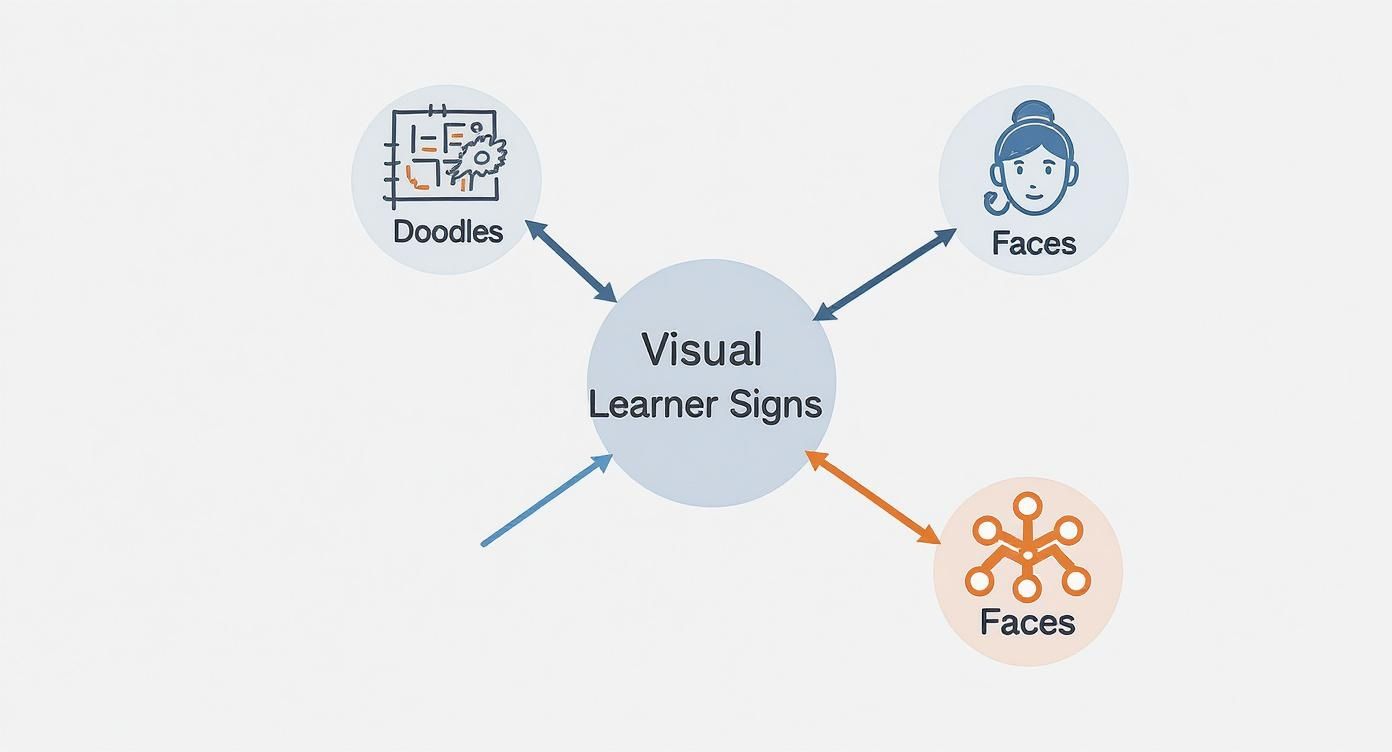
As you can see, if you find yourself doodling in margins, easily remembering faces, or instinctively organizing your thoughts into mind maps, you’re likely processing the world visually.
Transform Your Note-Taking
It's time to ditch the endless pages of linear text. Your notes should be a visual playground where ideas come to life. Try weaving these methods into your study routine to make your sessions far more effective.
Create Mind Maps: Put a central idea in the middle of the page and draw branches for related concepts. This non-linear approach helps you see the connections between different topics at a glance.
Use Flowcharts and Diagrams: Trying to understand a process or a historical timeline? A flowchart is your best friend. It turns a dense paragraph of text into a clear, logical path that's easy to follow.
Incorporate Sketches and Symbols: You don't have to be an artist! A quick sketch or a simple icon next to a key term can create a powerful mental shortcut, making abstract concepts feel much more concrete.
These strategies are more critical than ever. With the average human attention span now down to just 8 seconds—a drop of nearly 25% in only a few years—visually engaging material is essential for staying focused and retaining information.
Leverage Digital Tools For Visual Learning
Today’s technology offers some fantastic ways to cater to your learning style. In the past, visual learners relied on pens and paper, but digital tools have opened up a new world of possibilities.
Here's a quick look at how traditional methods stack up against modern digital alternatives.
Visual Study Techniques and Tools
Technique | Description | Recommended Tool |
|---|---|---|
Mind Mapping | Creating a diagram to visually organize information, starting with a central concept and branching out. | |
Flashcards | Using cards with visual cues (images, diagrams) on one side and information on the other for active recall. | |
Visual Note-Taking | Incorporating drawings, symbols, and spatial layouts into notes instead of just writing linear text. | Goodnotes or Notability |
Color-Coding | Assigning specific colors to different categories of information to create a visual organization system. | Evernote or a physical highlighter set |
These tools aren't just about making things look pretty; they actively help you process and remember information more effectively. For a wider view on how to improve your study habits, you can find helpful resources on platforms that offer general study and learning strategies.
By turning learning into an active process of visual creation, you're not just studying—you're building a mental library of interconnected images, making recall faster and more reliable.
For even more actionable ideas, check out our dedicated guide on study tips for visual learners.
Tools like Speak4Me can also be a game-changer. By highlighting text as it's read aloud, it combines both auditory and visual learning, which keeps you engaged and helps you follow along without getting lost in a wall of words. It’s a simple way to make your study materials more dynamic.
How Speak4Me Helps Visual Learners
If you’re a visual learner, staring at a massive wall of text can feel overwhelming, like a barrier to actually understanding the content. This is exactly where a tool like Speak4Me comes in. It helps turn those static pages into something much more dynamic and easier to process.
While its main job is to read text out loud, its real magic for visual learners is how it displays the information.
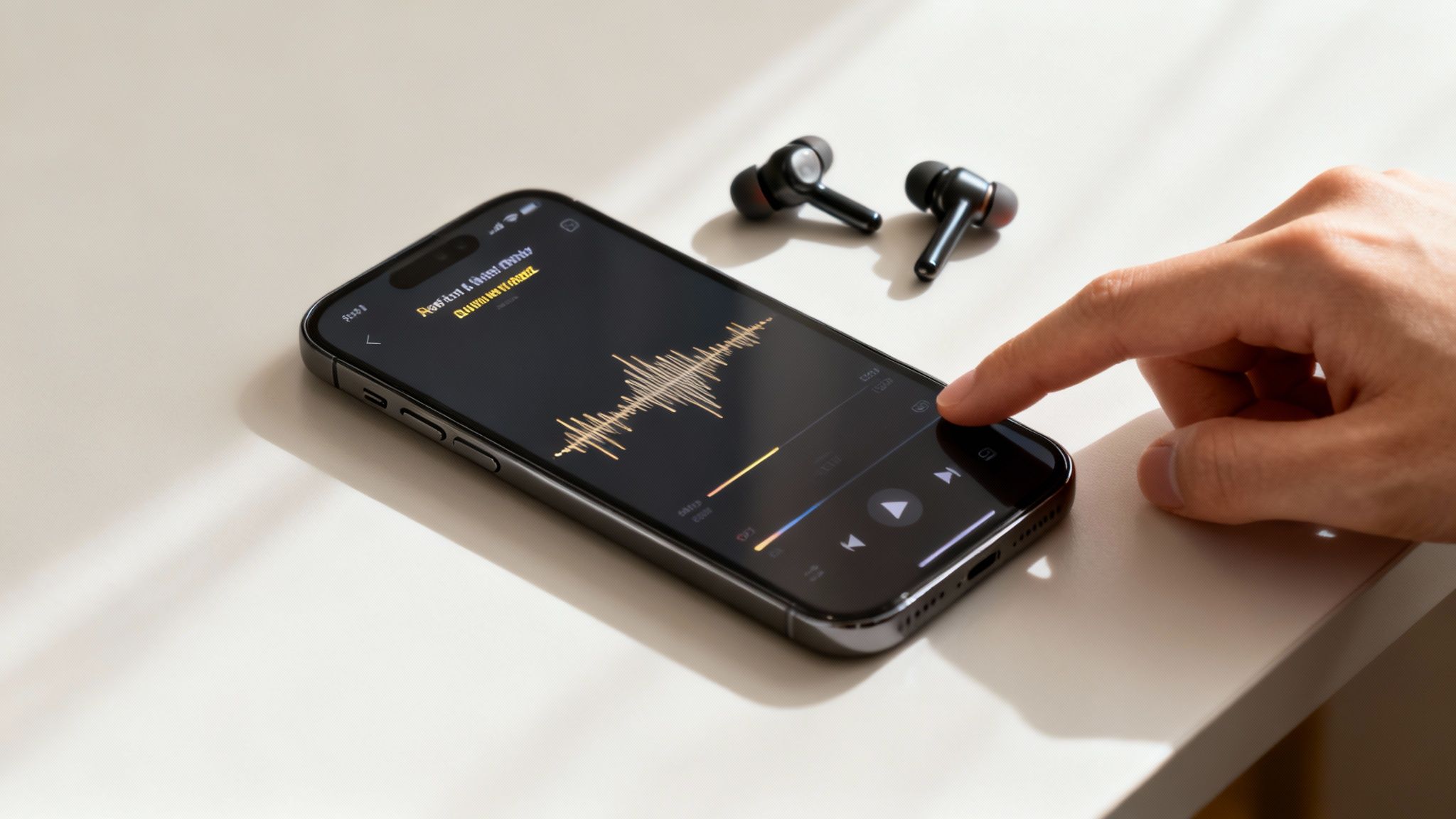
The app highlights each word as it’s spoken, creating a powerful connection between what you see and what you hear. This simple feature turns boring text into a moving guide that keeps your eyes on track, which can make a huge difference for focus and comprehension.
Connecting What You See with What You Hear
By letting you see and hear words at the same time, Speak4Me helps break down dense paragraphs into smaller, more manageable pieces. This dual-sensory approach works with the way your brain naturally processes information visually, making it much simpler to follow along without constantly losing your spot.
This method is a key part of modern assistive technology for reading and offers critical support for all kinds of learners. It lightens the mental load and makes tackling written material feel far less intimidating.
Highlighting text as it’s read aloud turns passive reading into an active, engaging experience. It assists with word recognition, strengthens the connection between written and spoken language, and ultimately helps you remember more of what you read.
On top of that, many people find that speaking their thoughts and having them typed out helps them create their own visual notes. Learning to dictate directly into a program like Google Docs can be a game-changer for getting your ideas down. To get the hang of it, you can check out this helpful guide to dictating directly into Google Docs.
At the end of the day, Speak4Me is a straightforward but incredibly effective tool for making text more accessible and visually engaging. It’s designed to help you work with your natural learning style, not fight against it.
Ready to add it to your toolkit? Download Speak4Me free on iOS and see how it can change the way you read.
What's the Real Deal with Learning Styles?
You’ve probably heard people talk about being a "visual learner" or an "auditory learner." But where did this idea come from, and what does the science actually say about it? Let's take a look at the popular VAK model—Visual, Auditory, and Kinesthetic—and get a clearer picture of what it all means today.
The whole concept of tailoring teaching methods to a student's specific learning style has been around for a long time. The VAK model, which includes the visual learning style, actually dates back to the 1910s. But even with that long history, most modern researchers now push back on the idea that people fit neatly into just one learning "box."
A Fresh Look at an Old Idea
It's fascinating, though, how much this idea has stuck around in education. A surprising 89% of teachers globally still believe that matching lessons to a student's learning style is beneficial, even though many scientists now consider this a neuromyth. You can dig into some of the interesting stats on learning here.
So, if the science is shaky, what does that mean when you ask, "what is visual learning style?"
The big takeaway here isn't about slapping a label on yourself. It's about recognizing that visual tools are an incredibly powerful, evidence-backed way to help almost everyone understand and hang onto information better.
Let's Focus on What Actually Works
The strategies in this guide aren't about subscribing to a rigid, outdated theory. They're all about using what we know works: visual communication makes learning easier and more effective. You don’t need to be a card-carrying "visual learner" to get a huge benefit from these techniques.
At the end of the day, using things like flowcharts, diagrams, and color-coded notes is just plain smart. It’s a great way to take dense, complicated information and translate it into a format our brains can digest much more easily.
Want to see how making text more visual can help you? Download Speak4Me free on iOS and see for yourself how features like highlighted text can boost your focus and understanding.
Got Questions About Visual Learning?
Let's tackle some of the most common questions people have about visual learning. Getting these answers straight can make a real difference in how you apply these ideas to your own study habits or daily life.
Can Someone Have More Than One Learning Style?
Definitely. Almost nobody is 100% one type of learner. Think of it less like a fixed category and more like a preference.
Most of us have a primary style but pull from others when we need to. This is often called a multimodal approach. You might be a strong visual learner who loves diagrams, but you still get a ton of value from listening to a great podcast (auditory) or getting your hands dirty building something (kinesthetic).
The point isn't to lock yourself in a box. It's about knowing your go-to style so you can build a more effective and flexible learning toolkit that truly works for you.
What Are Some Easy Ways to Use Visual Learning Every Day?
You don't have to overhaul your whole life to start seeing the benefits. Weaving in a few simple, visual habits can make a surprising difference in how you retain information day-to-day.
Color-Code Your Calendar: Ditch the boring black-and-white schedule. Assign specific colors to different parts of your life—work, family, fitness, errands. At a glance, you'll know exactly what your week looks like.
Default to Video: Need to learn something new? Whether it's fixing a bike chain or figuring out a new software trick, jump on YouTube first. Watching someone do it is often much easier than reading a manual.
Create Visual Reminders: Swap out your text-only to-do list for sticky notes with little sketches or symbols. A quick drawing of a lightbulb for a brainstorming session is much more engaging than plain words.
Sketch It Out: Before you start your next big project, grab a pen and paper and draw a mind map. It’s a fantastic way to see how all your ideas connect without getting stuck in a rigid, linear outline.
Are There Any Downsides to Being a Visual Learner?
It's not so much a "downside" as it is a challenge in certain situations. If you're stuck in a long, dry lecture with no slides or handed a dense report with zero charts, it can be tough to stay engaged. Your mind might start to wander when there's nothing for your eyes to latch onto.
The key isn’t to see this as a weakness but as a signal to adapt. Your strength lies in creating your own visual aids to bridge the gap when they aren't provided.
This is where you can take the driver's seat. In that boring lecture? Start doodling notes, creating flowcharts, and connecting ideas with arrows. When faced with a wall of text, a tool like Speak4Me can be a game-changer. It highlights words as it reads them aloud, instantly turning a static page into a dynamic, easy-to-follow visual experience.
Turn dense text into an engaging visual and auditory experience with Speak4Me. See how highlighted text can improve your focus and comprehension when you Download Speak4Me free on iOS.
Try Speak4Me for Free
