What Is Working Memory Explained Simply

Working memory is your brain's temporary, active workspace. Think of it as a mental whiteboard where you can hold, manipulate, and use information to get things done right now. It’s the critical skill that lets you follow a conversation, figure out a tip in your head, or remember a new phone number just long enough to dial it.
Understanding Your Brain's Mental Whiteboard

Let's use a simple example: following a recipe. You read a step, hold that instruction in your mind while you grab the ingredients, and then perform the action. That whole juggling act—reading, remembering, and doing—is managed by your working memory.
It’s not just a passive storage bin. It's an incredibly active, dynamic system that processes information in real time.
This mental workspace is what connects our past experiences with our present actions. When a friend tells you a story, your working memory holds the beginning of their sentence so the end makes sense. It’s the cognitive engine that powers our reasoning, planning, and day-to-day understanding of the world.
How It Differs From Other Memory Types
It’s easy to get working memory mixed up with short-term or long-term memory, but they each play a very different role in how your brain operates.
Short-Term Memory: This is just a temporary holding pen. It keeps a few pieces of information for a very brief time (usually less than 30 seconds) without doing anything to them. Imagine a sticky note that quickly loses its stickiness.
Long-Term Memory: This is your brain's vast, permanent library. It's where a lifetime of knowledge, skills, and experiences are stored. Information here is filed away for later retrieval, from your first pet's name to how to ride a bike.
Working memory is the busy bridge between the two. It pulls relevant files from your long-term memory library and combines them with new information coming in from your senses, helping you navigate whatever you're doing at the moment.
Working memory is the crucial link between perception, long-term memory, and action. It’s the manager that decides what information to focus on, what to ignore, and how to use it to achieve a goal.
Working Memory vs. Other Memory Types
To make the distinction crystal clear, here’s a quick comparison of their jobs, how much they can hold, and for how long.
Memory Type | Function | Capacity | Duration |
|---|---|---|---|
Working Memory | Actively processes and manipulates information | Very limited (a few items at a time) | Seconds to minutes |
Short-Term Memory | Temporarily holds information passively | Limited (around 7 items) | Up to 30 seconds |
Long-Term Memory | Stores information for future retrieval | Virtually unlimited | Minutes to a lifetime |
This difference is key. When you feel mentally swamped, it’s usually your working memory—the active processor—that's overloaded, not your storage.
Supporting this mental whiteboard is the secret to clearer thinking and better focus. Ready to give your working memory a powerful assistant? Download Speak4Me free on iOS and see how a smarter approach to managing information can help.
How Your Working Memory Juggles Information
Ever wonder how you can hold a phone number in your head just long enough to dial it? That's your working memory in action. The best way to think about it is like a small, highly efficient project team running things inside your mind.
This team isn't just a passive storage space; it's constantly working, managing, and manipulating information to help you get things done right now. The leader of this mental crew is the Central Executive, which acts as the project manager. It decides where your attention goes and coordinates the whole operation.
But the Central Executive doesn't do all the heavy lifting itself. It has two specialists it delegates tasks to, each one an expert in handling a different type of information. This setup is why you can process sights and sounds at the same time, making it possible to do something complex like follow GPS directions while navigating traffic.
This image below gives you a great visual of how these three core parts—the Central Executive, Phonological Loop, and Visuospatial Sketchpad—work together as a system.
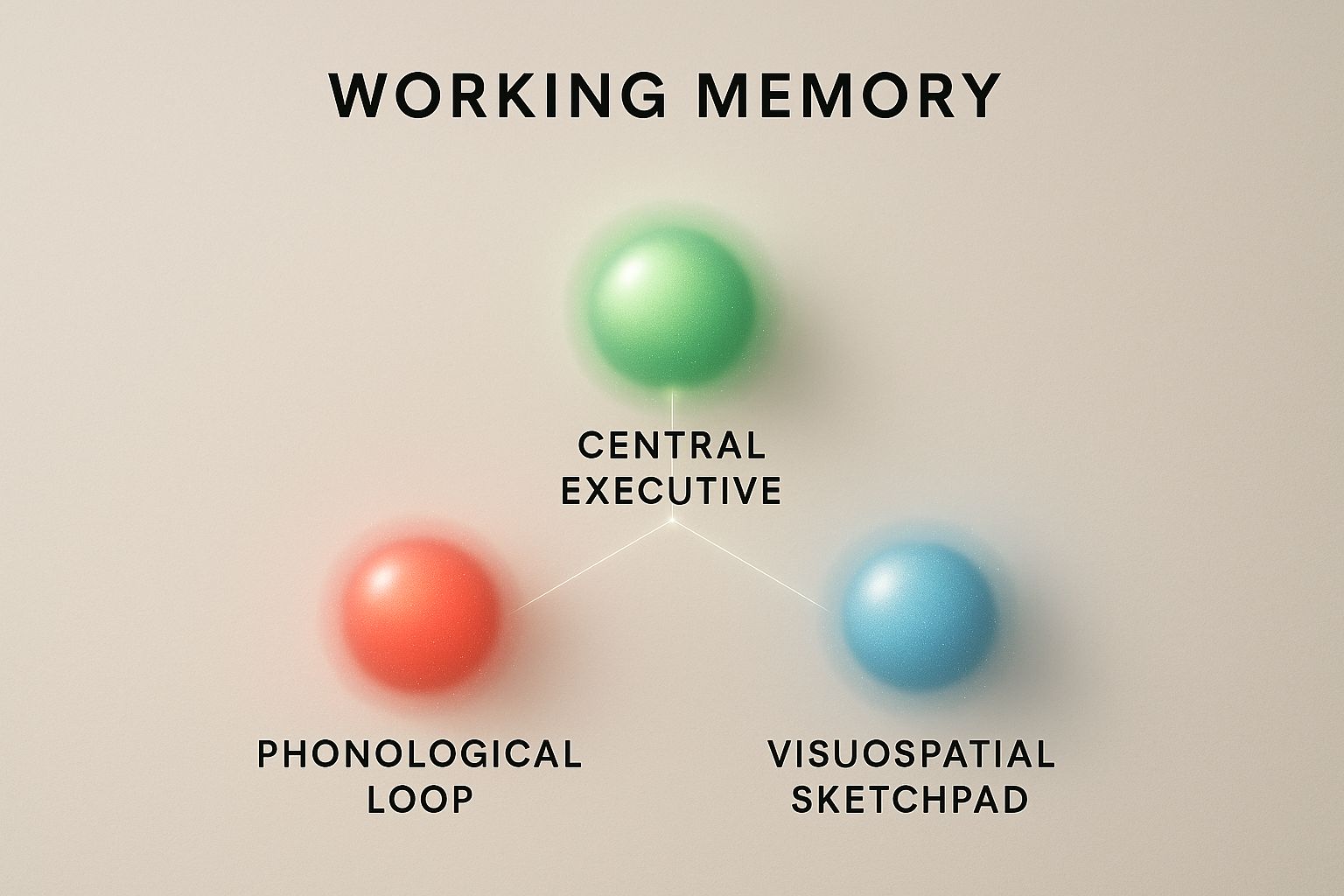
As you can see, the Central Executive is the command center, directing the flow of information to its two specialized assistants for processing.
The Auditory and Visual Specialists
First up is the Phonological Loop. You can think of this as your brain's "inner voice" and "inner ear." It’s in charge of all things sound-related, repeating information to itself to keep it fresh in your mind.
Example: Someone gives you their phone number, and you silently say it over and over to yourself. That's your Phonological Loop holding onto the digits until you can jot them down.
The second specialist is the Visuospatial Sketchpad, which is basically your "inner eye." This is the part that handles visual and spatial details, letting you build and move images around in your head.
Example: You're rearranging your living room. The Visuospatial Sketchpad is what lets you picture how the couch would look against the other wall, all without having to move a thing.
These two components work together beautifully. As your inner eye visualizes the route to a new coffee shop, your inner voice might be rehearsing the street name for your next turn. It's this teamwork that lets us navigate the world so effectively.
Of course, this mental team has its limits. It can get overwhelmed pretty easily. If you’re trying to remember a long list of instructions while also dealing with a noisy, busy environment, the Central Executive can really struggle to keep up. If you're interested in digging deeper, there are great resources on focus mastery and brain concentration that can help.
This is exactly where an external tool can make a huge difference. By using an app like Speak4Me, you can offload some of that auditory or visual information. The app can essentially assist your brain, freeing up your internal team to focus on what really matters. It takes the pressure off that mental juggling act.
Why Your Mental Workspace Gets Overloaded
Ever tried to listen to a podcast, answer an email, and mentally run through a grocery list all at once? If you have, you’ve probably felt your brain just hit a wall. That feeling of being mentally “full” is your working memory bumping up against its natural—and surprisingly small—capacity.
This limit is what experts call cognitive load: the total amount of mental effort being used in your working memory at any given time. Your brain can only juggle a few pieces of information before things start to get dropped. Once you push past that limit, your performance nosedives, mistakes creep in, and that familiar feeling of being overwhelmed takes over.
Think of it like a computer with a tiny amount of RAM. A couple of simple programs? No problem. But try to open ten complex applications, and the whole system will slow down, freeze, or maybe even crash. Your brain works in a similar way, carefully rationing its limited resources to handle whatever you throw at it.
The Role of Complexity and Distractions
It’s not just about how many things you’re trying to remember, but how complex they are.
For instance, holding three simple numbers like "5, 8, 2" in your head is a piece of cake. But remembering three complex scientific terms like "mitochondria, ribosome, cytoplasm" is a whole different ball game.
Research consistently shows that as information gets more complex, the effective capacity of our working memory shrinks. Simpler items take up less mental space, letting you hold more of them. But complicated ideas, with all their interconnected parts, demand a huge chunk of your mental resources. If you're curious about the science, there's a lot of research on item complexity and working memory capacity.
And it’s not just the task itself. External factors can shrink your available mental bandwidth even more.
Stress and Fatigue: When you're tired or anxious, your brain is already busy managing those feelings, leaving less room for everything else.
Constant Distractions: Every notification, interruption, and bit of background noise is a new competitor for your attention. This forces your working memory to constantly switch gears, which is exhausting. Our guide offers practical tips on how to improve focus in a noisy world.
Information Overload: Sometimes, just being exposed to too much information at once can max out your capacity before you’ve even started processing it.
Understanding these limitations is the first step toward managing them. When your mental workspace is consistently overloaded, it’s not a personal failing—it’s a sign that your cognitive system is being pushed beyond its natural limits.
This is exactly where assistive tools can be such a game-changer. By offloading information to an external aid, you free up your precious mental RAM for what it does best: thinking, solving problems, and connecting ideas.
Lighten your cognitive load and give your brain the support it needs. Download Speak4Me free on iOS to create a more efficient mental workspace.
Working Memory in Action Every Day
Think of your working memory as the brain’s busy countertop. It’s not where you store things long-term (that’s the pantry), but it’s where you place all the ingredients you need right now to get a task done. You use this mental workspace constantly, often without even realizing it.
Ever tried to calculate a tip at a restaurant without a calculator? You have to hold the bill’s total in your head, remember if you want to leave 15% or 20%, do the math, and then add it all up. Each of those steps relies on your working memory holding and juggling those numbers for you.
From Conversations to Comprehension
This mental juggling happens all day, every day.
When a friend is telling you a long story, your working memory holds onto the names and plot points from the beginning so you can actually understand the punchline at the end. Without it, the story would just be a jumble of disconnected sentences.
Reading this article is another perfect example. Your working memory is what keeps the main idea from the first paragraph in mind as you move on to the next one, letting you build a complete picture of the topic. This is why it’s so crucial for reasoning, learning, and just making sense of the world. In fact, research clearly shows a strong link between working memory capacity and other key cognitive skills like processing speed and reasoning. You can see how these cognitive functions are linked in detailed studies.
Every time you follow a recipe with multiple steps, map out a new route in your head, or even just compare the prices of two items at the grocery store, you’re leaning on your working memory. It’s the active “holding and using” of information that makes it all possible.
Recognizing When You Need a Hand
Because it’s always on, you definitely feel it when your working memory gets overloaded. Have you ever forgotten the first half of an instruction someone just gave you? Or lost your train of thought right in the middle of a sentence? That’s your mental countertop getting too cluttered.
For students, that strain can make learning feel like an uphill battle, but there are ways to manage it. Exploring different memory techniques for studying can offer some really effective strategies.
This is where having an external tool can be a game-changer. Instead of forcing your brain to hold onto every single detail, Speak4Me can capture verbal instructions, meeting notes, or key reminders for you. When you offload that information, you free up valuable mental space to focus on what really matters.
Ready to give your working memory the support it deserves? Download Speak4Me free on iOS and handle daily tasks with a little more ease and confidence.
How Speak4Me Can Support Your External Memory
When your mental workspace is constantly full, the goal isn't to force your brain to work harder. It's to work smarter by giving it a reliable assistant. This is the whole idea behind cognitive offloading—using external tools to hold onto information so your working memory is free for the heavy lifting of thinking, problem-solving, and creating.
Think about it: you wouldn’t try to memorize a massive shopping list if you could just write it down. Speak4Me is built on that same simple logic. The app helps act as a powerful external memory you can tap into anytime, anywhere, giving you a practical way to work around the natural limits of our cognitive load.
By offloading information to a system you can trust, you lower your mental strain, reduce the chance of forgetting something important, and feel more confident tackling complex tasks.
Supporting Your Brain’s Core Processes
Speak4Me was designed to directly support the key players in your working memory. Its features line up with how your brain already processes information, making it feel less like a tool and more like a natural extension of your mind.
For example, the text-to-speech function gives your Phonological Loop—that inner voice in your head—a much-needed break. Instead of mentally repeating a set of instructions or a paragraph from a report over and over, you can just have Speak4Me read it aloud. This reinforces the information audibly without using up your precious mental bandwidth.
And what about saving text snippets? This creates a secure, external storage space for details you need to remember. This takes a huge burden off your Central Executive—the team leader of your brain. Instead of wasting its limited energy just remembering data, it can focus on using that data to make decisions and connect the dots.
The Benefits of A Lighter Cognitive Load
When your working memory isn't so cluttered, you can think more clearly and tune out distractions much more easily. Research shows that people with higher working memory capacity are better at ignoring irrelevant information, which gives them more efficient cognitive control. By offloading tasks to Speak4Me, you’re helping your brain achieve a similar state of focused calm. You can read more about the research on cognitive control in this study.
Cognitive offloading isn't a crutch; it's a strategy. By letting technology handle the simple memorization, you save your brainpower for the high-level thinking that truly matters.
Bringing Speak4Me into your daily routine can make a real difference:
Less Frustration: Stop worrying that you'll forget a key detail during a meeting or a lecture.
Clearer Thinking: With fewer items to juggle mentally, you have more room for deep thought and creativity.
More Confidence: Take on complex projects knowing you have a reliable system assisting you.
Ready to give your brain a break and lighten your mental load? Download Speak4Me free on iOS and see for yourself how an external memory can sharpen your focus and boost your productivity.
Lifestyle Habits That Support Working Memory

While technology can give your working memory a serious boost, nothing replaces the fundamentals. Certain lifestyle habits are the bedrock of cognitive health, creating the ideal conditions for your brain to juggle information efficiently.
One of the biggest game-changers is simply getting enough quality sleep. When you’re in a deep sleep, your brain is hard at work, consolidating memories and moving important information from that temporary mental notepad into long-term storage. Skimp on sleep, and that process gets derailed, leaving your working memory feeling foggy and overloaded the next day.
Actionable Strategies for Brain Health
Getting your body moving is another non-negotiable. Regular physical activity pumps more blood to your brain, delivering the oxygen and nutrients it craves to function at its peak. You don't have to run a marathon; even a brisk walk can sharpen your focus and alertness right away.
Mindfulness and meditation are also incredibly powerful. These practices train your brain to filter out the noise and zero in on what matters. By cutting down on distractions, you reduce the unnecessary load on your working memory, freeing up precious mental real estate.
A holistic approach combines healthy habits with smart tools. By supporting your brain's natural processes, you enhance the effectiveness of assistive technologies, creating a powerful system for managing cognitive well-being.
To round out your brain-boosting routine, here are a few more habits to fold into your life:
Engage in Mentally Stimulating Activities: Your brain is like a muscle—it needs a workout. Things like puzzles, learning a new skill, or even reading a complex book help keep your cognitive functions sharp.
Maintain a Balanced Diet: Fueling your brain with the right stuff matters. Foods packed with omega-3s, antioxidants, and key vitamins are known to support brain health. Beyond a good diet, you can also look into the best supplements for cognitive function for an extra edge. Our guide on how to retain information better also has some great tips on this.
When you pair these daily habits with smart tools, you create a complete support system for your brain. It's about giving your mind every advantage possible.
Ready to see how technology can complement your healthy habits? Download Speak4Me free on iOS and take the next step.
Got Questions About Working Memory? We’ve Got Answers.
As we dig into how working memory operates, a few questions tend to pop up again and again. Let's tackle them head-on to clear up any confusion and give you a rock-solid understanding of this incredible cognitive tool.
Is Working Memory Just Another Name for Short-Term Memory?
It’s a common mix-up, but they aren't the same thing. The two are definitely related, but they play very different roles.
Think of short-term memory as a simple holding bin. It can store a few pieces of information for a handful of seconds, but that's it. It’s passive.
Working memory, on the other hand, is the active workspace. It’s not just holding the information; it’s juggling it, manipulating it, and using it to figure something out. It’s the mental countertop where you actually do the work.
So, Can I Actually Make My Working Memory Better?
Yes and no. You probably can't increase its fundamental storage capacity—that seems to be pretty fixed. But you can absolutely make it work smarter and more efficiently.
Things like getting enough sleep and regular exercise are huge for keeping the whole system running at peak performance. But the real game-changer is learning to offload the mental clutter. When you use a tool like Speak4Me to help with remembering, you free up your working memory to focus on what it does best: thinking and problem-solving.
Does Working Memory Get Worse as You Get Older?
It's true that working memory function can change with age. For many people, processing speed might slow down a bit, making it tougher to juggle multiple thoughts at once. This is a totally normal part of the aging process.
The good news is you can absolutely counteract this. Staying mentally sharp and physically active helps a ton. More importantly, you can adopt strategies and tools to support your cognition. Using an app to offload information builds an external support system, taking the strain off your brain and making it easier to handle complex tasks with confidence, no matter your age.
Ready to give your working memory the backup it deserves? Speak4Me can act like your personal external memory, so you can focus on what you do best.
Try Speak4Me for Free
