8 Effective Note Taking Methods to Try in 2025

In a world of information overload, simply writing things down isn't enough. The key to better learning, retention, and productivity lies not in what you record, but how you record it. Many of us stick to the first method we ever learned, but what if a different approach could unlock a new level of understanding? Choosing the right system can transform passive listening into active engagement.
This guide explores eight powerful and effective note taking methods, each designed for different learning styles and situations. Whether you're a student facing dense textbooks, a professional in back-to-back meetings, or a lifelong learner, there's a system here for you. Understanding how your brain processes information is fundamental to this choice; you can explore proven memory retention techniques to see how different strategies align with cognitive science.
But what if you could make your notes even more dynamic? Imagine converting your detailed notes from a lecture or meeting into audio you can listen to anywhere. That's where technology can assist. While exploring these methods, consider how a tool like Speak4Me can supercharge your review process. By transforming your meticulously crafted notes into natural-sounding speech, you engage both your visual and auditory senses, which can significantly enhance comprehension. Ready to find the method that will revolutionize the way you learn? Let's dive in.
1. The Cornell Note-Taking System: A Framework for Active Recall
Developed at Cornell University, this method is a powerhouse for systematic learning. It divides your page into three distinct sections: a main area for detailed notes, a narrow column for cues or questions, and a bottom section for a concise summary. This structure isn't just about organization; it’s about actively engaging with the material.
The Cornell Method transforms passive listening into an active learning process. By forcing you to formulate questions and summarize key ideas, it makes for one of the most effective note taking methods for students and professionals who need to master complex subjects.
How to Implement It
Getting started is simple. Just prepare your page before any lecture, meeting, or reading session.
Divide Your Page: Draw a horizontal line about two inches from the bottom of the page. Then, draw a vertical line about 2.5 inches from the left edge, stopping at the horizontal line. You now have a large main notes area, a narrow cue column, and a summary section.
Take Notes: During the session, use the main (right) column to capture notes. Use sentences, short phrases, or whatever style works for you.
Formulate Cues: Soon after, review your notes. In the left-hand cue column, write keywords, prompts, or questions that correspond to the main notes.
Summarize: In the bottom section, write a one or two-sentence summary of the key takeaways from that page.
Review Actively: Cover the main notes column and try to answer your questions using only your cues. This self-testing is the secret to long-term retention.
This infographic breaks down the core components of the Cornell Note-Taking System for quick reference.
As the visualization highlights, the system's success depends on the three-section layout, timely review, and efficient note-capturing techniques.
After summarizing your notes, use Speak4Me to read the summary and cue questions aloud. Hearing the material reinforces the main ideas and prepares you for active recall. For a smarter study session, download Speak4Me free on iOS at https://apps.apple.com/us/app/id894460403 and turn your notes into a personalized audio study guide.
2. Mind Mapping: A Visual Approach to Connecting Ideas
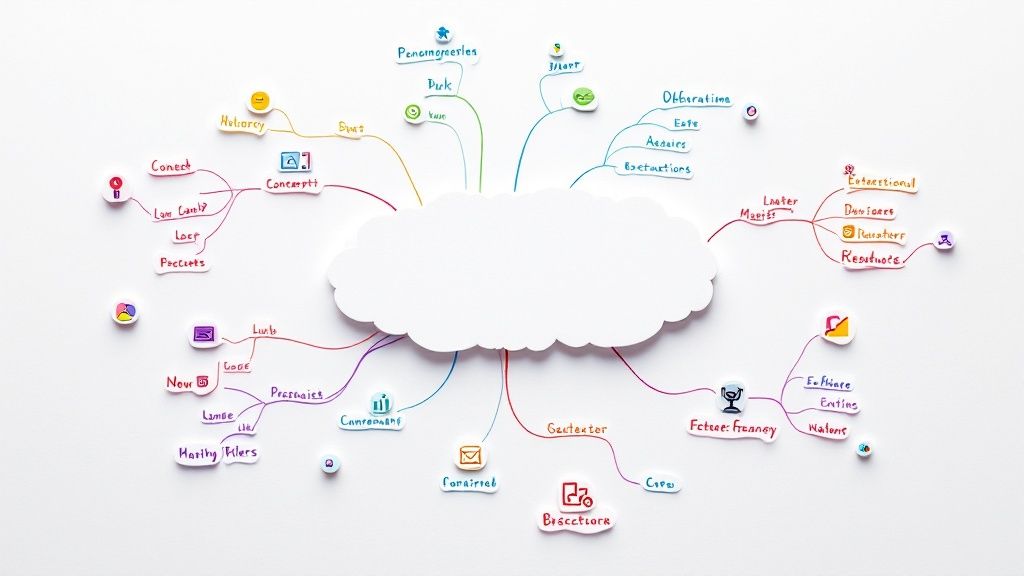
Popularized by author Tony Buzan, Mind Mapping is a visual note-taking method that mirrors the brain's natural way of thinking. It starts with a central idea and radiates outward with related concepts, creating a diagram of interconnected thoughts. This technique uses colors, images, and spatial arrangement to boost memory and creativity.
Mind Mapping is one of the most effective note taking methods for brainstorming sessions and organizing complex information. It transforms linear notes into a memorable and engaging visual map, making it easier to see the big picture and the relationships between different pieces of information. For creative professionals, these visual techniques are invaluable, helping to effectively organize complex ideas when they live the design process.
How to Implement It
Creating a mind map is an intuitive and flexible process, whether you're using pen and paper or digital tools.
Start in the Center: Begin with your main topic or concept in the middle of a blank page. Using an image for your central idea can make it more memorable.
Branch Out: Draw branches radiating from the central topic for your main subtopics. Keep these branches curved to make them more visually appealing and organic.
Use Keywords: Place single keywords or very short phrases on each branch. This concise approach encourages you to focus on the most important information.
Add Color and Images: Assign different colors to different themes or branches to visually separate ideas. Add small icons or drawings to reinforce concepts and aid recall.
Expand Further: Create smaller, "child" branches off your main branches to add more detailed information, continuing to build out your map as ideas emerge.
As shown in the image, the radiating structure allows for a clear overview of a topic, from core concepts to granular details. This method is used by major organizations like Boeing and the BBC for everything from project management to program planning.
Once your mind map is complete, capture the main branches and central theme with your phone. You can use Speak4Me to read these keywords aloud, helping to solidify the connections between concepts. For a more dynamic study tool, download Speak4Me free on iOS at https://apps.apple.com/us/app/id894460403 and transform your visual notes into an auditory learning experience.
3. The Outline Method: A Blueprint for Logical Structure
Favored in academic and professional settings, the Outline Method organizes information hierarchically. It uses a system of main topics, subtopics, and supporting details, typically formatted with Roman numerals, letters, and numbers. This creates a clear, logical flow from general concepts to specific points.
This method excels at revealing the underlying structure of a subject, making it one of the most effective note taking methods for organizing complex information. It is ideal for planning essays, preparing for presentations, or taking notes on highly structured material like textbooks and legal documents.
How to Implement It
The key to the Outline Method is establishing a clear hierarchy before you fill in the details.
Identify Main Topics: Before you start, listen or skim for the main themes. These will be your top-level headings (e.g., I, II, III).
Add Subtopics: Under each main topic, indent and list the key supporting ideas. Use a different signifier for this level (e.g., A, B, C).
Fill in Supporting Details: Further indent to add specific details, facts, or examples under each subtopic (e.g., 1, 2, 3).
Use Consistent Formatting: Maintain the same indentation and numbering system throughout your notes to keep the relationships between ideas clear.
Leave Space: Leave room under each point to add more information later without disrupting the structure.
This approach not only organizes your thoughts during the note-taking process but also makes the information easier to study and recall later.
To boost your efficiency, you can also explore different strategies for how to be more productive when studying.
After creating your outline, use Speak4Me to read your main topics and subtopics aloud. Hearing the logical flow of your notes helps solidify the structure in your mind, making review sessions more effective. For a more organized approach to learning, download Speak4Me free on iOS at https://apps.apple.com/us/app/id894460403 and transform your structured notes into an audio study guide.
4. The Charting Method: Organizing Information in Columns
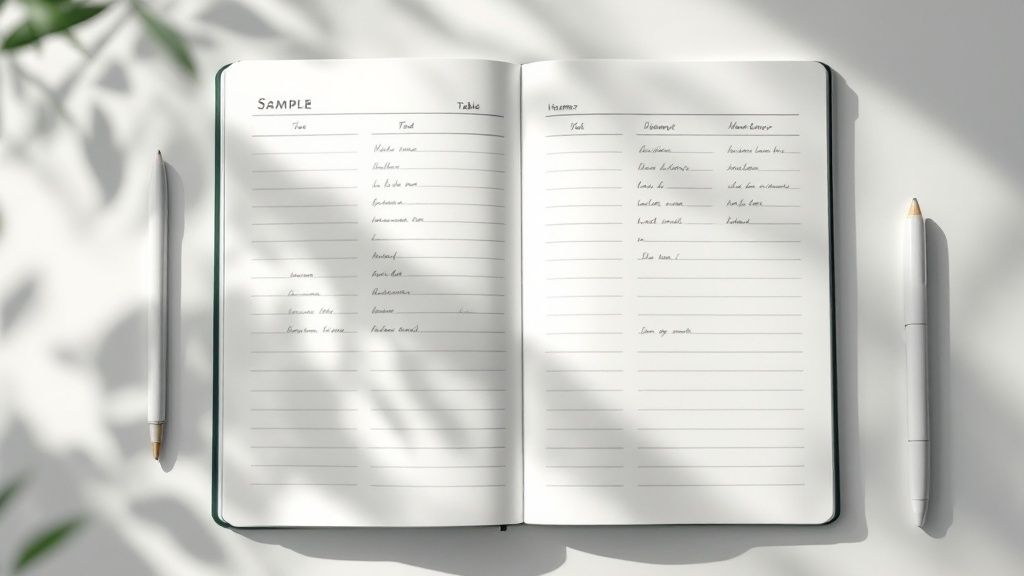
The Charting Method is a systematic approach that organizes information into a table or matrix. By using columns and rows, you can categorize and compare facts, making it ideal for content that has a clear, repeatable structure. This method excels at highlighting relationships between different pieces of information.
This approach is one of the most effective note taking methods for subjects where direct comparison is key. It helps you quickly identify patterns, similarities, and differences, making it invaluable for both academic study and professional analysis. For example, it is frequently used in business for competitive analysis and in history classes to track events across different regions.
How to Implement It
Setting up a chart is straightforward and works well for both pen-and-paper and digital notes.
Identify Categories: Before the lecture or reading begins, determine the main categories of information you need to capture. These will become your column headers. For instance, in a history class, columns might be "Date," "Event," "Key Figures," and "Significance."
Create Your Table: Draw a table with your predefined categories as the column headers. Leave ample space to fill in the rows during your note-taking session.
Fill in Information: As you listen or read, record the information in the appropriate column. Use abbreviations and short phrases to keep the notes concise and easy to fit within the cells.
Review and Analyze: After the session, review your chart. The structured format allows you to easily compare information across rows and columns, helping you to synthesize the material and draw conclusions.
The structured nature of this visualization makes it easy to see how different concepts relate to one another at a glance.
To enhance your review process, type your chart’s key points into a document and use Speak4Me to read it back to you. Hearing the comparative data read aloud can solidify your understanding and make memorization more effective. For a multi-sensory study experience, download Speak4Me free on iOS at https://apps.apple.com/us/app/id894460403 and transform your structured notes into an audio review session.
5. The Mapping Method: Visually Connecting Ideas
The Mapping Method is a visual note-taking technique that prioritizes the relationships between concepts. Unlike linear notes, it uses a non-linear, graphical format like a flowchart or concept map to illustrate how ideas connect, creating a powerful mental model of the subject matter. This structure is about seeing the bigger picture and understanding the flow of information.
By organizing information spatially, the Mapping Method transforms abstract concepts into a tangible visual guide. This makes it one of the most effective note taking methods for visual learners, systems thinkers, and anyone needing to grasp complex interdependencies, from software architecture to biological processes.
How to Implement It
Getting started involves thinking graphically from the very beginning. Instead of a lined page, a blank one is your best canvas.
Identify the Core Topic: Start by writing the main subject or central idea in the middle of the page and circling it. This is your anchor point.
Branch Out with Key Concepts: As new major ideas are introduced, draw lines branching out from the central topic. Label each branch with a main sub-topic.
Add Supporting Details: From each main branch, add smaller branches for supporting details, examples, or related facts. Use keywords and short phrases.
Show Connections: Use arrows, lines, and colors to link related ideas across different branches. This is crucial for showing relationships that linear notes might miss.
Use Visual Cues: Incorporate simple symbols, icons, or colors to categorize information or emphasize key points, making your map easy to scan and review.
This method excels in fields like business process improvement and psychology, where understanding the flow and connection between different components is critical for effective planning and analysis.
Once your map is complete, use Speak4Me to vocalize the main branches and key connections. Hearing the relationships you've mapped out loud can solidify your understanding and highlight the most critical pathways. For a more dynamic review session, download Speak4Me free on iOS at https://apps.apple.com/us/app/id894460403 and turn your visual maps into an auditory learning experience.
6. The SQ3R Method: A Comprehensive Reading Strategy
The SQ3R Method is less of a note-taking style and more a complete framework for active reading and studying. Developed by educational psychologist Francis P. Robinson, its name is an acronym for its five steps: Survey, Question, Read, Recite, and Review. This systematic approach is designed to improve comprehension and long-term retention of written material, making it ideal for textbook study and dense research papers.
This method transforms reading from a passive activity into an investigative process. By engaging with the text before, during, and after you read, you build a strong mental framework for the information. For anyone who needs to not just read but truly understand and remember complex content, SQ3R is one of the most effective note taking methods available.
How to Implement It
SQ3R guides you through a structured five-step process that builds upon itself to maximize learning.
Survey: Before reading, skim the chapter. Look at headings, subheadings, captions under images, and the introduction and conclusion. The goal is to get a general sense of the material's structure and scope.
Question: Turn each heading and subheading into a question. For example, a heading like "The Causes of the Industrial Revolution" becomes "What were the main causes of the Industrial Revolution?" These questions prime your brain to look for answers.
Read: Actively read the material one section at a time, specifically looking for the answers to the questions you just formulated. Take notes in your own words as you find key information.
Recite: After reading a section, look away from the text and try to answer your question aloud or by writing a brief summary from memory. This step is crucial for moving information from short-term to long-term memory.
Review: Once you have completed the entire chapter, conduct a final review. Go over your notes and your questions, solidifying your understanding and filling in any gaps. Regular, spaced reviews are key. To learn more about memory-enhancing techniques, check out this guide on how to memorize something fast.
To boost the review process, use Speak4Me to read your questions and summarized notes aloud. Listening to the material reinforces your learning and helps you identify areas that need more attention. For a more dynamic study routine, download Speak4Me free on iOS at https://apps.apple.com/us/app/id894460403 and turn your study guide into an interactive audio lesson.
7. The Sentence Method: Capturing Every Detail Sequentially
The Sentence Method is a straightforward and linear approach where each new thought, fact, or topic is written as a separate, complete sentence. This technique prioritizes capturing information chronologically as it is presented, making it one of the most effective note taking methods for fast-paced environments where detail and accuracy are paramount.
Popularized by journalists, court reporters, and field researchers, this method excels in situations like interviews, legal depositions, and detailed lectures. It ensures that no critical piece of information is lost and provides a clear, sequential record of the proceedings, making it easy to reconstruct events or conversations later.
How to Implement It
Adopting the Sentence Method requires focus and speed, but its structure is refreshingly simple. There's no complex page layout to prepare beforehand.
Start a New Line for Each Idea: As you listen or read, write each new concept or piece of information on a new line as a distinct sentence.
Number Your Sentences: Use sequential numbering for each sentence. This simple step adds structure and makes it easy to reference specific points later.
Use Shorthand: To keep up with the pace, develop a personal shorthand for common words and phrases. This is crucial for capturing information quickly without sacrificing detail.
Leave Space: Intentionally leave some blank space between different topics or key ideas. This allows you to go back and add more details, connections, or clarifying thoughts during your review.
Review and Refine: Shortly after the session, read through your sentences. Highlight key themes, correct any errors, and add any missing context to ensure the notes are comprehensive and clear.
After reviewing your notes, use Speak4Me to read the numbered sentences back to you. Hearing the information in the order it was captured can help you identify the most important sequences and patterns. For a more effective review session, download Speak4Me free on iOS at https://apps.apple.com/us/app/id894460403 and turn your detailed notes into a powerful audio learning tool.
8. The Split-Page Method: A Flexible Two-Column Approach
The Split-Page Method, also known as the Two-Column Method, is a highly adaptable system that brings clarity and structure to your notes. It involves dividing your page into two columns, dedicating one for main ideas or questions and the other for detailed explanations, examples, or answers. This layout promotes an organized and analytical approach to note-taking.
This method transforms note-taking from a passive activity into an active process of categorizing information as you receive it. By separating main points from supporting details, it stands out as one of the most effective note taking methods for everything from academic lectures to business meetings, making review sessions significantly more efficient.
How to Implement It
Setting up a split-page system is straightforward and can be customized for any subject or topic.
Divide Your Page: Draw a single vertical line down your page. You can place it in the center or off to one side depending on what you plan to record in each column.
Define Your Columns: Before you begin, assign a purpose to each column. For example, use the left for key concepts and the right for definitions, or one for meeting agenda items and the other for action items.
Take Notes: As you listen or read, populate the columns accordingly. The separation forces you to actively process and sort the information in real time.
Connect Ideas: Use arrows or symbols to draw connections between related points across the two columns, highlighting relationships and dependencies.
Review Systematically: During review, you can cover one column to test your knowledge of the other. This built-in study tool is perfect for reinforcing memory and understanding. For a comprehensive overview of digital tools that can enhance this process, explore these homework help apps that can make your life easier.
After your note-taking session, use Speak4Me to read your key concepts aloud, followed by their corresponding details. This auditory reinforcement helps solidify the connections you made on the page. For a more dynamic study experience, download Speak4Me free on iOS at https://apps.apple.com/us/app/id894460403 and turn your organized notes into a powerful audio learning tool.
Effective Note-Taking Methods Comparison Table
Method | Implementation Complexity 🔄 | Resource Requirements ⚡ | Expected Outcomes 📊 | Ideal Use Cases 💡 | Key Advantages ⭐ |
|---|---|---|---|---|---|
Cornell Note-Taking System | Medium - needs consistent format | Low - pen/paper or apps | Strong retention and review guides | Students, structured lectures, exam preparation | Encourages active processing; built-in review |
Mind Mapping | Medium-High - artistic skills needed | Moderate - color tools/digital apps | Enhanced creativity and connections | Creative projects, brainstorming, visual learning | Shows relationships visually; stimulates creativity |
Outline Method | Medium - logical structuring | Low - basic writing tools | Clear logical flow and hierarchy | Academic writing, structured lectures, presentations | Easy to follow progression; good for sequential info |
Charting Method | Medium - pre-planning categories | Moderate - table/chart tools | Quick comparison and data organization | Comparative studies, data-heavy subjects, analysis | Excellent for comparison; highlights patterns |
Mapping Method | High - spatial and diagram skills | Moderate - diagram tools | Clear understanding of complex relations | Complex systems, process flows, relationship mapping | Flexible visual formats; shows process flow clearly |
SQ3R Method | High - multi-step disciplined process | Low - reading materials | Improved comprehension and retention | Textbook study, academic research, exam prep | Research-backed; combines reading with note-taking |
Sentence Method | Low - simple linear notes | Low - pen and paper | Detailed info capture in order | Fast lectures, interviews, fact-heavy content | Easy for fast note-taking; no complex format |
Split-Page Method (Two-Column Method) | Low-Medium - flexible, simple division | Low - basic writing tools | Organized, active engagement | Comparative analysis, language learning, meetings | Flexible use; promotes active thinking |
Find Your Method and Supercharge Your Learning
We’ve journeyed through a powerful collection of effective note taking methods, from the structured logic of the Cornell and Outline Methods to the visual freedom of Mind Mapping. Each system offers a unique framework for capturing, organizing, and synthesizing information. You’ve seen how the Charting Method can simplify complex comparisons, how the SQ3R Method turns passive reading into an active investigation, and how the Sentence Method provides a straightforward, linear approach for fast-paced lectures.
The central takeaway is this: there is no single "best" method. The most effective approach is the one that aligns with your personal learning style, the subject matter, and the specific context. A history lecture might be perfect for the Outline Method, while a brainstorming session for a group project could come alive with a collaborative Mind Map. The goal is to move beyond simply transcribing words and start actively engaging with the material. True learning happens when you process, question, and connect ideas in a way that makes sense to you.
Your Action Plan for Better Notes
To truly discover which of these effective note taking methods works for you, you must experiment. Don't just read about them; put them into practice.
Pick one new method to try for the next week. If you usually just write everything down, try the Split-Page Method for your next meeting or class.
Analyze the results. Did you feel more engaged? Was it easier to find key information later? Did reviewing your notes feel more productive?
Mix and match. Don’t be afraid to combine elements from different systems. You might use an outline structure within a larger Mind Map or add a summary section, inspired by the Cornell Method, to your Sentence Method notes.
Mastering these techniques is about more than just getting better grades or being more organized at work. It's about building a fundamental skill for lifelong learning. When you can efficiently capture and understand new information, you unlock your potential to grow in any field, adapt to new challenges, and satisfy your own curiosity. Your notes become more than a record; they become a personalized tool for intellectual growth.
But what if you could add another powerful layer to your learning process? Imagine transforming your meticulously crafted notes, your dense textbook chapters, or any research article into clear audio. This is where modern technology can supercharge your efforts. By converting text to speech, you engage multiple senses, which can significantly boost retention and comprehension. You can review key concepts during your commute, while exercising, or simply by listening, which provides a welcome break for tired eyes. This approach is especially supportive for auditory learners and individuals with learning differences like dyslexia.
Elevate your study sessions and boost your productivity by integrating an auditory dimension into your learning. Speak4Me converts your notes, articles, and documents into high-quality audio, allowing you to review material anytime, anywhere. Take the next step in optimizing your learning workflow. Download Speak4Me free on iOS at https://apps.apple.com/us/app/id894460403 and hear the difference for yourself.
Try Speak4Me for Free
