9 Essential Time Management Strategies for Students in 2025

Between lectures, assignments, social life, and maybe even a part-time job, a student's schedule can feel impossible to manage. It often seems like there aren't enough hours in the day to get everything done. But what if the problem isn't a lack of time, but a lack of strategy?
Effective time management is one of the most powerful skills you can develop to reduce stress, improve your grades, and create a balanced academic life. It’s not about working harder; it’s about working smarter. This guide moves beyond generic advice to provide nine proven time management strategies for students, giving you specific tools and techniques to take control of your calendar. We will explore methods like the Pomodoro Technique, Time Blocking, and the Eisenhower Matrix, each broken down into actionable steps.
For those long study sessions with dense reading materials, you need a way to absorb information efficiently. A tool like Speak4Me can be a game-changer, assisting you by reading textbooks, articles, and notes aloud. This feature helps turn your commute or downtime into productive study time. Download Speak4Me free on iOS to start listening and learning more effectively. Now, let’s dive into the strategies that will transform your approach to studying.
1. Pomodoro Technique
The Pomodoro Technique is a powerful time management method that can transform how you study. It was developed by Francesco Cirillo and uses a timer to break down work into focused, 25-minute intervals known as "pomodoros." Each intense work session is followed by a short, 5-minute break. After completing four pomodoros, you reward yourself with a longer break of 15-30 minutes.
This approach is one of the most effective time management strategies for students because it combats mental fatigue and improves focus. Instead of facing a daunting three-hour study block, you only need to concentrate for 25 minutes at a time. This makes it easier to start and maintain momentum, especially for dense subjects.
alt="Speak4Me – A red tomato-shaped kitchen timer used for the Pomodoro Technique, set against a blurred background."
How to Implement the Pomodoro Technique
This technique is especially useful for tasks that require deep concentration or memorization. A programming student could use one pomodoro to debug a specific function, while a medical student might dedicate a session to memorizing anatomical terms. The key is single-tasking; each pomodoro should be dedicated to one specific goal.
To supercharge this method, you can pair it with an audio tool. Use Speak4Me to listen to a chapter summary during one pomodoro, then use the next 25-minute block to write down key concepts from what you heard. This creates an active learning cycle that supports information retention. For a deeper dive and practical steps on implementation, you can learn more about the Pomodoro Technique.
Download Speak4Me free on iOS to create your own study-and-review pomodoro cycles.
2. Time Blocking
Time blocking is a method where you schedule every part of your day, assigning a specific time slot for each task or activity. Instead of working from a simple to-do list, you create a visual, concrete plan on your calendar. Popularized by figures like Cal Newport, this approach turns your intentions into a scheduled commitment, making it clear what you should be working on and when.
This method is one of the most powerful time management strategies for students because it eliminates decision fatigue and prevents unstructured time from being wasted. By assigning a specific purpose to every hour, you gain control over your schedule and can intentionally balance academics, social life, and personal well-being.
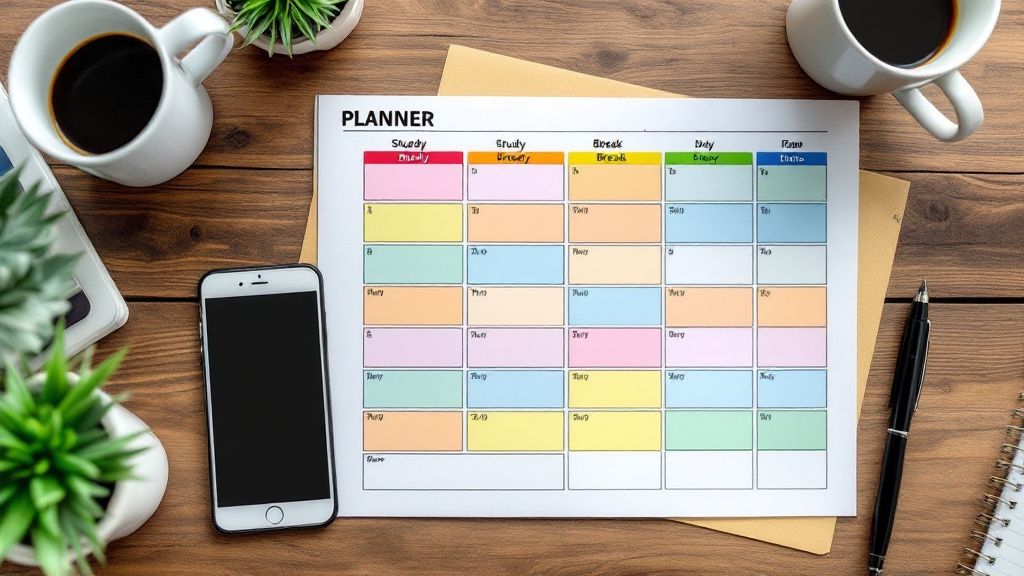
alt="Speak4Me – A digital calendar showing a week planned out with colorful time blocks for different activities."
How to Implement Time Blocking
Time blocking excels at managing complex schedules with multiple competing priorities. A law student can block out two-hour chunks for case study analysis, while an engineering student can schedule specific times for lectures, lab work, and project collaboration. The core principle is to give every minute a job, ensuring that even breaks and meals are part of your plan.
You can enhance your time blocks with digital tools. Schedule a block for listening to assigned readings with Speak4Me while commuting, then schedule a follow-up block to review and summarize the key points later. This creates a highly efficient workflow. To discover more tools that support this strategy, you can find a guide to the best productivity apps to build your perfect system.
Download Speak4Me free on iOS to turn your study materials into audio for effective time-blocked learning sessions.
3. Getting Things Done (GTD)
Getting Things Done (GTD) is a comprehensive productivity framework developed by David Allen. It's designed to help you manage commitments and clear mental clutter by capturing everything in an external, trusted system. Instead of trying to remember every deadline, idea, and task, GTD gives you a method to organize it all, allowing you to focus completely on the task at hand without stress.
This system is one of the most robust time management strategies for students because it handles the complexity of academic life. It moves your to-do list from your head to an organized system, freeing up mental energy to think, learn, and create. It’s perfect for managing multiple subjects, extracurriculars, and personal commitments simultaneously.

alt="Speak4Me – A flowchart showing the five steps of the Getting Things Done (GTD) method: Capture, Clarify, Organize, Reflect, and Engage."
How to Implement the Getting Things Done (GTD) Method
GTD is highly adaptable for any student. A PhD candidate can use it to track research milestones, teaching duties, and publication deadlines. Similarly, a business student can manage internship applications, case study preparations, and networking events, ensuring nothing falls through the cracks. The core principle is to capture everything and then process it systematically.
You can enhance the GTD "Capture" step using an audio tool. Use Speak4Me to quickly record lecture notes, research ideas, or assignment reminders on the go. Later, during your "Organize" phase, you can listen back to these audio notes to process them into actionable tasks within your GTD system. This helps ensure no brilliant idea is ever lost. To learn more about the core principles, you can explore the official Getting Things Done website.
Download Speak4Me free on iOS to effortlessly capture your thoughts and integrate them into your GTD workflow.
4. Eisenhower Matrix (Priority Matrix)
The Eisenhower Matrix is a decision-making framework that helps you categorize tasks based on urgency and importance. Popularized by President Dwight D. Eisenhower and Stephen Covey, this tool divides your to-do list into four distinct quadrants: Do (Urgent & Important), Schedule (Important & Not Urgent), Delegate (Urgent & Not Important), and Eliminate (Not Urgent & Not Important).
This model is one of the most powerful time management strategies for students because it forces you to distinguish between what feels urgent and what is truly important. Instead of reacting to every notification and deadline, you can proactively focus your energy on tasks that align with your long-term academic and personal goals, preventing burnout and busy work.
This infographic simplifies the Eisenhower Matrix into three actionable groups to help you prioritize your tasks effectively.
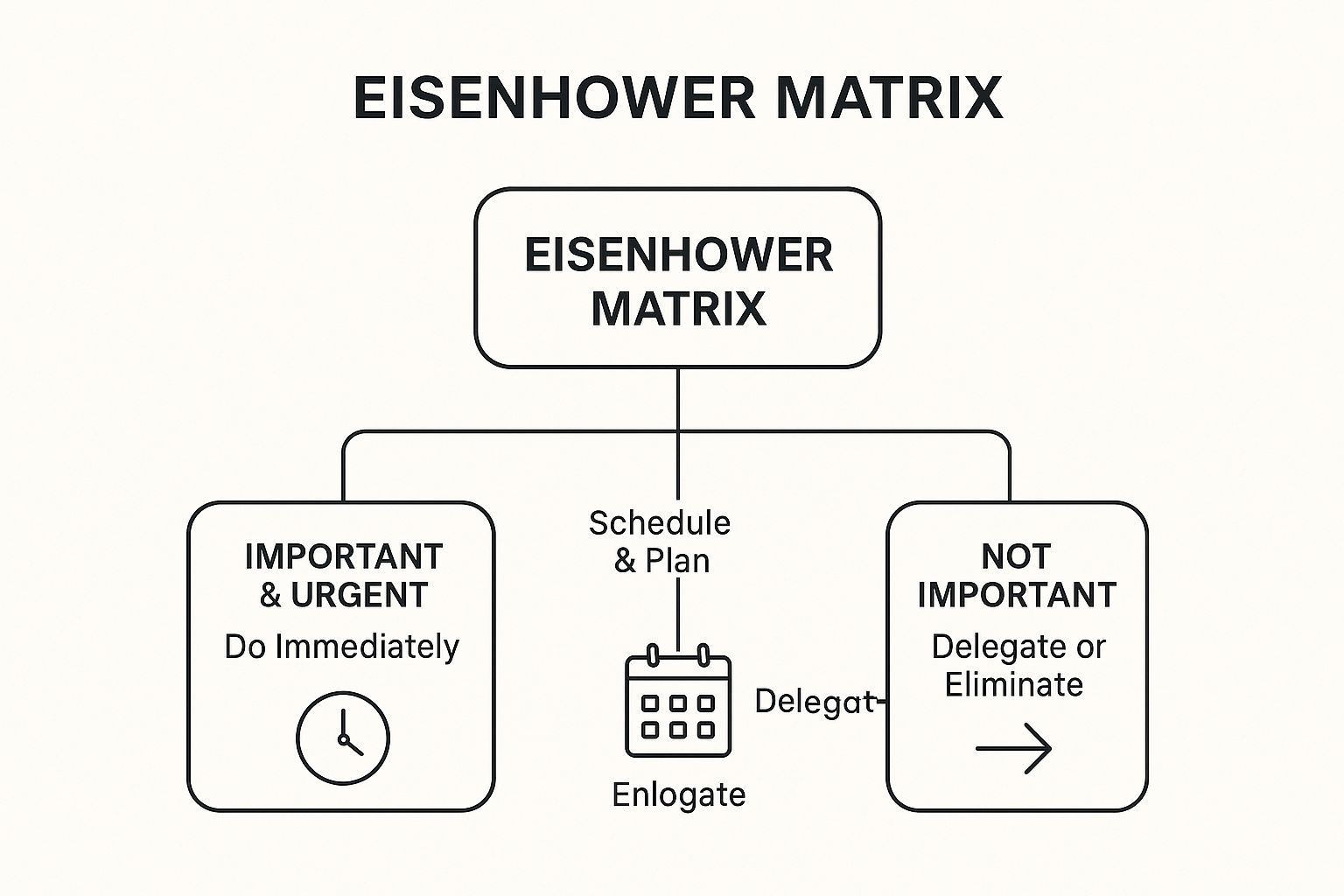
alt="Speak4Me – A concept map of the Eisenhower Matrix showing how to handle tasks: Do Important & Urgent tasks immediately, Schedule Important & Not Urgent tasks, and Delegate or Eliminate Not Important tasks."
The visual highlights that your primary focus should be on scheduling important, non-urgent activities to avoid them from becoming last-minute emergencies.
How to Implement the Eisenhower Matrix
This matrix is ideal for students feeling overwhelmed by a mix of academic deadlines, extracurricular activities, and personal commitments. For example, a college student would place "Study for tomorrow's midterm" in Quadrant 1 (Do) and "Research summer internships" in Quadrant 2 (Schedule). Meanwhile, "Respond to a non-essential group chat" would fall into Quadrant 3 (Delegate/Ignore), and "Mindlessly scrolling social media" belongs in Quadrant 4 (Eliminate).
To make this even more effective, use an audio tool to manage your quadrants. Use Speak4Me to read your notes aloud for an important upcoming exam (Quadrant 2), freeing up your time to handle an urgent assignment (Quadrant 1). By using audio for review sessions, you can ensure long-term goals don't get pushed aside by immediate demands. For more detailed guidance, you can learn more about the Eisenhower Matrix.
Download Speak4Me free on iOS to better manage your important tasks and stay ahead of your schedule.
5. ABCDE Method
The ABCDE Method, popularized by productivity expert Brian Tracy, is a powerful prioritization system that helps you focus on what truly matters. Instead of just making a to-do list, you assign a letter grade (A, B, C, D, or E) to each task based on its importance and the consequences of not completing it. This simple framework brings immediate clarity to your workload.
This system is one of the most effective time management strategies for students because it forces you to distinguish between urgent and important tasks. An 'A' task is critical with serious consequences if left undone (like studying for a final exam), while an 'E' task can be eliminated entirely without any real impact (like reorganizing your bookshelf). This prevents you from spending valuable time on low-impact activities.
How to Implement the ABCDE Method
This method is perfect for managing a heavy course load or balancing academics with extracurriculars. To begin, list all your tasks for the day or week. Then, assign a letter to each one: 'A' for must-do, 'B' for should-do, 'C' for nice-to-do, 'D' for delegate, and 'E' for eliminate. The rule is simple: you never work on a 'B' task while an 'A' task is still unfinished.
For even greater clarity, you can number your 'A' tasks (A1, A2, A3) to identify your single most important priority. A graduate student might label their thesis chapter draft as A1 and preparing for a conference as B2. Use Speak4Me to read your assigned 'A1' textbook chapter aloud while you commute, then use that focused time back at your desk to complete the corresponding summary.
Download Speak4Me free on iOS to turn your high-priority reading assignments into audio tasks you can tackle anywhere.
6. Deep Work Scheduling
Deep Work Scheduling is a method popularized by author Cal Newport that involves dedicating specific, uninterrupted blocks of time to cognitively demanding tasks. This strategy requires you to identify your peak energy hours and fiercely protect them from distractions like social media, emails, and multitasking. The goal is to achieve a state of high concentration where you can produce high-quality work in less time.
This approach is one of the most powerful time management strategies for students because it acknowledges that not all work is created equal. Instead of constantly switching between shallow tasks (like answering texts) and deep tasks (like writing a research paper), you create a clear separation. This allows your brain to focus completely, leading to better comprehension, creativity, and retention of complex information.
How to Implement Deep Work Scheduling
This technique is ideal for tasks that require sustained focus and critical thinking. A computer science student might schedule a three-hour deep work block to code a complex algorithm, while a philosophy student could use a two-hour session to analyze a dense philosophical text without any digital devices nearby. The core principle is eliminating all distractions to maximize intellectual output.
To get started, schedule a 60-90 minute deep work session in your calendar during your most productive time of day. Find a quiet space, put your phone on airplane mode, and close all unnecessary browser tabs. You can use Speak4Me to read your research material aloud just before the session begins, priming your brain with the necessary information. This lets you spend the entire block thinking and creating, not just catching up. For more ideas on how to structure these sessions, you can learn more about being productive.
Download Speak4Me free on iOS to prepare for your deep work sessions by listening to your notes and readings.
7. Eat That Frog
The "Eat That Frog" method, inspired by a Mark Twain quote and popularized by Brian Tracy, is a straightforward yet powerful productivity principle. The core idea is to identify your most challenging or important task of the day, your "frog," and tackle it first thing in the morning when your focus and willpower are at their peak.
This is one of the most effective time management strategies for students because it builds momentum and reduces procrastination. By getting your most dreaded task out of the way early, the rest of your assignments feel significantly easier and more manageable. This psychological win sets a productive tone for the entire day, preventing that one difficult task from hanging over your head.
How to Implement the Eat That Frog Method
This strategy is perfect for major assignments or subjects you find particularly difficult. For instance, a student might choose to write the most challenging section of their research paper first thing in the morning or tackle a complex set of calculus problems before moving on to lighter reading assignments. The key is prioritizing impact over ease.
To make this method even more effective, identify your "frog" the night before and prepare everything you need to start immediately. You can use Speak4Me to read your "frog" assignment instructions aloud while you get ready, helping you mentally prepare to dive right in. This eliminates startup friction and makes the task less intimidating. For more tools to help you manage tough assignments, you can find homework help apps that make student life easier.
Download Speak4Me free on iOS to help you face your "frog" with confidence and clarity.
8. The 80/20 Rule (Pareto Principle)
The 80/20 Rule, also known as the Pareto Principle, suggests that roughly 80% of your results come from just 20% of your efforts. For students, this principle is a game-changer. It shifts your focus from being "busy" to being effective, encouraging you to identify and concentrate on the most impactful tasks that drive the majority of your academic success.
This concept is one of the most powerful time management strategies for students because it forces you to prioritize ruthlessly. Instead of treating every task as equally important, you learn to distinguish between the high-value activities (the vital 20%) and the low-value ones that consume time with little return. This is key for managing heavy course loads and avoiding burnout.
How to Implement the 80/20 Rule
This principle is perfect for optimizing your study habits and exam preparation. For example, a language student might discover that focusing on the 1,000 most common words (the 20%) allows them to understand 80% of everyday conversations. Similarly, a math student could find that mastering a few key problem types yields most of the marks on an exam. The goal is to find your specific 20%.
You can amplify this strategy by identifying your most effective learning inputs. Use Speak4Me to convert dense chapter summaries or complex articles into audio. Listen to them and identify the core concepts that appear most frequently. This helps you quickly pinpoint the 20% of the material that will likely form 80% of your exam questions, making your study sessions dramatically more efficient.
Download Speak4Me free on iOS to identify and focus on your highest-impact study materials.
9. Timeboxing
Timeboxing is a focused time management technique where you allocate a fixed, non-negotiable time period, or "timebox," to a specific task. Unlike other methods where you work until a task is done, timeboxing forces you to work within strict time constraints, regardless of completion. This creates a sense of urgency that boosts efficiency and prevents perfectionism from derailing your schedule.
This approach is one of the most practical time management strategies for students because it stops tasks from expanding to fill all available time. By setting a hard limit, such as 45 minutes to outline an essay or 30 minutes for a set of practice problems, you force yourself to concentrate on making meaningful progress quickly. It’s a powerful way to manage large projects and avoid getting stuck on minor details.
How to Implement Timeboxing
Timeboxing is ideal for tasks that can drag on indefinitely, like research, brainstorming, or studying for a test. A history student could create a two-hour timebox for researching a paper, forcing them to gather essential sources efficiently before moving on to writing. Similarly, a language learner might allocate a 20-minute timebox each morning solely for practicing vocabulary.
To enhance this method, integrate it with an audio tool. Use Speak4Me to read your lecture notes or research articles aloud during a one-hour timebox. Then, dedicate the next 30-minute timebox to summarizing the key points without re-listening. This active recall cycle supports your understanding and keeps you moving forward.
Download Speak4Me free on iOS to set focused timeboxes for listening and reviewing your study materials.
Time Management Strategies Comparison
Method | Implementation Complexity 🔄 | Resource Requirements ⚡ | Expected Outcomes 📊 | Ideal Use Cases 💡 | Key Advantages ⭐ |
|---|---|---|---|---|---|
Pomodoro Technique | Low 🔄 | Minimal (timer) ⚡ | Improved focus, reduced fatigue 📊 | Students struggling with procrastination and focus | Simple, natural break reminders, easy to start ⭐ |
Time Blocking | Moderate 🔄 | Calendar/planner ⚡ | Clear daily structure, reduced decision fatigue 📊 | Students needing structured, balanced schedules | Visual roadmap of day, reduces overbooking ⭐ |
Getting Things Done (GTD) | High 🔄 | Tools for capture and organization ⚡ | Reduced mental clutter, comprehensive task management 📊 | Students with complex academics and extracurriculars | Scalable, improves clarity and habits ⭐ |
Eisenhower Matrix | Low-Moderate 🔄 | Pen & paper or digital ⚡ | Better prioritization, reduced busywork 📊 | Students confused about urgent vs. important tasks | Simple, quick priority clarity ⭐ |
ABCDE Method | Low 🔄 | Pen & paper or apps ⚡ | Focus on high-impact tasks, task elimination 📊 | Students needing simple daily task prioritization | Intuitive, consequence-based prioritization ⭐ |
Deep Work Scheduling | Moderate-High 🔄 | Quiet workspace, planning tools ⚡ | Higher quality work, better comprehension 📊 | Students facing challenging coursework or research projects | Builds focus, leverages peak energy ⭐ |
Eat That Frog | Low 🔄 | Minimal ⚡ | Reduced procrastination, increased momentum 📊 | Students avoiding difficult or unpleasant tasks | Uses peak morning willpower, builds confidence ⭐ |
The 80/20 Rule (Pareto) | Moderate 🔄 | Analysis tools optional ⚡ | Max efficiency, high academic returns 📊 | Students wanting max output with minimal time | Focuses effort on most impactful tasks ⭐ |
Timeboxing | Moderate 🔄 | Timer and planning ⚡ | Controlled time use, reduced perfectionism 📊 | Students prone to overthinking or procrastination | Creates urgency, improves time estimation ⭐ |
Turn Strategy into Success with the Right Tools
You've just explored a powerful toolkit of time management strategies for students, from the focused sprints of the Pomodoro Technique to the high-impact prioritization of the Eisenhower Matrix. We've covered a range of methods designed to bring structure, clarity, and efficiency to your academic life. Whether you choose to "Eat That Frog" by tackling your toughest task first or apply the 80/20 Rule to maximize your results, the core principle remains the same: taking intentional control of your time is the single most effective way to reduce stress and improve your grades.
The journey from learning these strategies to mastering them begins with consistent application. Each method, from Time Blocking to the ABCDE Method, offers a unique framework for organizing your days. The key is not to adopt every single one, but to experiment and find the combination that aligns with your personal study habits and academic demands. The goal is to build a personalized system that makes productivity feel less like a chore and more like a natural part of your routine. This proactive approach transforms you from a student who simply reacts to deadlines into one who strategically plans for success.
From Plan to Action: Implementing Your System
To put these concepts into practice, you need a way to visualize your commitments and track your progress. A simple, well-designed planner can be the bridge between your intentions and your actions. To help you apply these strategies, consider utilizing a dedicated tool such as a free downloadable student planner to map out your schedule, set priorities, and monitor your achievements. This tangible step makes abstract plans concrete and manageable.
However, a planner organizes your time; it doesn't create more of it. That’s where smart tools come in to optimize your study process. Many of the strategies we discussed, especially Deep Work and Timeboxing, rely on maximizing your focus and efficiency within a set period. One of the biggest time sinks for any student is the sheer volume of required reading.
This is where an assistive tool can be a game-changer. Imagine being able to listen to your textbook chapters while commuting, review lecture notes while at the gym, or absorb research articles while preparing a meal. This isn’t about multitasking in a distracting way; it’s about integrating learning into the moments of your day that would otherwise be unproductive. Tools that convert text to speech support your time management efforts by making your study materials accessible in an audio format, helping you cover more ground without needing to be glued to a screen. By turning reading into listening, you can reduce study time while supporting your learning.
Ready to reclaim your time and enhance your study sessions? Speak4Me transforms your written materials into clear audio, allowing you to learn on the go and absorb information more efficiently. Start integrating your reading into every part of your day.
Try Speak4Me for Free
