What Is Executive Function Disorder?

When you hear the term executive function disorder—often called executive dysfunction—it's describing a set of challenges with the brain's core self-management system. This isn't a formal, standalone diagnosis you'd find in a medical manual. Instead, it’s a way to describe a pattern of difficulties with essential cognitive skills like planning, focusing, remembering instructions, and juggling multiple tasks.
It’s crucial to understand that this isn't about a lack of effort or willpower. These struggles stem from genuine neurological differences that can significantly impact daily life.
What Is Executive Dysfunction, Really?
Think of your executive functions as the CEO of your brain. This internal "CEO" is responsible for directing, managing, and organizing all your other mental abilities to help you get things done and achieve your goals. When this system isn't running smoothly, you get what we call executive dysfunction. It’s a breakdown in the very processes that allow you to manage your thoughts, actions, and emotions.
This isn't a character flaw or a sign of laziness. It's a real neurological challenge that makes seemingly simple activities feel monumental. Kicking off a project, being on time for an appointment, or even just organizing your thoughts to join a conversation can feel overwhelmingly complex.
To get a clearer picture of executive dysfunction, it helps to look at the specific cognitive skills involved. While there are many, they generally fall under a few core categories that all work together. A weakness in one area often creates a domino effect, impacting the others.
Here's a quick breakdown of the primary skills that make up our executive functions:
The Core Skills of Executive Function
Executive Function Skill | What It Helps You Do |
|---|---|
Working Memory | Holding and manipulating information in your mind to complete a task. |
Cognitive Flexibility | Shifting your thinking from one concept to another and adapting to new rules. |
Inhibitory Control | Resisting impulses, distractions, and habits to stay focused on a goal. |
Planning & Prioritizing | Deciding on a goal and figuring out the steps needed to reach it. |
Task Initiation | Getting started on a task without procrastinating. |
Organization | Keeping track of information, materials, and schedules. |
Emotional Regulation | Managing your feelings to respond appropriately to situations. |
These skills are the building blocks that allow us to navigate our daily lives effectively. When they don't work in harmony, it can feel like you're constantly fighting against your own brain.
The Three Pillars of Executive Function
Most experts boil these skills down to three foundational pillars. Weakness in any of these core areas can cause widespread difficulties.
The diagram below shows how these three pillars form the bedrock of our executive abilities.
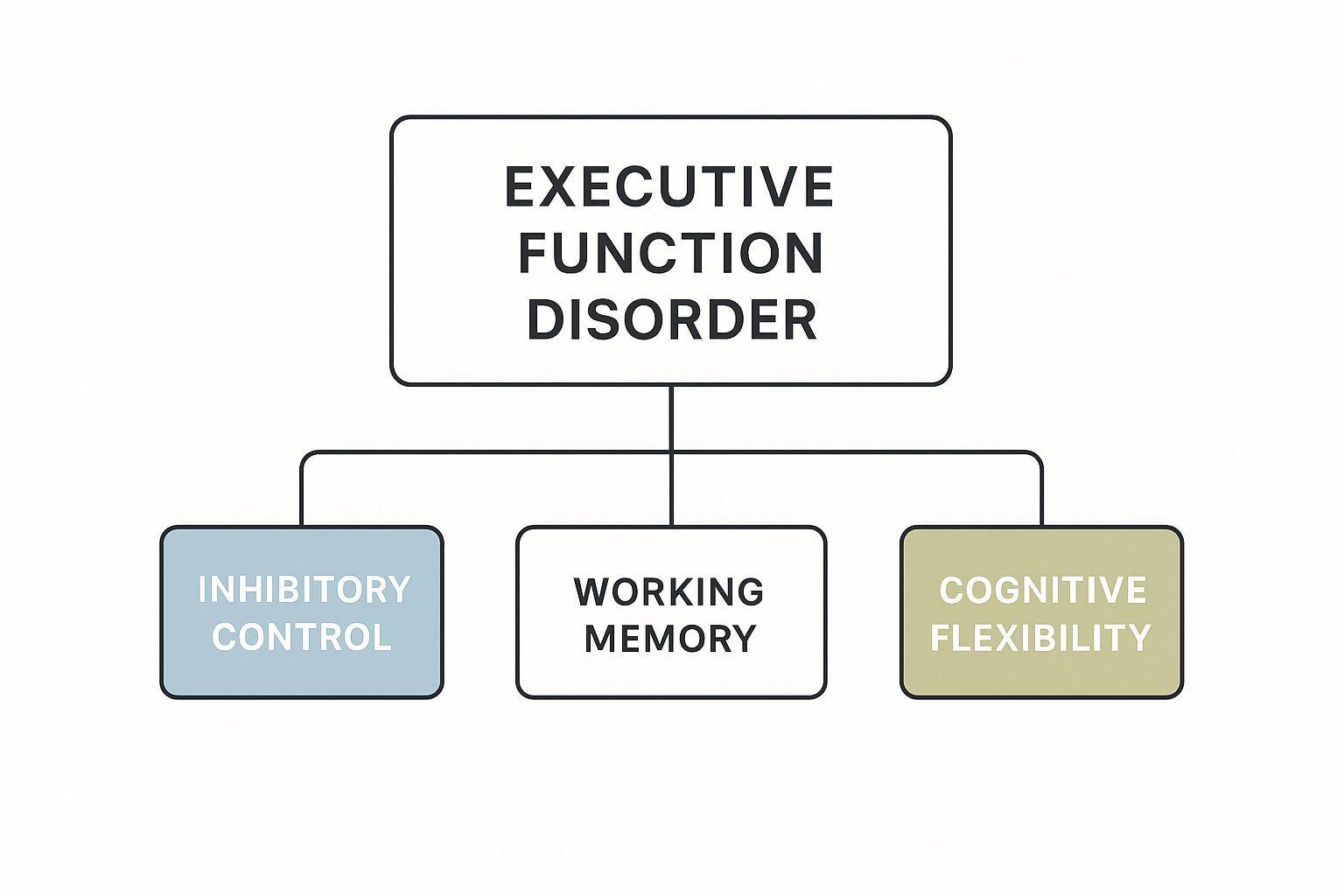
As you can see, the major components—Inhibitory Control, Working Memory, and Cognitive Flexibility—are distinct but deeply interconnected. A breakdown here is what truly defines executive dysfunction.
How Does This Connect to ADHD?
Executive dysfunction is a hallmark of several neurodevelopmental conditions, but it's most famously linked with Attention-Deficit Hyperactivity Disorder (ADHD). For people with ADHD, these challenges aren't just an occasional nuisance; they are a central part of the experience. While not everyone with executive dysfunction has ADHD, nearly everyone with ADHD struggles with it.
A 2020 report estimated that symptomatic adult ADHD affects about 6.76% of adults worldwide. That's a staggering 366.33 million people who are likely grappling with these core challenges every day. You can explore more data on the prevalence of ADHD and its deep connection to executive skills.
This connection is so important because it reframes the struggle. It shifts the perspective from "I can't do this" to "My brain works differently, and I need different tools." Understanding the 'why' behind the challenge is the first real step toward finding strategies that actually work.
For instance, when organizing your thoughts for a conversation feels like an uphill battle, it's often a direct result of weak working memory and mental organization. This is where assistive tools can be a game-changer, providing the external structure your brain needs to bridge that gap.
If you find it hard to sequence your ideas before you speak, an app like Speak4Me can help you organize and articulate your thoughts clearly. Download Speak4Me free on iOS and see how it can support more structured communication.
Recognizing the Signs in Everyday Life
It’s one thing to read a definition of executive function disorder, but it’s another thing entirely to see how it shows up at the kitchen table on a Tuesday morning. The real-world signs aren't just abstract concepts; they are the small, frustrating, and often overwhelming moments that can throw a whole day off track for children and adults alike.
This isn't about being lazy or careless. What you're seeing are the direct results of a brain struggling with skills like getting started on a task, staying organized, holding information in mind, and managing emotions. Pinpointing these signs is the first, most powerful step toward understanding what's really going on and finding the right kind of help.

Common Signs in Children and Teens
With kids and teenagers, executive function challenges often get mistaken for bad behavior or academic struggles. What looks like defiance from the outside is frequently an internal battle with the brain's management system.
Here’s how these difficulties can manifest:
The Chronically Messy Room: We're not talking about typical kid clutter. This is a room where finding a clean pair of socks is an archaeological dig and old science projects become permanent fixtures. It points to a breakdown in organization and task initiation—the child literally can't figure out where or how to start cleaning.
The Homework Standoff: The daily fight just to begin homework is a classic sign. The child might be perfectly capable of doing the work, but initiating the task feels like trying to push a boulder uphill. This is a tell-tale sign of a major challenge with task initiation.
Forgetting Everything, All the Time: It’s the student who consistently leaves their completed homework on the kitchen counter, forgets their textbook, or has no memory of a major project being assigned. This isn't carelessness; it's a direct result of a weak working memory and poor planning skills.
These scenarios create a cycle of friction at home and school, leaving kids feeling misunderstood and parents feeling completely exasperated. The trick is to see the behavior as a symptom, not the core problem.
Common Signs in Adults
Once you’re an adult, the stakes get higher. Executive dysfunction can start to impact your career, finances, and relationships as the challenges simply adapt to adult-sized responsibilities.
The struggle isn't about ability; it's about execution. An adult with executive function challenges might be brilliant and creative but find themselves unable to translate their ideas into consistent, tangible results. This gap between potential and performance is a major source of stress and self-doubt.
Here are a few real-world examples of what this looks like:
Always Missing Deadlines: Despite having the best intentions, an adult with executive dysfunction might consistently submit work late. They struggle to estimate how long a task will take or get lost in the weeds, showing a clear weakness in time management and prioritization.
Paralyzed by the To-Do List: A long list of tasks, even simple ones, can feel so impossibly large that it leads to total inaction. This "analysis paralysis" highlights a deep struggle with planning and breaking down big goals into small, manageable steps.
A Constant Battle with Finances: Paying bills on time, sticking to a budget, or keeping financial documents in order can feel like a nightmare. This points directly to issues with organization, working memory (like remembering due dates), and inhibitory control (which can lead to impulse buys).
Thoughts Feel Trapped: You know exactly what you want to say, but organizing those thoughts into a clear, step-by-step conversation feels impossible. This challenge with mental organization can make meetings, presentations, or even important personal talks incredibly draining.
These everyday struggles are not personal failures. They are the predictable outcomes when the brain’s "air traffic control" system isn't running smoothly. When you feel stuck just trying to organize your thoughts for a conversation, sometimes an assistive tool can provide the structure you need.
For those moments, an app that helps lay out your ideas can be a game-changer. Download Speak4Me free on iOS to see how it can help you organize your thoughts for clearer, more confident communication.
What's Happening in the Brain?
To really get a handle on executive function disorder, we need to peek under the hood and look at the brain itself. These struggles aren’t about a lack of willpower or effort; they're deeply rooted in the brain's structure, its chemical messengers, and its development over time.
When we explore the science, we can start to let go of the blame game. It helps us see these difficulties for what they truly are—a difference in neurology. Understanding the "why" is the first step toward self-compassion and finding strategies that actually work, instead of just telling someone to "try harder."
The Brain’s Command Center
The star of the show here is the prefrontal cortex (PFC). This area, located right behind your forehead, is the most recently evolved part of our brain. Think of it as the CEO or the air traffic controller for all your high-level thinking.
It's the part of the brain that handles everything from mapping out a five-year plan to stopping yourself from saying something you'll regret. When the PFC isn't working at its best, the messages that coordinate planning, focus, and self-control can get jumbled, delayed, or even lost entirely.
Brain Development and Different Wiring
Here’s a crucial piece of the puzzle: the prefrontal cortex is the last part of the brain to fully mature. It's under construction well into our mid-20s. This is a big reason why teenagers can be so impulsive and struggle with long-term planning—their brain's CEO is still in training.
For people with neurodevelopmental conditions like ADHD, the PFC might develop on a different timeline or simply function differently.
This often comes down to a few key things:
Brain Chemistry: Neurotransmitters like dopamine and norepinephrine are the mail carriers of the brain, delivering messages that help regulate our attention, motivation, and mood. In brains with executive function challenges, these chemical messengers might be in short supply or the brain might not use them as efficiently.
Structural Differences: Brain imaging studies have shown subtle differences in the size, thickness, and connectivity of certain brain areas, especially the PFC, in people with conditions like ADHD.
Genetics: It's no coincidence that these challenges often run in families. Our genes provide the blueprint for how our brains are built and wired, which can predispose some of us to these difficulties.
Realizing this is so liberating. It confirms that the struggle isn't a moral failing or a character flaw. It’s about brain wiring and chemistry, which explains why a task that seems simple to one person can feel like climbing a mountain for someone else.
How Other Conditions Play a Role
Executive function disorder isn't a standalone diagnosis you'd find in a medical manual. Instead, it's a key feature of several other conditions, and the root cause changes how the challenges show up.
ADHD: This is the big one. For people with ADHD, the core challenges come from the brain's struggle to regulate attention and impulses, often tied to those neurotransmitter differences we talked about. To go deeper, check out our guide on what ADHD is and its symptoms.
Autism Spectrum Disorder (ASD): Many autistic individuals find cognitive flexibility especially tough. Switching from one task to another or rolling with an unexpected change can be incredibly difficult, which is linked to unique ways their brains process information and handle transitions.
Brain Injuries: A traumatic brain injury (TBI), a stroke, or other neurological damage can directly injure the prefrontal cortex. This can cause a sudden and dramatic onset of executive function challenges in someone who never had them before.
When the brain's command center is struggling, just trying to organize your thoughts for a conversation can feel impossible. This is exactly where the right tools can make a world of difference.
Speak4Me acts like an external scaffold for your thoughts, giving you the structure to plan what you want to say and voice your ideas clearly. Download Speak4Me free on iOS and see how it can help.
How Executive Dysfunction Is Assessed
If the daily struggles we've described are hitting a little too close to home, you're probably wondering what to do next. Getting a professional opinion is a great way to find some clarity, and the process is usually more straightforward than people imagine. It’s key to remember that executive dysfunction isn't a standalone diagnosis; it's a symptom that points to an underlying condition, very often ADHD.
The whole point of an assessment is to get a complete picture of you—your strengths, your challenges, and the unique way your brain is wired. A qualified professional, like a neuropsychologist, psychiatrist, or a specially trained psychologist, will guide you through a thorough evaluation to pinpoint what might be causing these difficulties. This process is all about understanding, not judgment.

What to Expect During an Evaluation
A proper assessment for executive function challenges isn't just one test or a quick checklist. It’s more like a fact-finding mission, where information is gathered from several different places to build a detailed story of your experiences over time.
You can expect the process to involve a few key parts:
Clinical Interviews: This is really just a deep conversation with the professional. You'll talk through your personal history—developmental milestones, how school or work has gone, your relationships, and the specific hurdles you've run into. If it's for a child, they'll want to talk with parents and teachers, too.
Standardized Rating Scales: You, and maybe your family members or teachers, will fill out questionnaires. These are designed to measure how often and how severely certain behaviors pop up, like trouble with focus, acting on impulse, or staying organized.
A Look at Your History: The professional will likely ask to see old school report cards, work performance reviews, or any previous psychological evaluations. These documents are goldmines of information, offering historical context and revealing patterns that have been there for years.
Direct Cognitive Testing: Sometimes, you'll be asked to do a series of specific tasks or puzzles. These are designed to directly measure skills like working memory, how fast you process information, and your mental flexibility. It gives the professional a chance to see your executive functions in action, right there in the room.
It’s About Seeing the Whole Person
A good evaluation doesn't just zero in on what's going wrong. It's about looking at you as a whole person, which includes your strengths and all the things you do well. The clinician will also be careful to rule out other things that could be causing your symptoms. After all, conditions like anxiety, depression, and even sleep disorders can sometimes look a lot like executive dysfunction.
The real goal is to connect the dots between your daily struggles and what's happening on a neurological level. This gives you a clear "why" behind the challenges, which is the essential first step toward finding strategies and support that actually work.
Getting a proper assessment can feel like a huge weight has been lifted. It helps reframe these difficulties not as personal failings, but as understandable challenges tied to how your brain works. It gives you the knowledge you need to advocate for yourself (or your child) and find the right kind of help.
If the thought of trying to explain all your experiences during an assessment feels overwhelming, a tool that helps structure your ideas can make a world of difference. Planning out what you want to say beforehand ensures you get all your important points across clearly.
Download Speak4Me free on iOS to help organize your thoughts for important conversations.
The Ripple Effect: How Executive Function Challenges Connect to Other Conditions
Executive function issues rarely show up alone. Think of it like ripples in a pond—trouble with skills like planning, focus, and managing emotions almost always spreads out and intersects with other neurological and mental health conditions. Understanding this overlap is key, as it explains why day-to-day life can feel so incredibly overwhelming for so many people.
While most people immediately think of ADHD, executive dysfunction is a common thread that runs through a whole host of diagnoses. Seeing these connections helps us build support that treats the whole person, not just a single, isolated symptom.
Anxiety and Depression
Mental health and executive function are deeply connected. It's often a frustrating cycle where one problem feeds the other, making both harder to manage.
Depression: The "brain fog" that so often comes with depression can hit executive skills hard. It saps your motivation, making it feel impossible just to get started on a task (task initiation). It also slows down your thinking and muddles your working memory, which is why someone with depression might find it hard to keep up with a conversation or remember simple instructions.
Anxiety: When your mind is filled with constant worry and racing thoughts, it’s like trying to run too many programs on a computer at once. It completely overloads your brain's "RAM"—its working memory. With so much mental energy tied up in anxiety, there’s not much left for planning, organizing, or staying focused. This often leads to procrastination, which, of course, just adds more fuel to the anxiety fire.
It's no surprise, then, that executive dysfunction is a common feature in many significant psychiatric disorders. The World Health Organization (WHO) reports that nearly 20% of children and adolescents have some form of mental disorder, many of which get in the way of executive function. Major Depressive Disorder (MDD) is a perfect example, standing as the second leading cause of disability across the globe. You can learn more about the profound impact of these conditions on cognitive function in this detailed report.
Autism Spectrum Disorder
For many people on the autism spectrum, one of the biggest hurdles is cognitive flexibility. This is the executive skill that helps us roll with the punches—to adapt to change, see things from a different angle, and switch from one task to another.
When this skill is a challenge, an unexpected change in routine can feel completely destabilizing. It can also make it tough to understand someone else's perspective or move smoothly from one activity to the next. This isn't a matter of being stubborn; it's a real neurological difference in how the brain handles transitions.
Learning Disabilities
Specific learning disabilities like dyslexia and dyscalculia also go hand-in-hand with executive function challenges. After all, the mental work involved in reading, writing, and math puts huge demands on the brain's management system.
For instance, someone with dyslexia has to put in a massive amount of effort just to decode words on a page. This puts a heavy strain on their working memory, leaving very few mental resources left over for things like organizing their thoughts into an essay or remembering the details of what they just read.
Understanding this link is crucial for giving people the right kind of support, whether at school or at work. For a closer look at this, you might find our guide on the symptoms of dyslexia in adults and how to manage them helpful.
Seeing how these conditions play off one another is the first step toward finding support that actually works. When the combination of challenges makes communication itself difficult, assistive technology can be a game-changer by providing a vital bridge. Just having a tool to structure your thoughts before you speak can take a huge weight off.
Download Speak4Me free on iOS to get support in organizing and articulating your ideas with confidence.
7. Actionable Strategies to Support Daily Life
Knowing what executive function disorder is is one thing; figuring out how to live with it is another. The goal isn't to force your brain to operate like everyone else's. Instead, it's about building a support system around you—one that works with your brain's unique wiring, not against it. With the right strategies, you can reduce the daily friction and create more opportunities to thrive.

Think of it as creating an external "scaffolding" for your mind. You're using tools, routines, and technology to handle the heavy lifting of planning, organizing, and remembering. This frees up your mental energy to focus on what you're actually trying to do.
Mastering Time Management and Organization
When your brain struggles with planning and perceiving time, abstract ideas like "later" or "soon" are basically meaningless. The trick is to make time and tasks as visible and tangible as possible.
Here are a few ways to do that:
Break It All Down: A big project can feel completely paralyzing. The secret is to break every task into its smallest possible components and write them down. Don't just write "clean the kitchen." Start with "clear the counters," then "put dishes in the sink," and so on.
Use Visual Timers: A timer that physically shows time passing can be a game-changer. It turns an abstract concept—time—into something you can see, which makes it easier to get started and stay on track.
Give Everything a "Home": Cut down on the mental stress of constantly looking for things. Designate one specific, logical spot for your keys, wallet, phone, and important papers. A simple bowl by the door can make a massive difference.
Lean on Checklists: Use them for everything! From your morning routine to a multi-step work project, a checklist gives you a clear roadmap and the sweet satisfaction of ticking things off.
For more ideas on structuring your day, our guide on how to be more productive has some great tips that are especially helpful for brains with executive function challenges.
Strategies for Emotional Regulation
Emotional regulation is a core executive function. When it's a weak spot, feelings can go from zero to one hundred in a flash. The key is having a plan in place before you're in the middle of a stressful moment.
One of the most effective strategies is to build a "calm-down toolkit." This can be a physical box or just a mental list of things that help you self-soothe: a go-to playlist, a stress ball, a quick walk around the block, or a five-minute breathing exercise. Having this ready before you need it is crucial.
You can also create more brain-healthy habits in your daily life. Simple changes to your diet and environment can have a real impact. For practical, science-backed advice, many people have found actionable strategies to improve brain function and emotional health that make a noticeable difference.
The Power of Assistive Technology
We're lucky to live in a time where technology can act as a powerful ally. Certain apps and tools can essentially serve as an external prefrontal cortex, helping you handle the very tasks your brain finds most difficult.
Calendar reminders, project management apps, and simple note-taking software are all forms of assistive tech. They're not just for organization; they're for offloading the mental work.
This is especially true for communication. When challenges with organization and working memory make it tough to structure your thoughts, assistive tools can bridge that gap. This is exactly why Speak4Me was created—to help you plan out conversations, organize your ideas logically, and say what you mean with confidence.
Got Questions? We’ve Got Answers.
Here are some of the most common questions people have after learning about executive function challenges. We’ll break down the answers to help clear things up.
Is Executive Function Disorder the Same as ADHD?
Not quite, though they are very closely related. Think of executive function disorder (or dysfunction) as a description of the symptoms—the struggles with planning, focus, self-control, and memory.
ADHD, on the other hand, is a specific diagnosis—one of the reasons a person might experience those symptoms. Many people with ADHD have significant executive function challenges, but you can also have these difficulties due to other conditions like autism, depression, or even a brain injury. So, while almost everyone with ADHD has executive dysfunction, not everyone with executive dysfunction has ADHD.
Can Executive Function Skills Actually Be Improved?
Yes, absolutely. While you might not change the fundamental wiring of your brain, you can absolutely build powerful skills, habits, and support systems to manage the challenges. It's all about strategy.
Through things like therapy, specialized coaching, and even simple assistive technologies, you can learn to create external structures that do the heavy lifting. This approach doesn't just improve day-to-day life; it also reduces stress and builds a ton of confidence.
Can Adults Get Diagnosed With Executive Function Challenges?
Definitely. It's more common than ever for adults to seek an assessment for conditions like ADHD for the first time. Life gets more complicated, and the coping mechanisms that worked in school might not hold up under the pressure of a career, family, and adult responsibilities.
An evaluation for an adult will look specifically at how these challenges affect your work, relationships, and personal life. Getting assessed at any age is a great first step toward understanding how your brain works and getting the support you deserve.
When just getting your thoughts in order for a big conversation feels like half the battle, Speak4Me can be a game-changer. The app helps you structure your ideas so you can walk in feeling prepared and speak with confidence.
Download Speak4Me free on iOS and start building stronger communication habits.
Try Speak4Me for Free
